Incoming HD96 Lawmaker Danielle Duggar Sets Sights on Vaccine-Status Protections, Toll Relief and Grocery Tax Cut
Spanish Fort Republican Danielle Duggar, who won Alabama House District 96 with about 64% of the vote, plans to pursue a vaccination-status anti-discrimination bill, a refund for bridge toll payers and further grocery tax relief.
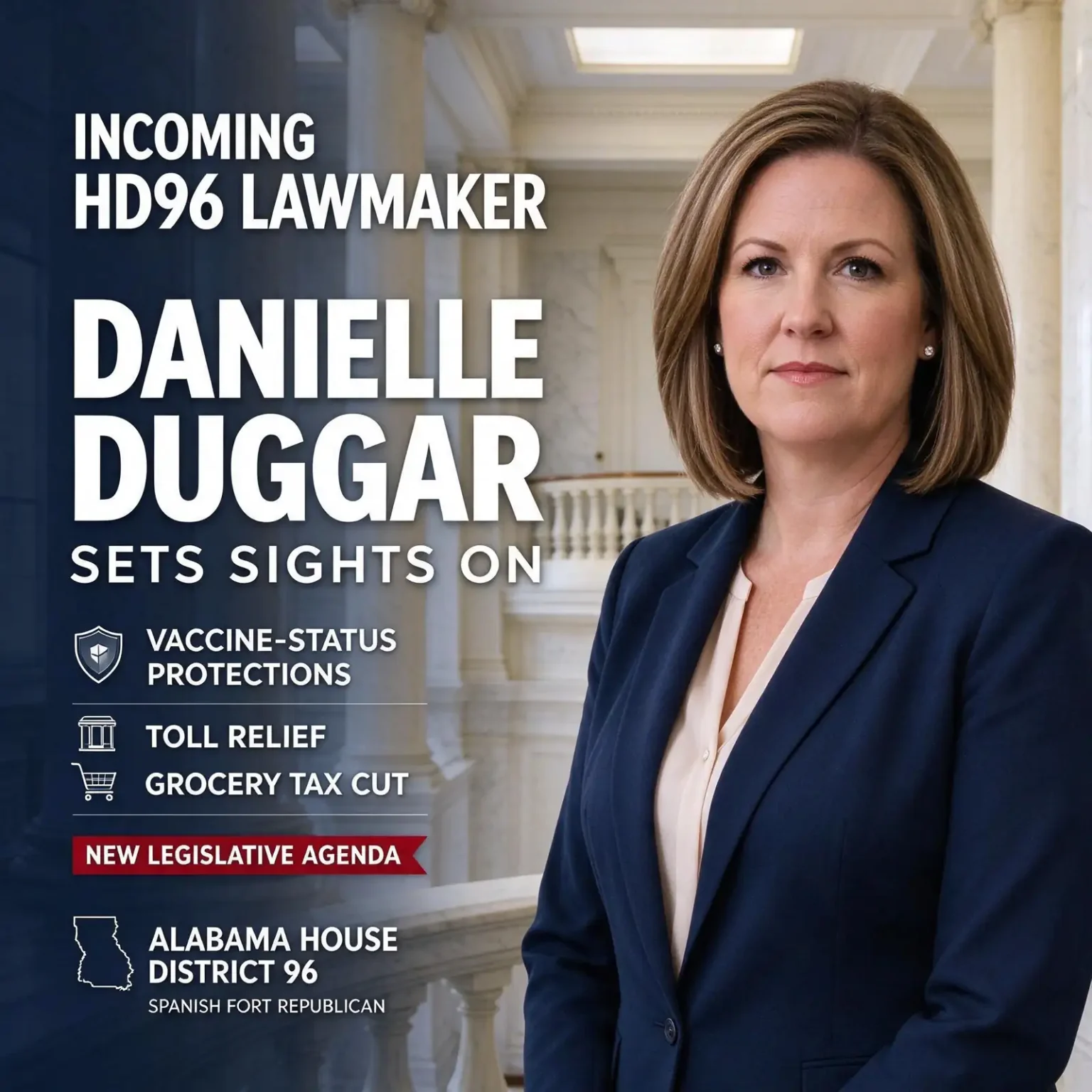
Danielle Duggar, the Spanish Fort Republican who will represent Alabama House District 96 starting with the new legislative term, is heading to Montgomery with a short list of goals that blend statewide health policy debates with pocketbook concerns at home in Baldwin County. Among them: a bill to bar workplace discrimination based on a person’s vaccination status, a plan to send bridge toll money back to commuters through a tax refund, and support for wiping out what remains of Alabama’s state sales tax on groceries.
Duggar, 42, is one of 14 first-time members who will join the 105-seat Alabama House of Representatives.
How the House District 96 Race Played Out
Duggar’s path to the State House ran through two contested elections in 2026.
In the May Republican primary, she unseated Rep. Matt Simpson of Daphne, who was seeking a third term. The race was close, and Simpson was one of eight sitting Alabama lawmakers to lose a primary this year. During and after that contest, Simpson sent a cease-and-desist demand to the Alabama Values political action committee alleging that its campaign mailers misrepresented his voting record, and he has raised the possibility of taking the PAC to court over those claims.
In the Nov. 3 general election, Duggar faced Democratic nominee Terri Osborne. Unofficial returns show Duggar with roughly 11,400 votes, or 64.1%, compared with nearly 6,400 votes, or 35.7%, for Osborne. Results become final once certified by election officials.
House District 96 lies on Baldwin County’s Eastern Shore and takes in Spanish Fort, Daphne and surrounding communities.
Who the New Representative Is
Duggar is a mother of three. Her oldest son is 23, her second son is in high school and her daughter is a sixth grader. Raising school-age children gives her a firsthand view of the pressures young people face today, from classroom content to athletics, friendships and social media, and that day-to-day experience as a parent is part of the perspective she intends to bring to policy discussions in Montgomery.
Before turning to policy work, Duggar taught. She later moved into legislative analysis, a career change driven by her interest in what supporters call medical freedom, the cause she considers her top passion. Since 2024, she has worked as a legislative analyst for the National Vaccine Information Center, a Virginia-based nonprofit.
The organization she works for
The National Vaccine Information Center states on its website that its mission is to prevent vaccine injuries and deaths and to advocate for exemptions from vaccine requirements. Its materials emphasize informed consent and focus on the possible risks of vaccines rather than on their role in preventing disease. The group is widely regarded by public health experts as anti-vaccine.
Duggar disputes that label. Her position is that the organization opposes vaccine mandates rather than vaccines themselves, and that its aim is for people to have complete information before choosing whether to be vaccinated, the same informed consent that physicians are expected to obtain from patients before any medical procedure.
Federal research offers a counterpoint on vaccine safety. A 2015 study by scientists in the Immunization Safety Office at the U.S. Centers for Disease Control and Prevention reviewed reports of deaths that occurred after vaccination between 1997 and 2013, most of them involving infants younger than 12 months, and found no concerning pattern linking the deaths to vaccines.
A First-Term Bill on Vaccination Status
The centerpiece of Duggar’s early agenda is a measure that would keep employers from discriminating against workers based on whether they have been vaccinated. The proposal, as she envisions it, would not outlaw vaccine mandates outright but would prohibit treating people differently because of their vaccination status. She is aiming to get it passed during her first term.
Earlier exemption efforts in Montgomery
Related proposals have surfaced repeatedly at the State House. Over the past three legislative sessions, Sen. Arthur Orr, R-Decatur, and Rep. Mack Butler, R-Rainbow City, have filed bills aimed at allowing religious exemptions from vaccine requirements. Orr’s 2025 version advanced through a House committee about two weeks before that year’s session ended, but it never won final passage.
The issue also has support at the top of the incoming state government. Gov.-elect Tommy Tuberville backs religious exemptions for vaccines, and as a U.S. senator he has filed federal legislation that would withhold funding from public schools that do not honor such exemptions.
The public health backdrop
The debate is unfolding as the United States contends with a measles outbreak, years after the disease was declared eliminated in the country in 2000. Measles is among the most contagious diseases known; the virus spreads through the air and can linger in a room after an infected person leaves. Three Alabama residents have tested positive since the outbreak began last year.
National case counts have climbed sharply. As of Friday, Nov. 13, the CDC had confirmed close to 5,200 measles cases in 2026, and about 96% of those patients had not been vaccinated against the disease. In 2025, there were nearly 2,300 confirmed cases, roughly 93% of them among unvaccinated people.
In Alabama, CDC figures show 94.3% of kindergarteners were vaccinated against measles for the 2025-26 school year, down from 95.2% a year earlier. Public health officials generally cite a 95% vaccination rate as the level needed for herd immunity, the point at which enough of a community is protected that the virus has trouble spreading. That means the state’s kindergarten rate has slipped just below that benchmark.
Committee Hopes
Incoming members are now weighing which House committees they want to serve on for the four-year term. Duggar’s top three choices are the Health Committee, the State Government Committee and the Education Policy Committee, panels that line up with her background in teaching and health policy analysis. Committee assignments in the Alabama House are made by the speaker, and the committees are where most bills receive their first hearing and vote before reaching the full chamber.
Bridge Tolls and Cost of Living at Home
Closer to home, affordability ranks as the leading concern among Duggar’s constituents, as it does for Alabamians generally.
For Eastern Shore residents, one of the most visible cost issues is the new crossing being built to link Mobile and Baldwin counties across Mobile Bay. Tolls on the project are expected to run from $3 to $7.70 per trip and will be used to repay a $2.52 billion federal loan that helps finance construction. The tolls proved unpopular with candidates from both parties throughout the 2026 campaign.
Duggar’s answer is a proposal for a dollar-for-dollar state tax refund for people who pay the tolls. The idea is aimed at an estimated 20,000 commuters from Baldwin and Mobile counties who cross the bay each day, with the goal of putting that money back in their pockets. Details of how such a refund would be structured or paid for have not yet been spelled out, and any proposal would need to pass both chambers of the Legislature and be signed by the governor.
Working with the local delegation
The legislative delegation representing the Mobile metro area will be made up of four Republicans and three Democrats. Duggar expects to work across party lines with the group. Local issues have tended to be bipartisan, with members generally willing to back whatever benefits the region regardless of party.
The Grocery Tax
Taxes are another area where Duggar wants to see relief. Tuberville and Republican legislative leaders have pledged to eliminate Alabama’s state sales tax on food in 2027. The state rate, currently 2%, has been lowered over the past three years, and Democratic lawmakers have pushed for repealing it for years as well.
Duggar supports finishing the job. A self-described conservative, she accepts that taxes are how government is funded but wants to cut the burden on residents wherever possible. Eliminating the remaining state grocery tax would not affect local sales taxes that cities and counties levy on food, which are set separately.
The Shape of the New House
When the new Legislature convenes, Republicans will hold 74 of the 105 seats in the House, a supermajority, while Democrats will hold 31. A supermajority gives the majority party enough votes on its own to meet the higher thresholds required for certain actions in the chamber, which shapes how much influence the minority has over the final outcome of contested legislation.
Alabama House members serve four-year terms, so Duggar and the other newcomers will hold their seats through the 2030 election cycle. The first year of a new term typically begins with a brief organizational session, when members are sworn in and leadership is chosen, followed later by the regular session in which bills such as the ones Duggar is planning can be introduced, assigned to committees and debated.
What to Watch
- Committee assignments: Whether Duggar lands spots on the Health, State Government or Education Policy committees will shape where she can influence legislation.
- Vaccination-status bill: Her proposal to bar workplace discrimination based on vaccination status would join a series of exemption-related bills that have stalled in past sessions.
- Toll refund idea: A dollar-for-dollar refund for bridge toll payers would need a funding plan and broad support to advance.
- Grocery tax repeal: With leaders of both parties on record supporting it, ending the remaining 2% state food tax is one of the more widely shared goals heading into 2027.
Duggar will take office as part of a large freshman class in a chamber where Republicans hold a commanding majority, and her early priorities suggest she intends to be an active voice on both health policy and the cost-of-living issues that dominate conversations on the Eastern Shore.