Spanish Fort Attorney Ends Fight Over Sanctions for AI Filing With Nonexistent Case Citations
A federal appeals court has dismissed a Spanish Fort attorney's challenge to a $5,000 fine and client-disclosure order imposed after an AI-assisted motion cited court cases that do not exist.
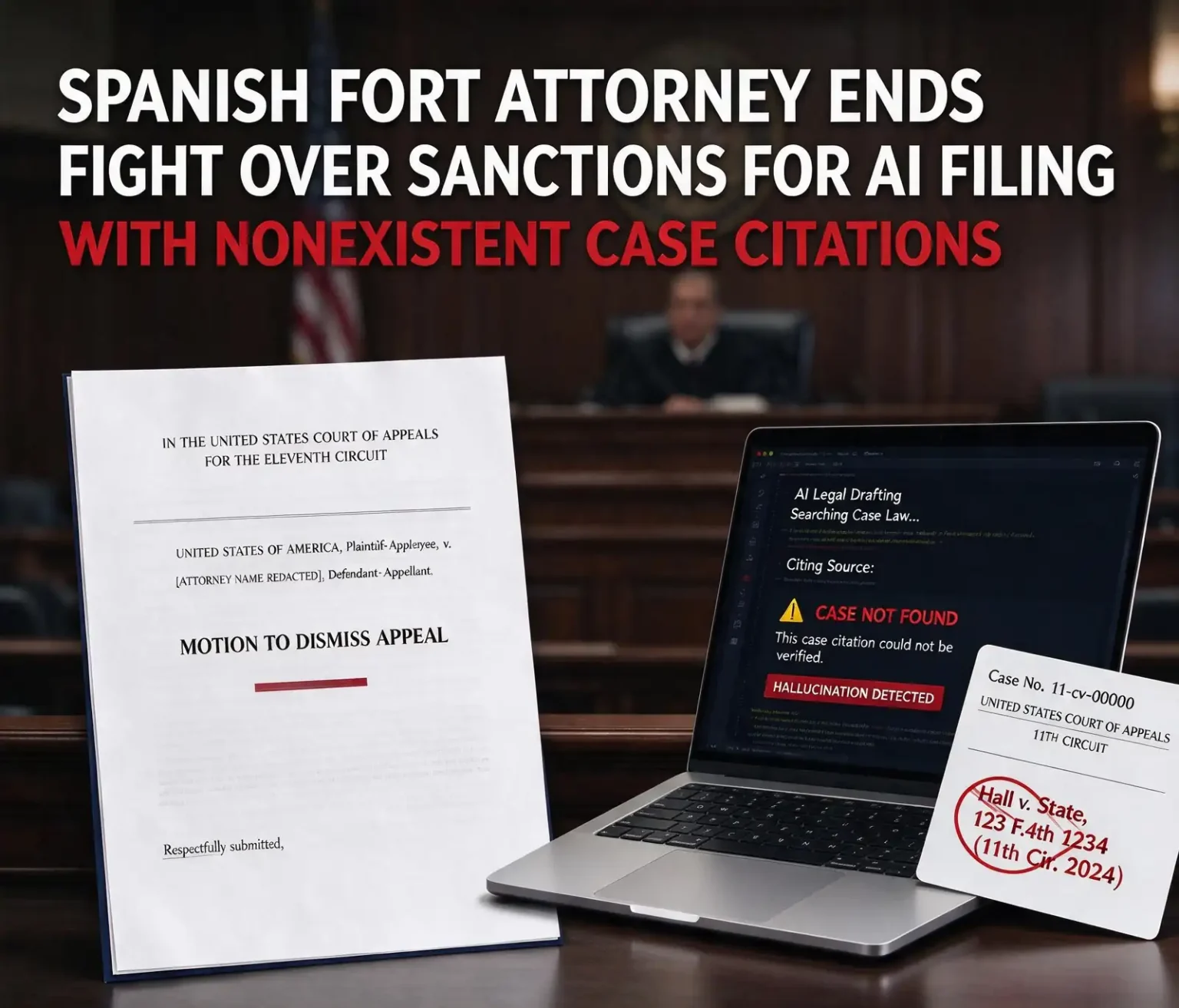
SPANISH FORT, Ala. — A Spanish Fort attorney sanctioned by a federal judge after an AI-assisted court filing cited cases that do not exist has abandoned his effort to overturn that punishment. The 11th U.S. Circuit Court of Appeals agreed on Thursday to dismiss the attorney’s appeal after he told the court that pressing ahead no longer served any practical purpose.
The decision closes an appellate chapter in a dispute that grew out of a federal drug conspiracy prosecution and became one more example of the problems that can follow when lawyers rely on artificial intelligence tools without checking the results.
Why the Attorney Stepped Back
The heart of the attorney’s request to end the appeal was timing. Part of his punishment required him to tell every one of his clients about the sanctions for a 12-month period. That year has now run out, and in his filing with the appeals court, he argued there was no longer a reason to keep the case alive.
He also pointed to the damage he said had already been done. In his written request, the attorney argued that the sanctions order, and the broad circulation it received, had caused serious harm to his professional reputation that could not be reversed. Even if the appeals court ruled in his favor, he wrote, such a decision could not truly repair that harm or return his standing to where it had been. He added that continuing to litigate the matter might only draw fresh public attention to events that could no longer be fixed.
The attorney made clear that walking away was not the same as agreeing with the judge. He told the court he still challenges both the factual and the legal grounds for the sanctions and asked that his decision to drop the appeal not be read as acceptance of the penalty. At the same time, he acknowledged that he had already paid the fine, that the other penalties had expired on their own, and that further proceedings offered little real chance of meaningful relief.
Key facts at a glance
- Who: A Spanish Fort attorney who served as defense counsel in a federal drug conspiracy case
- What went wrong: A motion seeking to delay the trial included several citations to court cases that do not exist, and the filing was tied to the use of artificial intelligence
- Judge: U.S. District Judge Terry Moorer
- Penalties: A $5,000 fine and a requirement that he inform every client of the sanctions for the next 12 months
- Appeal: Filed with the 11th U.S. Circuit Court of Appeals in Atlanta
- Outcome: The appeals court agreed Thursday to dismiss the appeal at the attorney’s request
- Status of penalties: Fine paid; 12-month disclosure period completed
How the Sanctions Came About
The trouble began last year, when the attorney was representing a defendant in a drug conspiracy case in federal court. That defendant, who has been described as a drug kingpin, has since been convicted.
While handling the case, the attorney filed a motion asking Judge Moorer to push back the trial date. Requests to postpone a trial are routine in criminal cases, and lawyers typically support them by pointing to earlier court decisions that back up their arguments. In this instance, however, several of the cases cited in the motion turned out not to exist.
The judge responded with sanctions. He ordered the attorney to pay $5,000 and required him to inform all of his clients about the sanctions for the next 12 months. The disclosure requirement meant that anyone who hired the attorney during that time would learn about the problem directly from him.
The attorney then took the matter to the 11th Circuit, the federal appeals court that hears cases from Alabama, Florida and Georgia. That appeal is the one now dismissed.
The Wider Problem of AI-Generated Citations
The case fits a pattern that courts across the country have been confronting since generative AI tools became widely available. Chatbots and other AI writing programs can produce text that looks polished and authoritative, complete with case names, volume numbers and page citations. But the programs can also invent material, a flaw often called hallucination, and the fabricated citations can look just as convincing as real ones.
For lawyers, that creates a serious risk. Legal arguments depend on accurate references to statutes and prior rulings, and judges rely on attorneys to represent the law truthfully. Professional conduct rules require lawyers to be competent and to be candid with the court, and those duties do not change because a computer program helped draft a document. A citation to a case that does not exist can mislead a judge, waste the time of opposing counsel and the court, and undermine confidence in the legal process.
Judges in a number of jurisdictions have imposed fines and other penalties on attorneys whose filings contained AI-generated fake citations, and some courts have adopted rules or standing orders addressing the use of artificial intelligence in court papers. Bar organizations have also issued guidance stressing that lawyers who use AI remain responsible for verifying everything they submit.
What Dismissal of the Appeal Means
Because the appeals court dismissed the case at the attorney’s request, it did not rule on whether the sanctions were justified. The district judge’s order therefore stands as issued. With the fine paid and the disclosure period over, there is little left for an appellate ruling to change, which was the core of the attorney’s argument for ending the appeal.
Federal appeals courts generally decide disputes that can still produce some practical effect for the parties. When a penalty has already been carried out in full, the person challenging it often has a harder time showing what a favorable ruling would accomplish. In this case, the attorney reached a similar conclusion himself and chose to end the appeal rather than continue.
The dismissal does not alter the outcome of the underlying criminal case. The defendant the attorney once represented remains convicted, and the sanctions dispute concerned only the attorney’s conduct in preparing the motion to delay the trial.
A Cautionary Tale for the Legal Community
For attorneys in Baldwin and Mobile counties and beyond, the episode is a reminder of how a single filing can carry consequences well beyond the case at hand. The penalties here included not only a fine but a year of required disclosures to clients, and the attorney himself has said the reputational effects reached further than either.
The lesson that many judges and legal ethics experts have emphasized is straightforward: AI tools may help with drafting, but every citation needs to be checked against a reliable legal source before it reaches a courtroom. Lawyers who skip that step risk sanctions, harm to their clients’ cases and lasting damage to their own professional standing.
With the appeal now dismissed, the sanctions order remains the final word on the filing, and the attorney’s challenge to it has come to an end.