Fairhope Pedestrian Hit by Reversing Pickup in Wright Boulevard Grocery Lot; Medical Helicopter Called
A pedestrian suffered head trauma and abrasions Friday evening when a pickup truck backed into them in the Publix parking lot on Wright Boulevard in Fairhope, and a medical helicopter was sent to the scene.
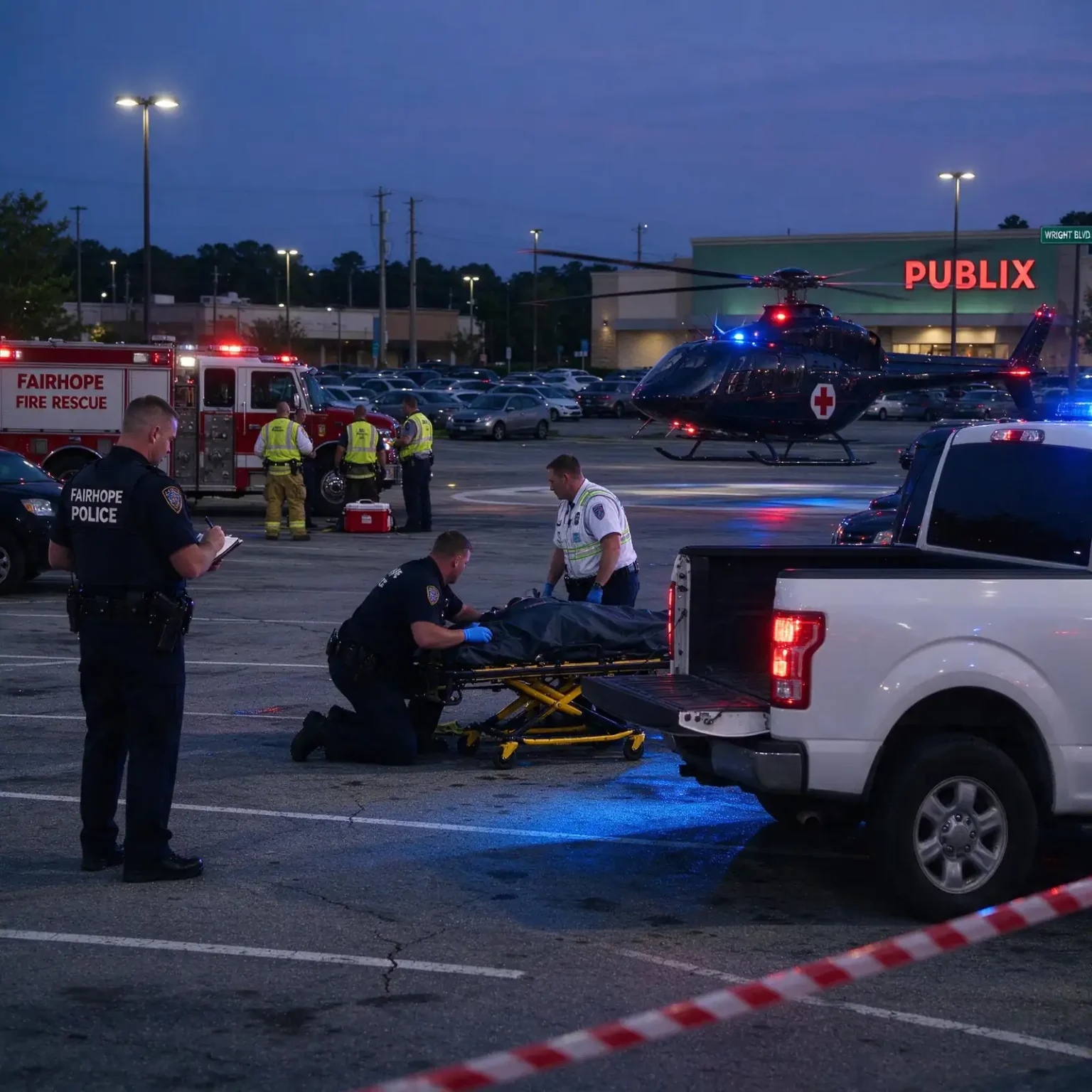
FAIRHOPE, Ala. — A Fairhope pedestrian hit by a pickup truck reversing through a busy grocery store parking lot Friday evening suffered head trauma and other injuries, and responders called for a medical helicopter.
The crash happened shortly before 5 p.m. on Friday, Nov. 20, 2026, in the Publix parking lot on Wright Boulevard. Fairhope police said they are investigating what happened.
What Emergency Crews Encountered
Calls to 911 described a person on the ground in the lot after being struck by a vehicle moving in reverse. Those who called said the person was bleeding and had been hurt.
Emergency medical services personnel later reported that the pedestrian was bleeding and had suffered head trauma along with abrasions. Officials have not released the person’s name or age, and they have not provided an update on the pedestrian’s condition.
Fairhope police officers, Fairhope firefighters and EMS crews all responded to the Wright Boulevard shopping center. A medical helicopter was dispatched to the scene as well.
Authorities have not identified the driver of the pickup or said whether any citations or charges are being considered. They have not described how fast the truck was moving or the circumstances that led to the collision.
Why a Helicopter May Be Called
Medical helicopters are typically requested when a patient’s injuries appear serious enough that reaching a specialized hospital quickly could make a difference. Head injuries are one of the conditions that often lead responders to consider air transport, because a trauma to the head can worsen rapidly and may require care from neurosurgeons and other specialists who are not available at every hospital.
Air ambulances are generally staffed by a flight crew that includes a pilot and medical personnel such as flight nurses and flight paramedics trained in critical care. Dispatch decisions usually weigh several factors, including the patient’s condition, how long a ground ambulance would take to reach an appropriate hospital, traffic and weather conditions, and whether a suitable landing zone is available near the scene.
In many cases, responders on the ground request a helicopter early, while they are still assessing the patient, so that it can be in the air without delay. Firefighters frequently secure a landing zone, often in an open parking area or field, and keep onlookers and vehicles clear while the aircraft lands and takes off. A helicopter being dispatched does not by itself indicate the outcome for a patient, and officials have not said whether or where the pedestrian was transported.
Alabama operates a statewide trauma system designed to help match seriously injured patients with hospitals that have the resources to treat their specific injuries. Coordinators work with emergency crews in the field to identify the most appropriate destination based on the type and severity of the injuries.
How Police Typically Handle a Parking Lot Crash
The Fairhope Police Department has said only that the crash is under investigation. In general, when a pedestrian is seriously hurt in a crash, officers document the scene, photograph the vehicle and its position, take measurements and speak with the driver and anyone who saw what happened.
Investigators may also look for video. Shopping centers and stores often have security cameras covering parking areas, and some vehicles carry dashboard cameras or backup cameras that may have recorded footage. Officers may also check whether the driver was impaired or distracted and whether the vehicle had any mechanical problems.
Once the investigation is complete, police and prosecutors decide whether any traffic or criminal charges are warranted. That process can take days or weeks, particularly when a victim’s injuries are serious and investigators are waiting on medical information or video evidence.
Why Head Injuries Get Special Attention
Medical experts treat any significant blow to the head seriously, even when a person is awake and talking. Traumatic brain injuries range from mild concussions to severe injuries involving bleeding or swelling inside the skull, and the full extent of an injury is not always obvious at the scene. Doctors commonly rely on imaging such as CT scans to determine whether there is damage that cannot be seen from the outside.
Some symptoms of a head injury may not appear right away. Health authorities advise that headaches that worsen, repeated vomiting, confusion, unusual drowsiness, slurred speech, weakness or numbness, and seizures are warning signs that call for immediate medical care. Older adults and people who take blood-thinning medications can be at higher risk of bleeding after a head injury.
That uncertainty is part of why emergency crews often act quickly and conservatively with head trauma, arranging the fastest practical route to a hospital that can provide advanced care. Officials have not described the severity of the pedestrian’s injuries beyond the head trauma and abrasions EMS reported.
The Hidden Danger Behind a Reversing Vehicle
Backover crashes occur when a vehicle moving in reverse strikes a person behind it. Safety experts point out that these collisions often happen at low speeds in places where people do not expect danger, such as driveways and parking lots. Pedestrians, especially young children and older adults, are among those most at risk.
Pickup trucks, SUVs and other larger vehicles can have sizable blind zones behind them. A person who is short, bending down to load groceries or crossing behind a vehicle may not be visible in mirrors or through the rear window, even to a careful driver.
To address that risk, the National Highway Traffic Safety Administration began requiring rearview cameras on new passenger vehicles under 10,000 pounds manufactured on or after May 1, 2018. The cameras show drivers an area directly behind the vehicle and have become standard equipment on most new cars and trucks. Many newer models also include rear cross-traffic alerts, parking sensors or automatic rear braking that can warn a driver or stop the vehicle when an obstacle is detected.
Those technologies help, but they have limits. Cameras can be blocked by dirt, rain or glare, sensors may not detect every object, and older vehicles may have no such equipment at all. Safety advocates stress that technology should supplement, not replace, a driver’s own attention.
Parking Lots Are Busier Than They Seem
Parking lots can feel like low-risk places because vehicles move slowly, but they combine many hazards at once. Drivers are often searching for spaces, checking phones, watching for other cars and reversing out of spots, while shoppers walk between rows, push carts and juggle bags or children.
Early evening hours can add to the challenge, particularly in late fall, when the sun sets earlier and lighting conditions change quickly. Busy grocery stores also tend to see heavy traffic around the end of the workday as people stop on their way home.
Safety Tips for Drivers and Shoppers
Traffic safety organizations offer straightforward advice for reducing the risk of backover and parking lot crashes. For drivers, recommended habits include:
- Walk around your vehicle before getting in, especially if children or pedestrians may be nearby.
- Whenever possible, back into a parking space or choose a pull-through spot so you can drive forward when leaving.
- Use your mirrors, backup camera and a look over your shoulder together, rather than relying on any single tool.
- Back out slowly and be ready to stop at any moment, and keep your phone out of reach while maneuvering.
- Keep your rear window, mirrors and camera lens clean so your view is as clear as possible.
- Watch for people loading cars, pushing carts or walking between parked vehicles.
Pedestrians can protect themselves, too. Safety experts recommend that shoppers:
- Use marked walkways and crosswalks where they are available.
- Watch for white reverse lights, engine sounds or brake lights that signal a vehicle may be about to move.
- Avoid walking directly behind parked vehicles whenever possible.
- Put phones away and remove headphones while walking through a lot.
- Make eye contact with drivers before crossing their path, and do not assume a driver can see you.
- Hold children’s hands and keep them close, since small children can be nearly impossible to see from a driver’s seat.
If You Witness a Crash
Bystanders are often the first people to reach someone who has been hit. Emergency officials generally advise calling 911 right away and giving a clear location, including the name of the business and the area of the lot. Unless there is an immediate danger such as fire or oncoming traffic, an injured person should not be moved, because moving someone with a head, neck or back injury can make it worse. If you are able, apply steady pressure to bleeding with a clean cloth, keep the person calm and still, and follow the dispatcher’s instructions until responders arrive.
What Comes Next
Fairhope police are continuing their investigation, and the department has not released additional details about the driver, the pedestrian or what led up to the crash. Further information, including any decision about charges, would come from police or prosecutors once the review is complete.
Anyone who witnessed the crash or has video of the parking lot around that time may be able to assist investigators by contacting the Fairhope Police Department. Even brief recordings or recollections can help officers build an accurate picture of what took place.
For shoppers along Wright Boulevard and across the Eastern Shore, the crash serves as a reminder that a routine errand can turn dangerous in seconds. A few extra moments of caution while backing up or walking through a lot can help prevent the kind of injuries that brought emergency crews and a medical helicopter to Fairhope on Friday evening.