Daphne Apartment Fire Forces Evacuation at Audubon Park as Fairhope Crews Join Late-Night Response
No one was hurt when fire and heavy smoke filled the attic of building twelve at Daphne's Audubon Park Apartments late Thursday, prompting an evacuation and a joint Daphne and Fairhope response.
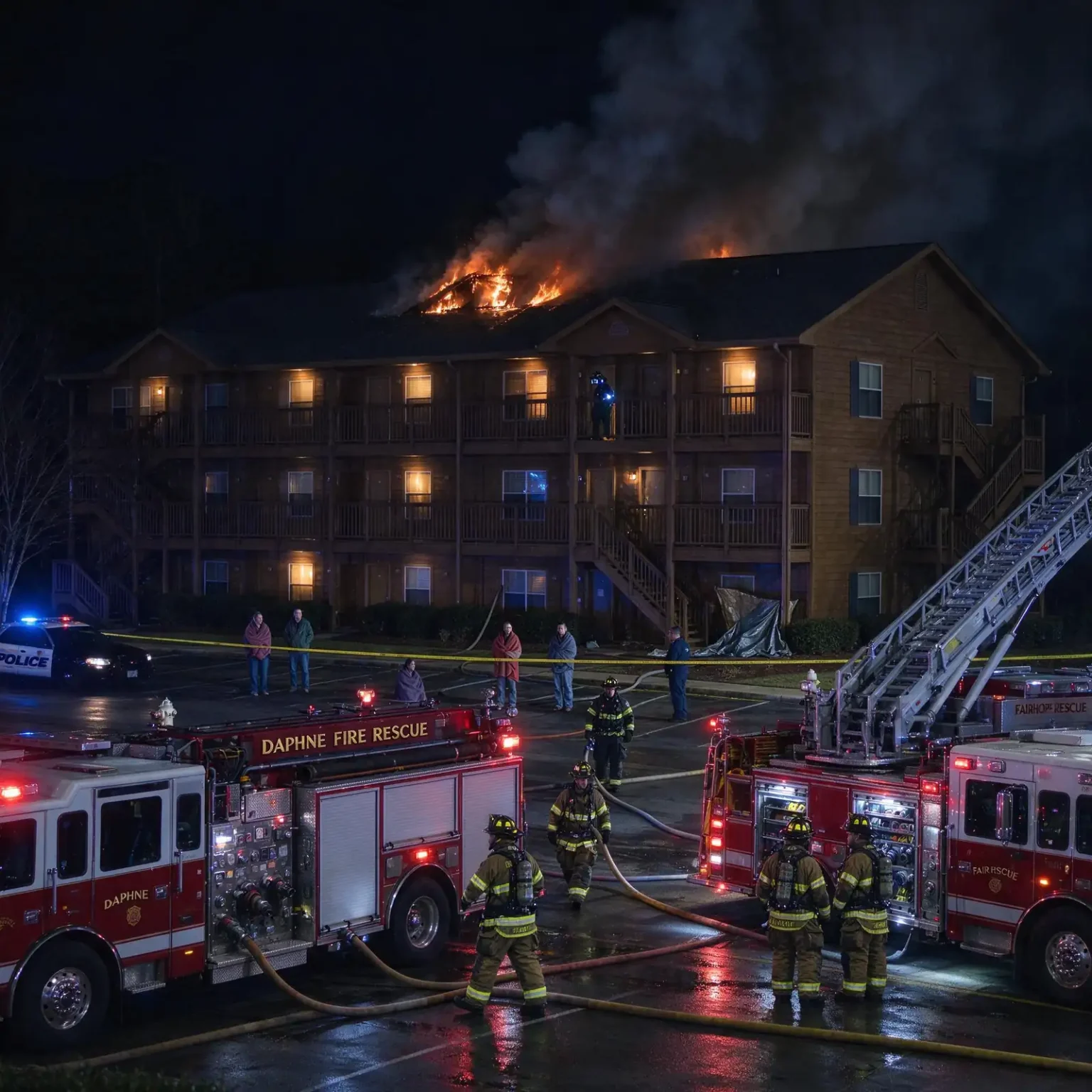
DAPHNE, Ala. — Fire crews from two Eastern Shore cities converged on a Daphne apartment fire late Thursday after flames and thick smoke were found in the attic of one of its buildings. Everyone inside got out, and fire officials said no one was injured.
The blaze broke out at the Audubon Park Apartments, 8160 County Road 64, close to 10:30 p.m. on Thursday, Nov. 19, 2026. Residents of building twelve were ordered out as firefighters went to work, and the cause remains under review.
Police Reached the Building First
The emergency began with a 911 call, which brought both Daphne police officers and Daphne firefighters to the complex. Officers got there ahead of the fire engines and helped move residents out of building twelve while crews were still on the way.
Fire officials described the blaze as a small fire that started inside one of the units. By the time firefighters were on scene, however, the fire had reached the attic, and heavy smoke was visible from the structure.
Early evacuation is one of the most important factors in keeping residents safe during an apartment fire. When police arrive first, they often go door to door, knock loudly and direct people toward exits so that firefighters can focus on the fire itself once they pull up.
Fairhope Sent Help Automatically
The Fairhope Fire Department was dispatched to the complex as part of an automatic mutual-aid arrangement with Daphne. Under that kind of setup, a neighboring department is sent at the same moment as the home department for certain types of calls, rather than waiting for a commander on the scene to ask for more help.
Traditional mutual aid works differently. In that model, the responding department first evaluates the incident and then requests additional engines, ladder trucks or personnel if it needs them. Automatic aid removes that delay, which can matter a great deal for structure fires, where conditions can worsen within minutes.
Fire departments across the country use automatic aid agreements to get enough firefighters to a working fire quickly. National fire service standards call for a substantial number of personnel at a residential structure fire to handle tasks such as attacking the fire, searching for occupants, ventilating the building and supplying water, and few individual departments can staff all of those roles from a single station at a moment’s notice.
On the Eastern Shore, where Daphne, Spanish Fort, Fairhope and surrounding communities have grown quickly in recent years, that kind of cooperation helps cover a large and busy service area. Firefighters from neighboring cities often train together and use compatible equipment so they can work side by side without confusion.
How Crews Typically Attack a Working Fire
Although the department has not described its tactics Thursday night in detail, firefighters at a structure fire generally follow a well-practiced sequence. The first officer to arrive conducts a size-up, walking or viewing the building to judge where the fire is, how far it has spread, whether anyone may be trapped and how best to approach it. That officer typically establishes incident command so that every arriving unit receives a clear assignment.
From there, crews stretch hose lines to the fire, search the building for anyone left inside and set up a reliable water supply from nearby hydrants. Ventilation, the controlled release of heat and smoke from the structure, is coordinated carefully, because opening a building at the wrong time can feed a fire fresh air and make it grow.
Once the visible fire is out, firefighters move into a phase called overhaul. They open walls and ceilings, look for embers hiding in insulation or framing and soak any remaining hot spots so the fire cannot rekindle hours later. Crews often perform salvage work at the same time, covering furniture and belongings with tarps and removing water to limit damage to residents’ property.
Why Attic Fires Are Hard to Fight
Attic fires present special challenges. Attics are often open, unfinished spaces filled with dry wooden framing, insulation and wiring, and in many apartment buildings a single attic may stretch above several units. Once fire gets into that space, it can travel horizontally and spread out of sight of anyone standing inside the apartments below.
Building codes generally require fire-resistant separations and draft stops in multifamily construction to slow that spread, but firefighters still must work quickly. Crews commonly pull down sections of ceiling to reach hidden fire, use thermal imaging cameras to find hot spots and check adjoining units to make sure flames have not moved through concealed spaces.
Smoke is also a major concern. Even when flames stay in a small area, smoke can fill hallways and neighboring apartments, and it is responsible for a large share of fire injuries and deaths. That is one reason firefighters push for a full evacuation whenever an attic fire is found in a shared building.
Where the Fire May Have Started
Fire officials said the fire may have begun in a bathroom. They have not identified a specific cause, and the fire is expected to be investigated further in the coming days.
In general, bathrooms contain several items that fire investigators routinely examine, including exhaust fans, light fixtures, electrical outlets, space heaters and plug-in appliances such as hair dryers and curling irons. Exhaust fans in particular are often mounted in the ceiling and vent into or through the attic, so investigators commonly check them when a fire involves both a bathroom and the space above it. None of that means any of these items played a role in Thursday’s fire; officials have not said what sparked it.
Fire investigations typically follow a structured process known as origin and cause analysis. Investigators study burn patterns, the depth of charring on wood and the condition of electrical wiring and appliances to trace the fire back to where it began. They also interview residents and first responders, review photos and sometimes collect items for laboratory testing. The goal is to determine whether a fire was accidental, natural, intentional or undetermined.
No Injuries Reported
Daphne fire officials reported that no one was hurt. The department did not say how many residents were evacuated, how long they were kept out of the building or how much damage the fire caused to building twelve.
After a fire in a multifamily building, residents are often not allowed back inside until crews confirm the structure is safe and utilities have been checked. Smoke and water damage can affect units that were never touched by flames, so property managers and insurers usually inspect apartments before people return.
Residents who are displaced after a fire may be eligible for short-term help from organizations such as the American Red Cross, which commonly assists with emergency lodging, food and basic necessities after home fires. Renters insurance can also cover personal belongings and temporary housing costs, depending on the policy.
Fire Safety Tips for Apartment Residents
Fire safety experts emphasize that a few simple habits can make a major difference in a shared building. The following guidance is drawn from widely recommended home fire safety practices:
- Check your smoke alarms. Make sure alarms are installed inside each bedroom, outside sleeping areas and on every level of your home. Test them monthly, and replace alarms that are 10 years old or older.
- Know two ways out. Learn the locations of exits and stairwells in your building, and plan a second escape route in case the first is blocked by smoke or fire.
- Close the door behind you. Shutting doors as you leave can slow the spread of smoke and fire and protect neighbors and escape routes.
- Never ignore an alarm. Treat every fire alarm as real, and get outside quickly. Once you are out, stay out and call 911.
- Mind your bathroom devices. Unplug hair tools when not in use, keep them away from towels and other materials that can burn, and clean exhaust fan covers of dust and lint.
- Report electrical problems. Tell your landlord right away about flickering lights, warm outlets, buzzing sounds or fans that run hot or noisily.
- Consider renters insurance. A policy can help replace belongings and pay for temporary housing after a fire.
Protecting Neighbors in a Shared Building
Living in an apartment means every resident’s habits can affect the people next door, above and below. Kitchen fires are a leading cause of home fires nationally, so staying in the kitchen while cooking on the stovetop and keeping flammable items away from burners are among the most effective steps anyone can take. Candles should never be left burning unattended, and smoking materials should be fully extinguished in a sturdy container.
Residents should also avoid overloading outlets and power strips, keep extension cords from running under rugs and leave space around heaters and electronics. Keeping hallways, stairwells and exit doors clear helps everyone get out quickly if an alarm sounds. Tenants who notice a missing smoke alarm, a broken fire door or a blocked exit should report it to building management right away.
What Happens Next
Fire officials will continue looking into the fire to pin down where and how it started. Once that work is complete, investigators may be able to say whether the bathroom was indeed the point of origin and what caused the flames to reach the attic.
For residents of building twelve, the next steps will depend on how much damage the fire left behind and how quickly repairs can be made. Property management will likely work with fire officials and insurers to determine when the building can be safely reoccupied.
The response also highlighted how emergency services on the Eastern Shore lean on one another. With police clearing the building and two fire departments sharing the work, a late-night fire in a crowded apartment complex ended without anyone being hurt, the kind of outcome every emergency response aims for.