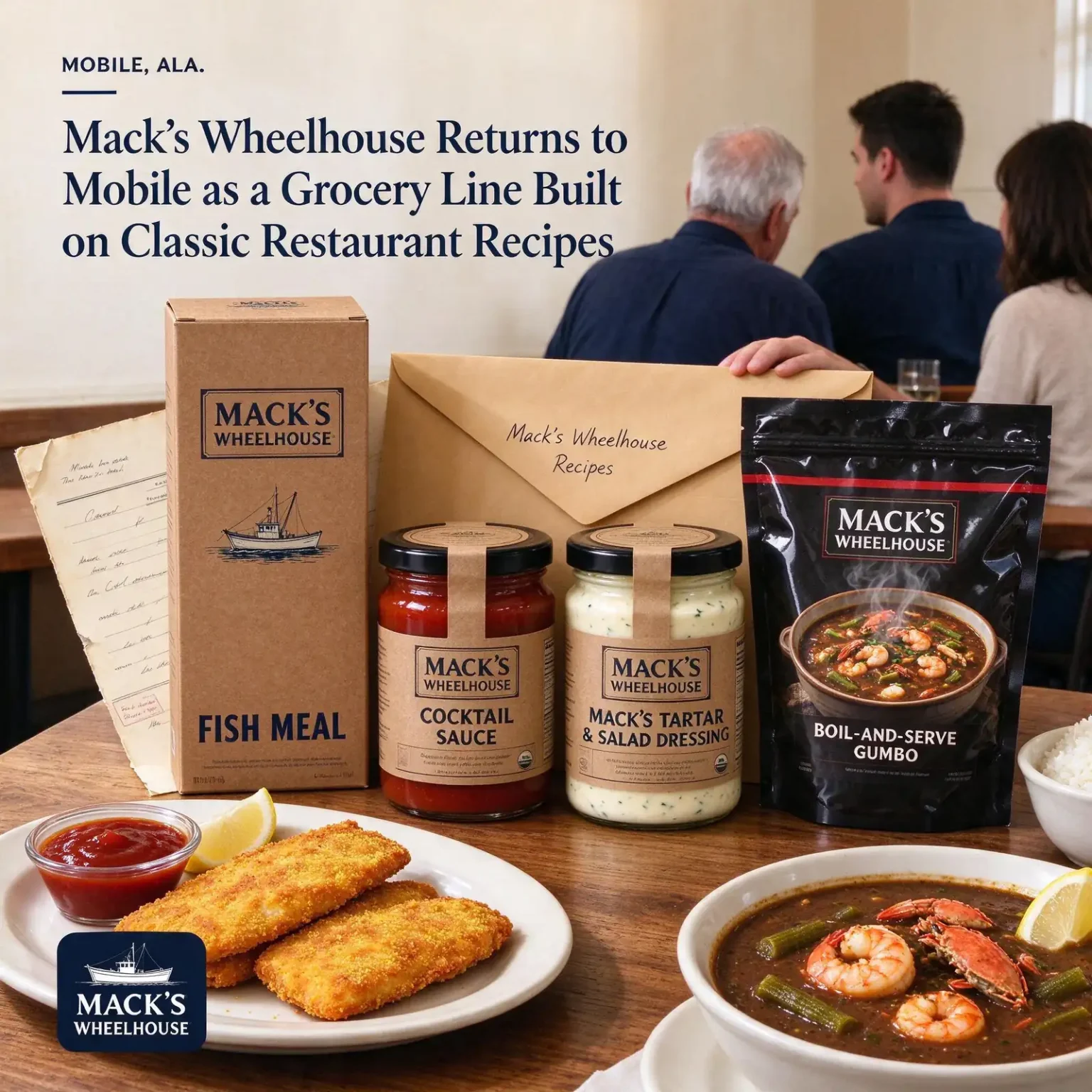
MOBILE, Ala. — Mack’s Wheelhouse, the seafood restaurant that fed generations of Mobile diners from its spot on Spring Hill Avenue, is making a comeback, this time on grocery store shelves. Two decades after the dining room closed in 2004, the family behind it has launched a line of four packaged products built on the restaurant’s original recipes: a Fish Meal for frying, a cocktail sauce, a tartar sauce sold under the name Mack’s Tartar & Salad Dressing, plus a frozen gumbo that is labeled as a boil-and-serve product.
The products have just started appearing in stores around the Mobile area. The effort is being led by the son of the restaurant’s founder, who ran the Wheelhouse in its later years, and the founder’s grandson, who worked in its kitchen as a teenager. Two partners round out the team: the grandson’s wife, who handles marketing and branding, and a longtime associate of the family who brings 25 years of restaurant industry experience.
Four Products, One Rulebook
The new line was not chosen at random. When the family began going back through the restaurant’s recipes, they settled on the four that looked most practical to package and sell at retail. Each one, they say, sticks closely to the way it was made at the restaurant, and each reflects the exacting standards of the man who created it.
Fish Meal. The breading mix may be the product with the deepest roots in the founder’s philosophy. According to his grandson, the founder insisted on two things. First, the meal could not cling to the fryer, since he was determined to keep his cooking oil clean and fresh. Second, it could carry no seasoning beyond salt. His reasoning, the grandson said, was that anyone ordering fried fish, shrimp or oysters should be tasting the seafood and nothing else.
Like many Gulf Coast frying mixes, the product combines wheat flour and cornmeal. The difference, the grandson said, is that the cornmeal is ground so finely that it is nearly flour itself, and he said anyone who handles it can feel the difference right away. The family says the result is a thin, crisp coating that lets the natural flavor of the fish come through, which is what the founder wanted. It can also be used for breading vegetables.
Cocktail sauce. Many coastal diners make their own version at the table by stirring together ketchup and horseradish, perhaps with Worcestershire, lemon or a few drops of hot sauce. The Wheelhouse recipe adds an ingredient the family says sets it apart. The founder’s son said they examined about 20 cocktail sauces on the market and found none that included chili sauce. Because chili sauce is a costly ingredient, he said, it makes their version more expensive to produce.
Mack’s Tartar & Salad Dressing. The family’s take on tartar sauce draws on the founder’s fondness for Greek food. His son said the founder blended that influence into the recipe, and the grandson describes the result as a tartar sauce with a Mediterranean character, unlike anything else he knows of. The dressing features dill, lemon and herbs.
The sauce earned a following of its own at the restaurant. The grandson said customers would spread it on crackers or pour it over salads, and some asked for it specifically as a salad dressing. His father recalled diners opening packets of crackers and working through an entire bottle while they waited for their food, something he still finds odd. The makers now recommend it for sandwiches and salads while saying it is at its best alongside seafood. They also suggest using it as an ingredient in chicken salad, slaw and salmon dip.
Boil-and-serve gumbo. The frozen gumbo is packed flat so it stacks neatly in grocery freezer cases and in home freezers. It is loaded with crab and shrimp, and it is very thick, so thick that some cooks may be tempted to add a little water. The family makes no apologies for that. The founder, they said, held firm to the belief that a true gumbo has to be thick enough to cling to rice, and that anything thinner is merely soup, regardless of what cooks in New Orleans might argue. His son agreed that gumbo was never supposed to be a soup.
Getting the Recipes Right at Scale
Having the recipes in hand turned out to be only the beginning. The founder’s son still holds on to them, tucked inside a manila envelope as photocopies of pages written in his father’s and mother’s handwriting. The recipes record not only the amount of each ingredient but also what each one cost at the time.
Those formulas were the result of careful trial and error, he said. His mother played a central role, helping keep a thick binder that documented what the couple had tested, what they adjusted and the reasons behind every change.
Translating restaurant batches into wholesale production proved harder than the family expected. Simply multiplying quantities did not reliably produce the same results, and some adjustments were needed to make the products shelf-stable. Each time, the team had to work back toward the flavor they remembered.
The grandson estimated they discarded about $15,000 worth of product during development. A batch would be made, he said, and he would taste it and decide it was not right, which meant returning to the packer to fine-tune the recipe again.
Finding the right packers took considerable time as well. The family ultimately chose two local companies: Carrington Foods in Saraland packs the gumbo, and Foxco Packaging in Mobile handles the products that are not frozen.
From a Crichton Grocery to Spring Hill Avenue
The Wheelhouse was one chapter in a family story that spans four generations and stretches back to the late 1920s. That was when a relative set out to open a grocery business in the Crichton section of Mobile. The result was a family grocery store that opened around 1930.
The restaurant’s founder took over that store in 1945, once he was back home after serving in World War II. His obituary, published following his death in 2005, notes that he held the presidency of a local grocers’ association for two terms.
His ambitions reached beyond groceries. He opened several restaurants in and around Crichton over the years. Just one of them, Roshell’s Café and Deli, is still in business, and it is operated by another branch of the family.
The Wheelhouse, which opened on Spring Hill Avenue in the early 1970s, became his signature project. His son worked there and then took over the business when the founder retired in 1990. The grandson worked at the restaurant during high school, until his parents made the decision to close it in 2004.
A Kitchen Built Around Freshness
In its prime, the Wheelhouse was known as one of the area’s top sources for fresh flounder and other seafood. The founder’s son said the restaurant took in as much as 5,000 pounds of flounder, whole, each week, sourcing it directly from Bayou La Batre and handling all of the processing on site.
To handle that volume, the founder put up his own processing plant on the property, behind the dining room. His son said the family was in the bayou daily, and that the restaurant likely went through at least 100 to 150 gallons of oysters each week.
Shrimp demanded its own share of labor. The grandson recalled that during his senior year of high school, the staff would peel roughly two hundred pounds of shrimp or more on Fridays and Saturdays. Most were butterflied. A machine split the shrimp, he said, but a great deal of handwork remained, including breading each shrimp by pressing it into a handful of meal until it opened up. As he described the process, his hands fell back into the old motions.
The founder’s standards extended to every corner of the operation, from how clean the kitchen was kept to the smallest details of each recipe. His grandson described him as extraordinarily meticulous about flavor. His son said he never believed a single person could keep watch over everything at once, but that his father managed it.
The restaurant’s atmosphere was another part of its appeal. The founder’s son described it as a relaxed, very casual spot where locals gathered, so much so that regulars took to calling it the Crichton Country Club. His father had worked in the food business his whole life, the son said, and wanted a place of his own where he could serve fresh, top-quality seafood made with his own recipes.
Feeding Mobile After Hurricane Frederick
One story captures the founder’s forward thinking. His son said that both his parents loved the restaurant business and devoted their lives to it. Father and son agreed that anyone who does not love the work will be worn down by it.
In 1979, before Hurricane Frederick struck, the founder began experimenting with freezing oysters, something his son said no one else was doing at the time. He worked out a method for freezing oysters by the gallon while preserving their freshness. The family thawed the first batch, tasted it and kept refining the process until, the son said, the frozen oysters could not be told apart from fresh ones.
Thinking ahead, the founder froze roughly a thousand gallons. After the storm struck, the restaurant reopened on generator power with flounder and oysters on hand, and the son said the Wheelhouse fed the city at a time when no other place was open.
The son said he is still amazed at how his parents developed so many recipes and worked through so many tastings. They poured themselves into the business around the clock, he said.
Why the Restaurant Closed, and Why It Is Back
The founder’s son said several factors led to the 2004 closing. The surrounding neighborhood was declining, the restaurant industry was becoming more difficult, and obtaining high-quality seafood had grown harder than it once was.
The idea of reviving the brand as a grocery line has been in the back of the family’s minds ever since, father and son said. The grandson said that every time they came close to committing, something in their lives got in the way, and the plan kept getting pushed to the following year until two decades had passed.
The founder’s son, who is about to turn 72, said he finally decided the time had come. The work began in November with the formation of a new limited liability company, followed by a return to the recipes to pick the first products.
He said no one on the team had ever been in the grocery business or packaged a product before. They set a launch budget, he said, and spent past it quickly.
Where to Find the Products
Mack’s Wheelhouse products are available at Piggly Wiggly stores across southwest Alabama. They are also stocked at several other shops and markets around the region:
- Fairhope: the Apple Market
- Chickasaw: Cash & Carry
- Daphne: Mosley’s Meat Market
- Bon Secour: Aquila Seafood
- Pensacola, Florida: Maria’s Fresh Seafood Market
The company’s website names further retailers, and the list is expected to grow. The grandson said he expects the products to be in about 40 locations in total by Christmas.
The current lineup may be only a start. The grandson said the family began with four products but hopes, if all goes well, to bring more of the restaurant’s recipes to market. Plenty of them are still waiting in that manila envelope.