Magnolia Springs Safety Grant of $1.9 Million Targets Three Crossroads; Daphne Lands $8.1 Million
Magnolia Springs will receive $1.9 million from the federal Safe Streets and Roads for All program to improve three busy intersections, while Daphne secured $8.1 million to remake a crash-prone stretch of County Road 13.
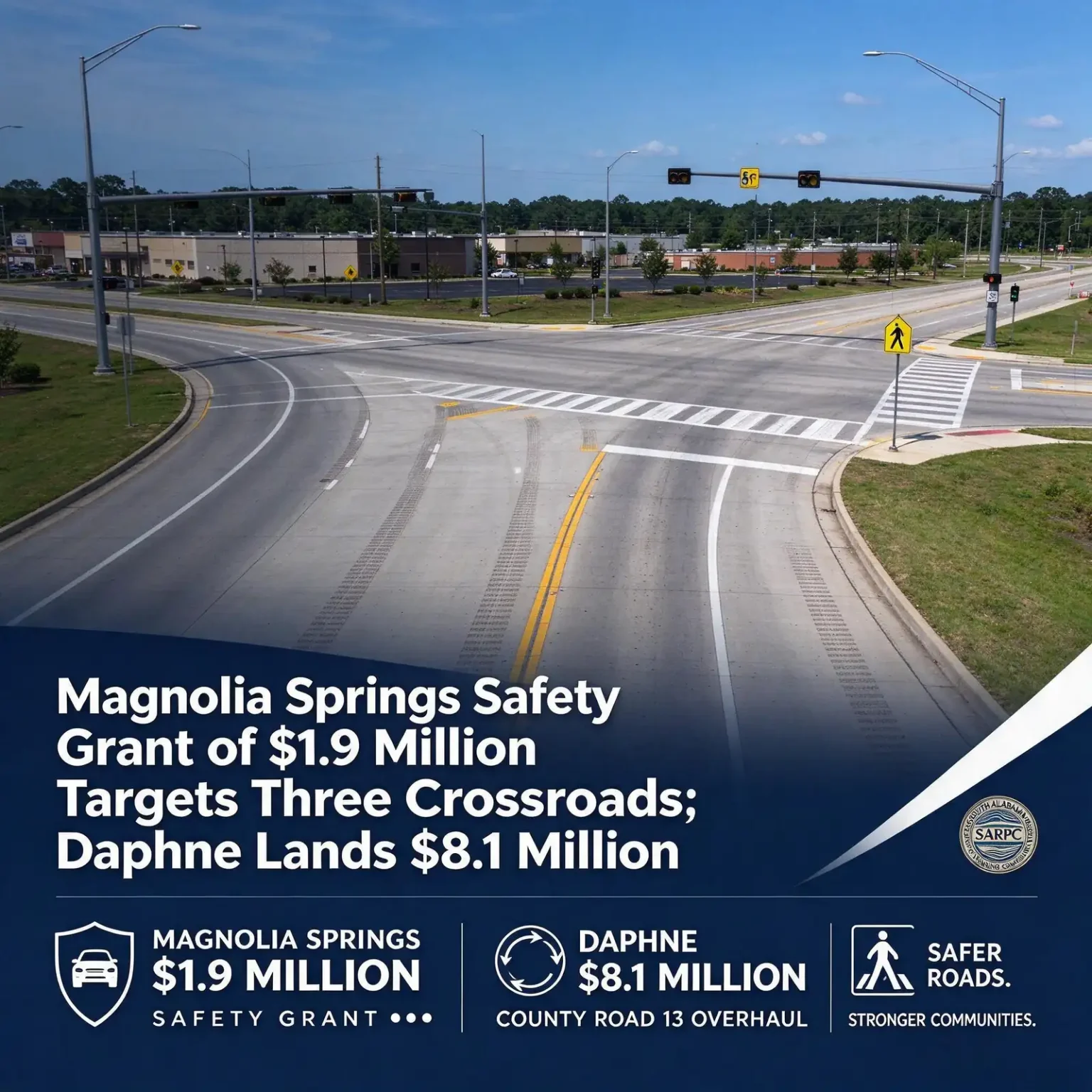
MAGNOLIA SPRINGS, Ala. — The town of Magnolia Springs is getting a $1.9 million federal boost to make three of its most important intersections safer, part of a pair of awards that will also send $8.1 million to Daphne for an overhaul of County Road 13. The Magnolia Springs safety grant comes through the fiscal year 2026 round of the federal Safe Streets & Roads for All program, known as SS4A.
Both awards were announced this week by South Alabama Regional Planning Commission officials. The agency is commonly known as SARPC. Neither the town nor the city has set a start date for construction.
Magnolia Springs’ Safer Crossroads Plan
Magnolia Springs will use its award for a project called Safer Crossroads, which targets intersection safety at three priority spots. They are the intersection of Highway 98 and Old Marlow Road, the junction where Highway 98 meets Magnolia Springs Highway, and the point where Magnolia Springs Highway crosses County Road 26.
According to SARPC, the three locations sit on a high-injury network where crashes have continued to occur year after year. Rather than relying on a single fix, the project bundles together a range of treatments drawn from the Federal Highway Administration’s Proven Safety Countermeasures, a collection of strategies the agency promotes because research has shown them to reduce crashes.
The planned improvements include:
- Additional turn lanes
- Better access management
- Lighting aimed at specific trouble spots
- Wider shoulders
- Broader edge lines
- Retroreflective signs and striping
- Raised pavement markers
- Rumble strips along both the centerline and the edge lines
- High-visibility crosswalks
- Extended sidewalks
- Portable signs that display drivers’ speeds
Highway 98 is a major east-west route across southern Baldwin County, connecting communities between the Eastern Shore and the Florida line, so intersections along it handle a mix of local trips, commuter traffic and visitors heading toward the coast. Improving safety where local roads meet the highway can benefit far more people than the town’s own residents.
The town has been experiencing growth, and traffic in the area has been increasing along with it. That combination of more vehicles and more development is a common reason smaller communities seek outside funding to upgrade roads before crash problems worsen.
What Each Safety Measure Is Designed to Do
The tools in the Magnolia Springs package each address a different kind of crash risk. In general terms, here is how traffic engineers describe their purpose:
Managing Turns and Driveways
Dedicated turn lanes give vehicles waiting to turn a place to slow down and stop outside the path of through traffic. That separation tends to reduce rear-end collisions and can lower the risk of crashes involving vehicles turning across oncoming lanes.
Access management refers to controlling where and how vehicles can enter and leave a roadway, such as consolidating driveways, adjusting median openings or limiting certain turning movements close to an intersection. Fewer entry points mean fewer places where vehicles can conflict, which makes traffic more predictable for everyone.
Helping Drivers Stay in Their Lane
Wider shoulders provide extra room for a driver who drifts off the travel lane to recover safely, and they offer space for disabled vehicles to pull over. Wider edge lines, often six inches instead of the traditional four, make the edge of the road easier to see, particularly at night and in bad weather.
Rumble strips are grooves cut into the pavement that create noise and vibration when a tire rolls over them. Along the centerline, they help warn drivers who are drifting toward oncoming traffic, reducing the risk of head-on collisions. Along the edge, they alert drowsy or distracted drivers who are about to leave the roadway.
Seeing and Being Seen After Dark
Retroreflective signs and pavement striping contain materials that bounce headlight beams back toward the driver, so they appear brighter at night. Raised pavement markers serve a similar role and can remain visible on wet roads when painted lines become harder to see. Targeted lighting improves visibility at intersections, where drivers must judge gaps in traffic and watch for pedestrians.
Protecting People on Foot and Slowing Traffic
High-visibility crosswalks use bold patterns, such as wide parallel bars, to make crossing points more noticeable to approaching drivers. Sidewalk extensions give pedestrians a dedicated space away from moving vehicles. Portable speed feedback signs display a driver’s current speed, a simple reminder that research and field experience suggest can encourage many motorists to slow down.
Daphne’s $8.1 Million County Road 13 Overhaul
In Daphne, the $8.1 million award will pay for safety upgrades along a 2.5-mile section of County Road 13. SARPC identified the road as one of the highest-crash corridors in Baldwin County. It carries about 9,600 vehicles every day.
From 2019 through 2023, the corridor saw 132 crashes. Three of them involved suspected serious injuries, and 27% happened when light was low.
The project calls for converting two intersections, at Pleasant Road and at Champions Way, into roundabouts. Plans also call for lighting along the corridor, sidewalks 8 feet wide and new crosswalks in school zones.
The corridor appears in the city’s SS4A Safety Action Plan, the document Daphne developed to identify and prioritize its most serious roadway safety needs. County Road 13 already has one new roundabout, which opened recently south of County Road 64 and appears to have helped traffic move more smoothly in the area.
Why Roundabouts and Lighting Matter on County Road 13
Roundabouts are among the most widely recommended intersection designs in the FHWA’s list of proven countermeasures. In a modern roundabout, traffic flows counterclockwise around a central island, and entering vehicles yield to those already circulating. The design forces drivers to slow down and eliminates the high-speed, right-angle and head-on collisions that can happen at traditional intersections, while reducing the number of points where vehicles’ paths cross.
The share of crashes in low-light conditions on County Road 13 helps explain the emphasis on lighting. Nationally, a disproportionate share of traffic deaths occur after dark, when it is harder for drivers to see the road, other vehicles and people walking. Lighting at intersections and along a corridor can help drivers spot hazards sooner.
Roundabouts can also be easier for pedestrians to navigate than large signalized intersections. Crosswalks are usually set back from the circulating lanes, and splitter islands at each entry allow people on foot to cross one direction of traffic at a time while vehicles approach at reduced speeds. For drivers new to them, the basic rules are simple: slow down on approach, yield to traffic already in the circle, and use the turn signal before exiting.
Wider sidewalks and school-zone crosswalks address another group of road users. Children walking to and from school, along with other pedestrians, benefit from having more room away from traffic and clearly marked places to cross.
How the Federal SS4A Program Works
SS4A was created by the Bipartisan Infrastructure Law, formally known as the Infrastructure Investment and Jobs Act, which Congress passed in 2021. The law set aside $5 billion for the program over five fiscal years, from 2022 through 2026, making the fiscal 2026 round the final one authorized under that legislation.
The program is run by the U.S. Department of Transportation and provides money directly to local and regional governments rather than routing it through state transportation departments. Cities, towns, counties, tribal governments and metropolitan planning organizations are among the eligible applicants.
SS4A offers two main types of grants:
- Planning and demonstration grants help communities create or update a comprehensive safety action plan, conduct studies and test temporary safety improvements.
- Implementation grants fund projects and strategies identified in an existing action plan, such as the intersection and corridor work planned in Magnolia Springs and Daphne.
Federal funds generally cover up to 80% of a project’s cost, with the local recipient responsible for the remaining share. Before a community can receive an implementation grant, it must have an eligible safety action plan in place, which is why documents such as Daphne’s plan play an important role in winning funding.
The Safe System Approach Behind the Grants
SS4A supports the U.S. Department of Transportation’s National Roadway Safety Strategy, which embraces a goal of eventually eliminating traffic deaths. The strategy is built on what is known as the Safe System Approach.
That approach starts from the idea that people will make mistakes behind the wheel and that human bodies can only withstand so much force in a crash. Rather than focusing only on changing driver behavior, it calls for roads, vehicles, speeds and emergency care to be designed so that a single error is less likely to cause a death or serious injury.
A key principle is redundancy, meaning multiple layers of protection. The Magnolia Springs project reflects that idea by combining many measures at once, from rumble strips that warn drivers to lighting that helps them see and crosswalks that protect pedestrians.
Regional Coordination and What Comes Next
SARPC serves as a regional planning agency for local governments in southwest Alabama, including Baldwin County, and helps communities pursue state and federal funding for transportation and other needs. The commission’s announcement of both awards reflects the growing attention to traffic safety in one of the state’s fastest-growing counties.
Projects funded through SS4A also tend to reflect public input. Safety action plans commonly draw on crash data along with comments from residents about places where they feel unsafe driving, walking or biking. Residents who want to follow the progress of either project, or share concerns about specific intersections, can watch for public meetings and updates from the Town of Magnolia Springs, the City of Daphne and SARPC.
For now, residents should not expect construction crews right away. No start dates have been announced for either project. Grant-funded road work typically must move through design, environmental review, agreements with funding agencies and bidding before construction can begin.
When work does get underway, drivers in Magnolia Springs and along County Road 13 in Daphne can expect the kinds of temporary lane shifts and delays that come with road improvements. Both projects share the same aim: fewer serious crashes on roads that many Baldwin County residents travel every day.