Public Safety Magnolia Springs
Magnolia Springs Plane Crash Leaves Empty Wreck as Pilot Appears to Have Left Site by Vehicle
Responders who rushed to a small plane crash near County Road 12 in Magnolia Springs on Saturday found the aircraft but no one with it, and tire tracks suggest the pilot left in a vehicle.
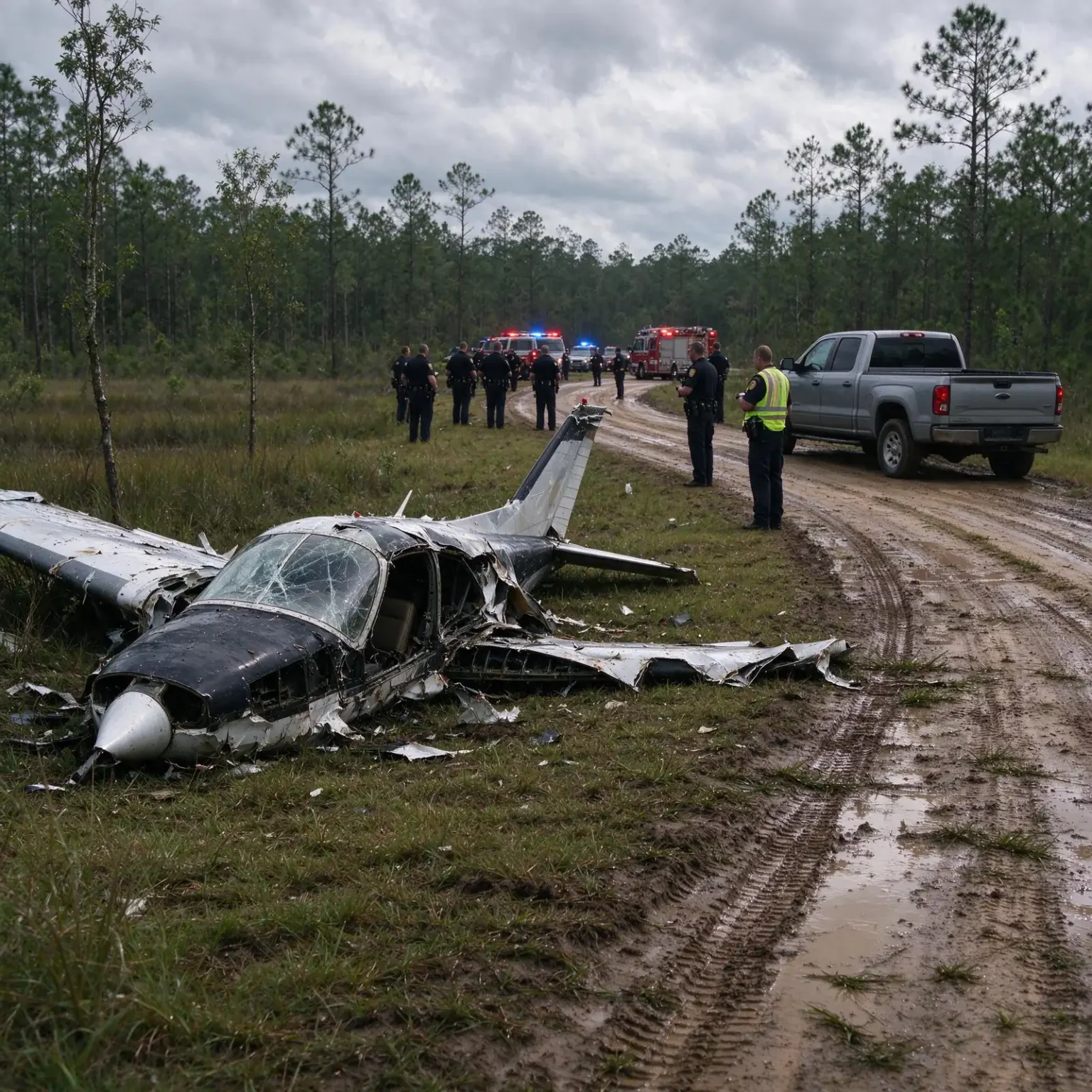
MAGNOLIA SPRINGS, Ala. — Emergency crews raced to a rural corner of town on Saturday afternoon after callers reported a Magnolia Springs plane crash, only to discover a wrecked aircraft with no one anywhere near it. Investigators believe the pilot climbed out and left in a vehicle before help arrived.
The crash, reported shortly before 1:30 p.m. on Saturday, Nov. 21, 2026, drew a sizable multi-agency response to the southern Baldwin County town. Authorities described the location as an active scene Saturday, and federal aviation officials are expected to become involved in the days ahead.
What Responders Found at the Crash Site
The aircraft was located near 10357 CR 12, in an area stretching from roughly 10500 Peaceful Park to Vernant Park Road. When rescuers reached it, the plane was damaged from the crash, but no pilot, passenger or bystander was present.
Law enforcement officers then spotted tire tracks left by a vehicle close to the wreck. Based on that evidence, authorities said it appeared the pilot had gotten out of the aircraft without assistance and was then driven away from the area.
Officials have not released the identity of the pilot, the type of aircraft involved, where the flight began or where it was headed. They also have not said whether anyone was hurt, and no cause for the crash has been announced. A spokesperson said authorities remained on site Saturday conducting their investigation.
A Large Response Across Agencies
The first word of trouble reached Baldwin County’s 911 communications center at about 1:25 p.m., when several calls came in about the downed plane. Dispatchers sent a wide range of responders, including deputies from the Baldwin County Sheriff’s Office, firefighters from the Magnolia Springs Fire Department, emergency medical services crews and other units.
A medical helicopter was launched toward the area as well. Dispatching air medical support early is a common precaution when an aircraft crash is reported, because responders cannot know in advance how many people may be on board or how serious their injuries might be. In this case, crews arrived to find no one in need of treatment at the site itself.
Small communities like Magnolia Springs rely heavily on volunteer and combination fire departments, county deputies and regional EMS providers working together. A plane crash is one of the less common calls these agencies handle, but it typically triggers a response similar to a serious vehicle wreck, with added attention to fuel leaks, fire risk and securing debris.
Federal Investigators Expected to Take a Look
The Federal Aviation Administration is likely to send an investigator to examine the aircraft, authorities said. That step is standard after a civil aircraft accident in the United States, even when the crash is small and occurs far from an airport.
Two federal agencies usually play roles after a general aviation crash. The National Transportation Safety Board, a stand-alone federal agency separate from the FAA, is responsible for investigating civil aviation accidents and determining their most likely cause. The NTSB does not regulate the industry or hand out penalties; its mission is to identify what went wrong and recommend changes that could prevent similar accidents.
The FAA, by contrast, is the agency that writes and enforces aviation rules, certifies pilots and aircraft, and oversees maintenance standards. Because the NTSB has a relatively small staff for the number of accidents that occur nationwide, FAA aviation safety inspectors frequently travel to the scene of smaller general aviation crashes to document the wreckage and gather early information, which is then shared with NTSB investigators.
How a Small-Plane Investigation Usually Unfolds
Although every case is different, investigations of small-plane crashes tend to follow a familiar path. Investigators generally focus on three broad areas: the people involved, the aircraft itself and the environment in which the flight took place.
- The pilot: Investigators typically review the pilot’s certificates, ratings, flight experience and medical certification, and they usually seek an interview with the pilot when the pilot is able to provide one.
- The aircraft: The wreckage is examined for signs of mechanical trouble, including the engine, flight controls, fuel system and propeller. Maintenance logbooks and inspection records are commonly reviewed.
- The environment: Weather conditions, visibility, wind, terrain and any air traffic control communications or flight-tracking data can all help investigators reconstruct the final moments of a flight.
Federal regulations define an aviation accident as an event tied to the operation of an aircraft in which someone dies or is seriously injured, or in which the aircraft sustains substantial damage. Lesser events may be classified as incidents. That classification can affect how extensive the federal review becomes, how much time investigators spend at the scene and what kind of report is eventually published.
Under federal rules, wreckage generally should not be disturbed except to help people, protect the wreckage or prevent further danger until investigators have had a chance to review it. Once the on-scene work is complete, damaged aircraft are often moved to a secure storage facility, where specialists can take a closer look at engines and components.
The NTSB typically publishes a preliminary report within a few weeks of an accident. That document usually lays out basic facts, such as the aircraft type, flight conditions and what was observed at the scene, but it does not state a cause. A final report with a formal finding of cause commonly takes a year or longer to complete. Both preliminary and final reports become publicly available through the NTSB’s online accident database.
Questions Remaining After the Pilot’s Departure
The most unusual aspect of Saturday’s crash is that responders arrived to an empty scene. Officials have not explained who drove the pilot away, where the pilot went or whether the pilot has since been in contact with investigators. They have also not indicated whether anyone else was aboard the aircraft.
Investigators may also try to determine whether the aircraft was equipped with flight-tracking technology. Many general aviation aircraft now broadcast their position through a system known as ADS-B, and that data, along with radar records and any radio communications, can help show the plane’s altitude, speed and path before it came down.
Those details matter to investigators because the pilot is often the most important source of information about what happened in the moments before a crash. Federal rules generally require the operator of an aircraft involved in an accident to notify the NTSB promptly and to submit a written report, which gives the agency a direct account of the flight.
Until authorities release more information, it is not known whether the crash resulted from mechanical trouble, weather, a planned emergency landing gone wrong or some other factor. Residents are encouraged to rely on official updates from the sheriff’s office and federal agencies rather than speculation circulating online.
Earlier Aviation Accidents in Baldwin County This Year
Saturday’s crash is the latest in a string of aviation accidents in Baldwin County during 2026. In March, two people were killed when a private plane went down in the Bon Secour area.
Two other crashes occurred in January. One plane came down in Bay Minette, and another crashed in Summerdale that same month, and several injuries were reported in connection with those January events.
Baldwin County is home to several public-use airports, including facilities in Fairhope, Foley, Gulf Shores and Bay Minette, and its coastal location and mild weather make it popular with recreational and private pilots throughout the year. Officials have not linked Saturday’s crash to any particular airport, and they have not suggested any connection among this year’s crashes.
What Residents Should Know About Crash Scenes
Aircraft crash sites can be hazardous long after the initial impact. Aviation fuel may leak and ignite, broken metal and composite materials can have sharp edges, and some aircraft carry equipment such as emergency locator transmitters or pressurized systems that should be handled only by trained personnel.
Safety officials generally offer the following guidance to people who live near or come across a downed aircraft:
- Call 911 immediately and give the most precise location possible, including road names, landmarks or GPS coordinates.
- Keep a safe distance and stay upwind if you smell fuel or see smoke.
- Do not move, touch or collect pieces of the aircraft, since debris can be critical evidence for investigators.
- Follow instructions from deputies and firefighters, and avoid driving into an active scene to look.
- If you saw or heard the aircraft before it went down, write down what you observed, including the time, the sound of the engine and the direction of flight, while the memory is fresh.
The NTSB accepts information from witnesses to aviation accidents and asks people with relevant observations, photos or video to share them with the agency through its witness email address, [email protected]. Even small details, such as whether the engine sounded rough or the aircraft appeared to be turning, can help investigators piece together a timeline.
What Comes Next
In the near term, deputies and federal officials are expected to finish documenting the crash site and determine how to safely remove the aircraft. Investigators will also likely work to locate and speak with the pilot to learn what happened during the flight.
Once federal investigators have gathered enough facts, a preliminary report should offer the public a clearer picture of the aircraft involved and the circumstances of the flight. Any conclusions about cause, however, will likely take considerably longer.
Magnolia Springs, a quiet town best known for its oak-shaded streets and the river that winds through it, is not accustomed to this kind of emergency. For now, residents near County Road 12 may continue to see law enforcement activity as the investigation moves forward, and officials are expected to share additional details as they become available.