Mobile Fire Rescue Recruits Haul 60 Pounds of Gear Up 40 Floors of RSA Tower Before Graduating
Before graduating as firefighter-EMTs, the 23 members of Mobile Fire Rescue Recruit Class 26-02 carried at least 60 pounds of gear up 40 floors of the RSA tower in downtown Mobile.
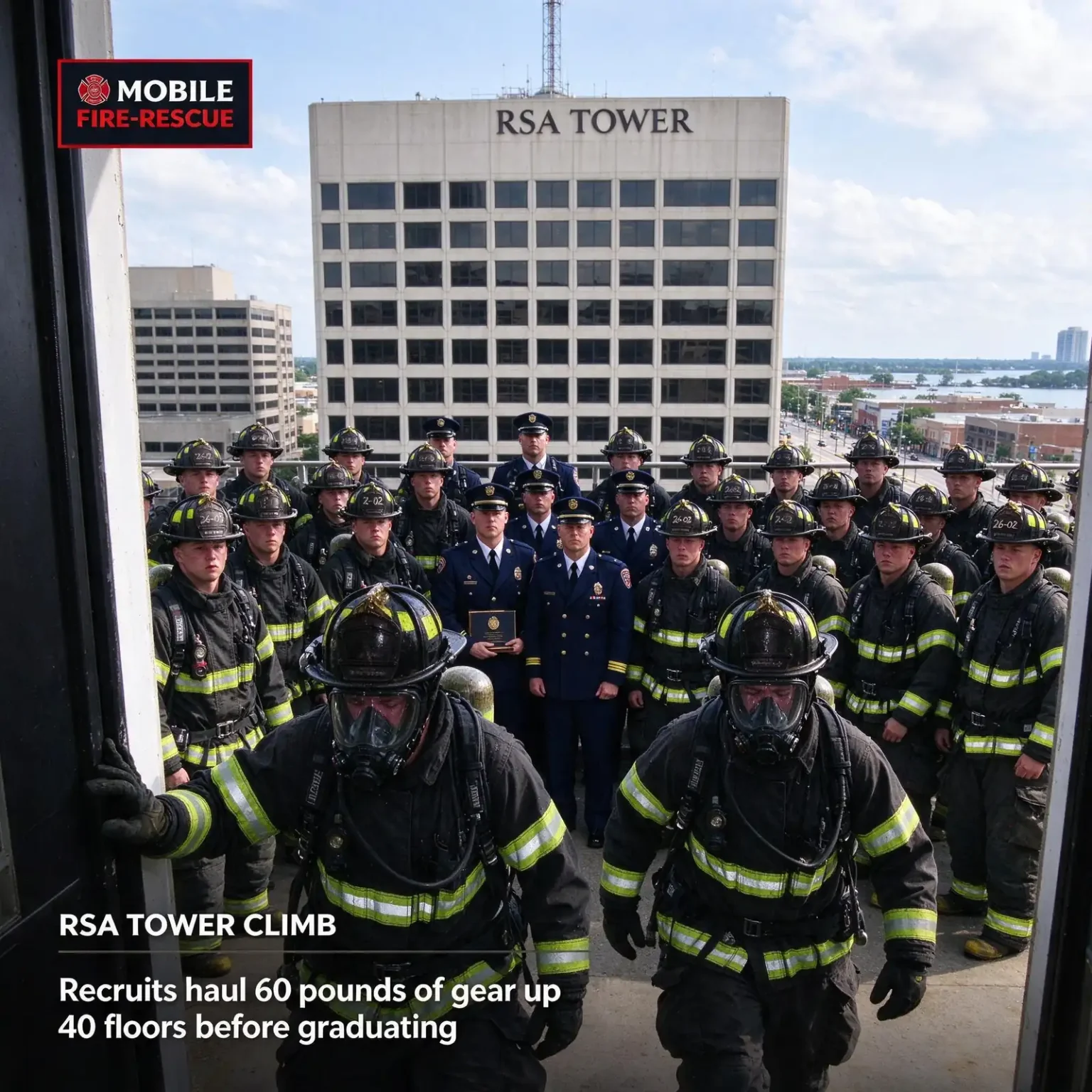
MOBILE, Ala. — The newest class of Mobile Fire Rescue recruits had one last test to pass before graduation, and it went straight up. On Tuesday morning, the members of Recruit Class 26-02 lined up at the base of the RSA tower in downtown Mobile and began climbing its 40 floors while wearing full firefighting gear.
All 23 recruits made the trip with at least 60 pounds of extra weight on their bodies. Later in the week, the Mobile Fire Rescue training academy graduated them as firefighter-EMTs, ready to join crews serving the city.
A Tradition Reserved for Graduation Week
The tower climb has become a fixture for the department. A department captain explained that every class of recruits now finishes fire school the same way: during the week they graduate, recruits suit up in their protective gear, strap on breathing apparatus, add a hose pack and climb to the top of the building.
The timing is deliberate. By graduation week, recruits have completed the bulk of their instruction, and the climb stands as their final training exercise, a last opportunity to work under the kind of conditions the job demands before they officially take their places in the department.
For Class 26-02, that final week capped 11 weeks of training at the academy. Over that span, recruits learned how to fight fires, handle emergency medical calls and work as part of a crew, all in preparation for the moment they would be trusted to answer calls on their own shifts.
What Recruits Carried Up the Stairs
Firefighters do not respond to emergencies in street clothes, and the tower climb is designed to reflect that reality. Recruits wore the same type of protective equipment they will rely on during actual fires.
That equipment typically includes turnout gear, sometimes called bunker gear: a heavy coat and pants built in layers to resist heat and flame, along with boots, gloves, a protective hood and a helmet. The layers that keep a firefighter safe from heat also trap body heat inside, which is a major reason physical work in turnout gear is so draining.
Recruits also wore SCBA, short for self-contained breathing apparatus. The system pairs a face piece with a cylinder of compressed air worn on the back, allowing firefighters to breathe while working in smoke and toxic gases. On top of that, each recruit shouldered an additional hose pack, a bundle of hose that firefighters bring with them into tall buildings.
Altogether, that load added at least 60 pounds to each recruit as they worked their way up one flight after another.
The Physical and Mental Strain of 40 Floors
Stair climbing with that much weight tests nearly every part of the body, from the legs and lungs to the heart and the grip needed to manage a hose pack. One recruit said that by roughly the 25th floor the effort had started to take its toll, describing the climb as hard on the body and saying his legs had begun to burn.
Another recruit said the mental side of the climb was every bit as demanding as the physical one. He admitted, with a laugh, that until he reached about the 30th floor he was not certain he would make it, but that from that point on he knew he would not give up.
That combination of physical stress and mental toughness is central to firefighting. Crews often must keep working while exhausted, hot and uncomfortable, and the ability to keep going when the body wants to stop is a skill that fire academies work to build through demanding, repeated drills.
Why Stairwell Training Matters
Climbing stairs in full gear is not just a symbolic exercise. When a fire breaks out in a tall building, firefighters frequently cannot depend on elevators to reach upper floors, so stairwells become their main route toward the problem.
Many high-rise buildings are equipped with standpipe systems, which are networks of pipes that carry water to connections on each floor. Firefighters bring their own hose up the stairs and attach it to those connections near the fire floor, which is why hose packs are a standard part of high-rise response. Arriving at the right floor with enough energy left to stretch a line and attack a fire is a basic expectation of the job.
Stair climbs have also taken on special meaning in the fire service nationwide. Each year, departments and firefighters across the country take part in memorial stair climbs honoring the 343 New York City firefighters who died responding to the World Trade Center attacks on Sept. 11, 2001. Those events often ask participants to climb in gear, echoing the climbs firefighters made that day.
A View of the City They Will Serve
Reaching the top of the tower offered more than relief. From 540 feet above the ground, the recruits could look out across Mobile, and the department captain said the view helps put the scope of the job into perspective.
He noted that the vantage point stretches from the downtown streets out to West Mobile and said that, during graduation week, the recruits are officially being given responsibility for protecting everything in that view. He called the experience surreal.
The recruits felt that weight, too. One recruit, a Mobile native, said he had never seen his hometown from that height before and that the sight left him in awe. He said the view gave him a deeper appreciation for the city and reminded him that he has an obligation to serve its people, and to serve them well.
Fitness, Discipline and the Academy Grind
Few jobs place sudden physical demands on workers the way firefighting does. A crew may go from sitting at the station to carrying heavy equipment, forcing doors, dragging charged hose lines or carrying a patient within minutes of a call coming in.
Because of that, physical conditioning is a core part of fire academy life. Recruits typically spend time on cardiovascular training, strength work and drills that simulate fireground tasks, such as hauling hose, raising ladders and moving weighted dummies that stand in for victims. The goal is not only to pass a test but to build the stamina needed to work safely for an entire career.
Heat stress is a constant concern as well. Because turnout gear holds heat close to the body, firefighters can overheat quickly, especially during Gulf Coast summers. Across the fire service, departments emphasize hydration, rest breaks and rehabilitation periods during long incidents and demanding drills so crews can recover before returning to work.
A 40-floor climb under a load of 60 pounds or more brings all of those lessons together. It asks recruits to pace themselves, manage their breathing and keep moving even as fatigue builds, the same habits they will need on a real emergency in a tall building.
Reaching graduation week represents a significant commitment. Before recruits ever set foot on the tower stairs, they spent weeks in classrooms, on training grounds and in practical exercises, learning skills that will form the foundation of their careers.
Recruit academies across the fire service are known for long days and high standards, and not every candidate who begins a program finishes it. Completing the training means a recruit has shown not only knowledge and physical ability but also the discipline to work within a team structure where everyone depends on everyone else.
Firefighter and EMT in One Role
The 23 graduates enter the department as firefighter-EMTs, reflecting a dual role that has become standard in many fire departments. In addition to responding to fires, firefighters across the country spend a large share of their time answering medical emergencies, from falls and breathing problems to car crashes and cardiac events.
Emergency medical technicians are trained to assess patients, provide basic life support, control bleeding, help with breathing and prepare patients for transport to a hospital. Having that training means the crew on a fire engine can begin caring for a patient as soon as it arrives on scene, which can make a difference when minutes matter.
That mix of skills is one reason fire academy training is so intense. Recruits must learn fire behavior, ladder and hose operations, search and rescue techniques, and medical care, then show they can apply those skills safely and under pressure.
Ready for the Next Step
For the members of Class 26-02, the tower climb marked the end of their time as recruits and the start of their careers. Looking back on the growth he experienced during the academy, one recruit said it was difficult to fully describe in words but that he could feel it deeply, and that he now feels prepared for the work ahead.
The new firefighter-EMTs will now head into the department’s stations, where they will continue learning from experienced crews. In the fire service, training never really ends; firefighters regularly drill on skills, refresh medical certifications and prepare for the wide range of emergencies a city can produce.
Residents may soon see some of these new faces on engines and rescue units across Mobile. For the 23 graduates, the stairwell of the RSA tower was the final step of the academy and the first look at the city they have now committed to protect.