Government Will Ask 11th Circuit to Overturn Order Halting ICE Policies in Baldwin County Construction Site Case
Federal prosecutors in Mobile plan to appeal a judge's order staying three ICE policies challenged by a U.S.-born Baldwin County construction worker, after the court refused to clarify the scope of its ruling.
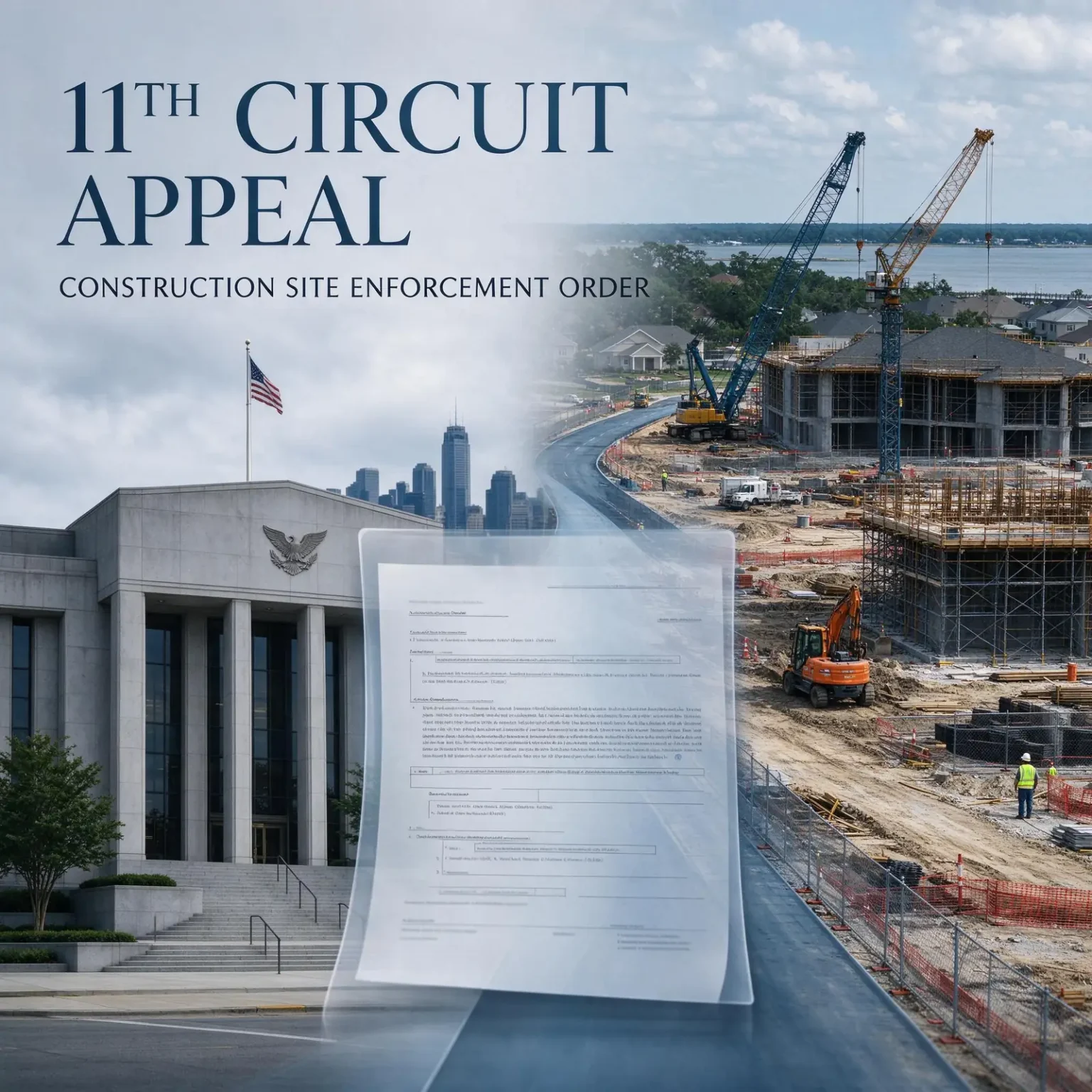
MOBILE, Ala. — The federal government is taking its fight over immigration enforcement at Baldwin County construction sites to the 11th U.S. Circuit Court of Appeals. Federal prosecutors in Mobile have notified the U.S. District Court that they will ask the Atlanta-based appeals court to throw out a ruling that halted three immigration enforcement policies, along with an earlier decision that allowed the underlying civil rights lawsuit to go forward.
The appeal follows a decision last week in which the district court refused the government’s request to spell out more precisely which policies it had found likely unconstitutional and who exactly is covered by the lawsuit.
Where the Case Stands Now
- The lawsuit: A U.S.-born construction worker from Baldwin County sued federal officials, including border czar Tom Homan, last year over his treatment during immigration raids at two job sites.
- The ruling being appealed: A federal judge in Mobile found that Immigration and Customs Enforcement had likely adopted unconstitutional policies and, in September, temporarily stayed three of them.
- Class action status: The court conditionally agreed to let the case proceed as a class action on behalf of others in similar circumstances.
- Last week: The judge denied the government’s motion asking the court to clarify the scope of the ruling.
- Next: The government will appeal to the 11th Circuit, challenging both the stay and the court’s earlier refusal to dismiss the case.
The Government’s Objections
The U.S. Attorney’s Office has made three core arguments in its recent filings.
1. A stay that works like an injunction
When the court acted in September, it stopped short of entering a formal preliminary injunction. Instead, the judge temporarily stayed the three challenged policies, a step the court described as a milder remedy than an injunction. Government lawyers contend that the distinction is one of label rather than substance. In their view, the order operates as an injunction in practice because it directs federal officers to stop enforcing the policies.
2. Unclear boundaries
Government attorneys told the court that because the scope of the order is open-ended, the United States cannot adequately protect itself against a possible contempt motion in the future. They said that without precise terms, the government is unable to determine what the order requires, give clear instructions to agents in the field, or fully evaluate the ruling’s effects for purposes of an appeal. The filing pointed specifically to the question of when agents are allowed to enter construction sites, arguing that the order leaves that unanswered.
The government said it still objects to any form of preliminary relief in the case, but asked the court, at a minimum, to define the limits of its ruling. The court declined to do so.
3. Policies that do not exist
Beyond the dispute over scope, the government has maintained throughout the case that the policies identified in the lawsuit do not exist at all. That position goes to the heart of the case, since the court cannot halt a policy that the government says was never adopted, and it is likely to be a central theme of the appeal.
What the Worker Alleges
The man at the center of the case was born in the United States and was working construction in Baldwin County when immigration agents carried out two raids at job sites where he was employed. According to his lawsuit, agents detained him without lawful justification and would not accept the STAR ID he presented to establish who he was.
The STAR ID is Alabama’s version of a REAL ID-compliant driver’s license or identification card. To get one, applicants must present documents proving identity, lawful status, Social Security number and residency, which is why the refusal to accept it is a key part of the worker’s claims.
The lawsuit names Homan and other federal officials as defendants and argues that the actions taken against the worker violated his constitutional rights. The court’s conditional certification of a class means the case may ultimately address the rights of a broader group of people affected by the same practices, not only the original plaintiff.
How the Appeal Could Unfold
The 11th Circuit hears federal appeals from Alabama, Florida and Georgia, and its rulings set binding precedent for federal courts throughout those three states. A decision in this case could therefore shape how immigration enforcement challenges are handled across a large part of the Southeast.
The government is asking the appeals court to review two separate rulings: the September stay and the district court’s earlier refusal to throw the lawsuit out. Appeals courts ordinarily review decisions that grant or deny preliminary relief more readily than other mid-case rulings, so one question the 11th Circuit may need to address is how much of the case is ready for review at this stage. The government’s characterization of the stay as a de facto injunction is relevant to that question.
While the appeal is pending, the district court’s stay remains in place unless a court orders otherwise. The government could also ask for the stay to be paused during the appeal.
Why the Case Matters Locally
Construction has been one of the busiest industries in Baldwin County as the region continues to grow, with residential, commercial and infrastructure projects underway across the Eastern Shore and south Baldwin. Construction crews often include workers of many backgrounds, and immigration enforcement actions at job sites can affect not only those who are detained but also employers, project timelines and fellow workers.
The worker’s claims raise a question that resonates beyond immigration status: what happens when a U.S. citizen carrying state-issued identification is detained during an enforcement operation. The outcome of the case could influence how agents verify identity during worksite operations and what limits courts place on enforcement tactics.
For the federal government, the stakes involve its ability to carry out immigration enforcement in ways it considers lawful without the risk of being held in contempt for violating an order it argues is unclear.
Key Legal Terms in the Case
Class action: A lawsuit in which one or more people sue on behalf of a larger group with similar claims. A court must certify the class before the case can proceed on the group’s behalf. Here, the court has granted certification on a conditional basis, meaning the details of who belongs to the class may still be refined.
Preliminary injunction: A court order issued before a case is decided that requires a party to do something or to stop doing something. Courts weigh factors such as the likelihood that the plaintiff will win and whether irreparable harm would occur without the order.
Stay: In this context, an order that temporarily pauses a policy or action from taking effect. The judge chose this route rather than an injunction, while the government argues the practical effect is the same.
Contempt: A finding that a party has disobeyed a court order. Contempt can carry penalties, which is why the government says it needs clear guidance on what the order requires of agents.
Motion to dismiss: A request asking a court to throw out a lawsuit, often on the grounds that the claims fail as a matter of law. The district court previously denied the government’s motion, allowing the case to proceed, and that ruling is also part of the planned appeal.
What Comes Next
Once the government formally files its notice of appeal, the 11th Circuit will set a briefing schedule. Both sides will submit written arguments, and the court may schedule oral arguments before issuing a decision. That process typically takes months.
In the meantime, proceedings in the district court in Mobile could continue on other aspects of the case, including issues related to the conditionally certified class, unless the court decides to put them on hold while the appeal is resolved.