Triangle and Acute, Two Rehabilitated Loggerheads, Return to the Gulf at Dauphin Island
Two loggerhead sea turtles accidentally hooked by fishermen were released at Dauphin Island after months of care at the Mississippi Aquarium in Gulfport.
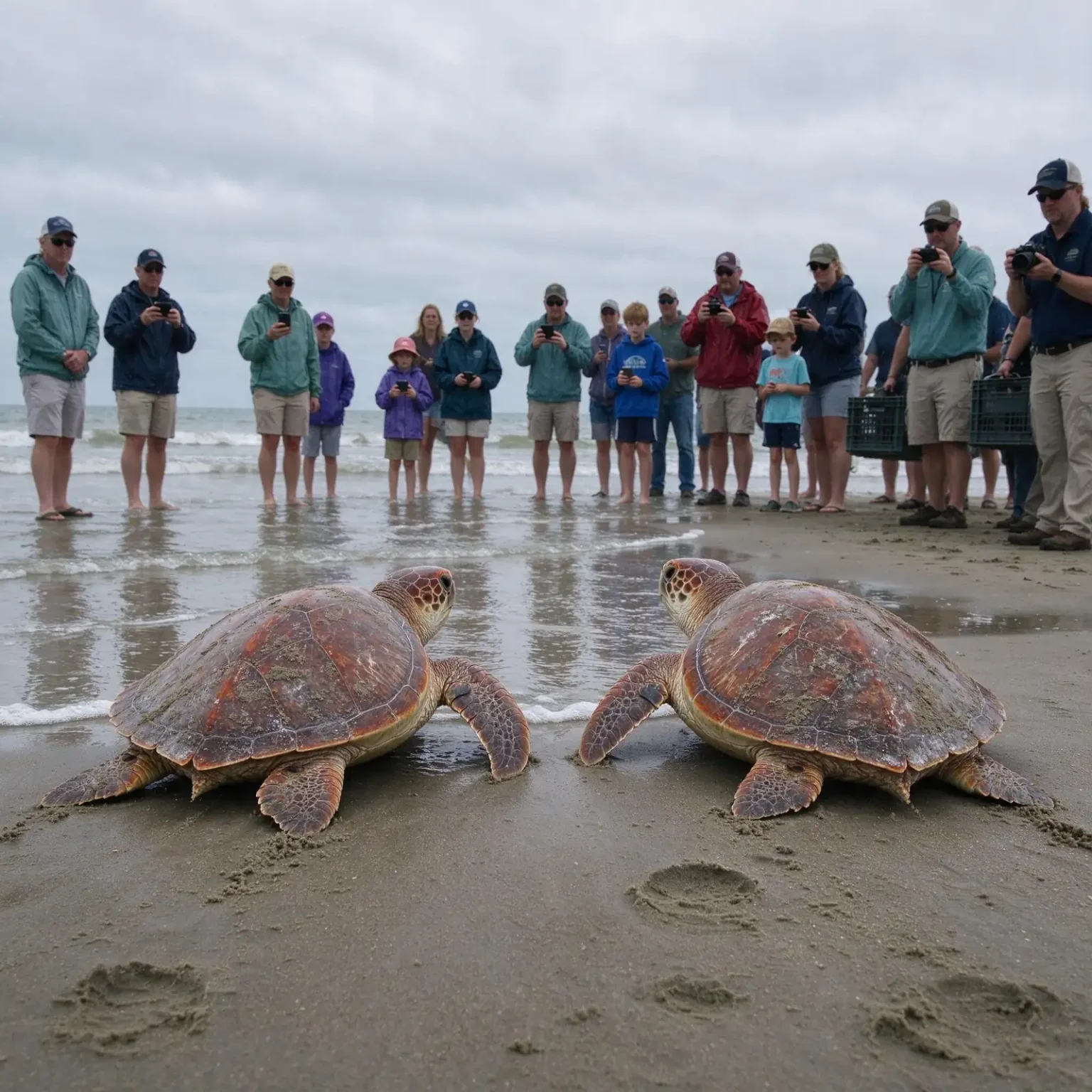
DAUPHIN ISLAND, Ala. — A pair of loggerhead sea turtles named Triangle and Acute are back in the wild after months of rehabilitation, swimming off into the Gulf from Dauphin Island on Tuesday afternoon, Nov. 24, as onlookers cheered from the beach under a gray sky.
Both turtles had been brought in for care after fishermen caught them by accident. They spent months recovering at the Mississippi Aquarium in Gulfport before staff judged them healthy enough to return to open water. The release was carried out with Alabama’s sea turtle stranding network, which responds to sick, injured and entangled turtles along the state’s coast.
A send-off on the island
Overcast weather did not keep people away. Several island residents gathered to watch and cheer as the turtles headed into the surf.
Aquarium staff said a crowd at a release is a chance to teach. A representative explained that public events like this one let the aquarium share its rehabilitation work and highlight the importance of cooperation between the Gulfport facility and its partners in Alabama. Visitors also learned about the different species of sea turtles found in Alabama, Mississippi and other parts of the Gulf, and what they can do to protect them.
How fishing and turtles cross paths
Accidental hooking is one of the most common reasons sea turtles end up in rehabilitation along the northern Gulf Coast. Turtles are drawn to bait on hooks, especially near piers and jetties, and they can swallow hooks or become tangled in fishing line. A hooked turtle may need X-rays, hook removal, treatment for infection and time to regain strength before it can be safely released.
Aquarium staff urged anglers to try not to hook sea turtles and, if one is caught, to contact authorities instead of handling the situation alone. General guidance from wildlife agencies is to avoid cutting the line, since trailing line can wrap around flippers or be swallowed, and to keep the turtle calm and secure until help arrives. Simple steps such as moving to another spot when turtles are seen nearby and avoiding casting toward them can prevent many encounters.
Trash is a threat too
Litter is another danger. Sea turtles can mistake plastic bags, balloons and other floating debris for food, and eating trash can block their digestive systems or leave them unable to dive and feed normally. Aquarium staff asked boaters not to toss trash overboard and asked beachgoers to pick up their litter before leaving, since items left on the sand can easily wash into the water.
Ways to help sea turtles
- Fish responsibly and report any hooked or entangled sea turtle right away.
- Never throw trash into the water; secure loose items on boats.
- Pick up litter on the beach, including fishing line, bags and balloons.
- Volunteer with the aquarium or the stranding network.
- Call the hotline if you see a turtle in distress.
Who to call
Anyone who spots a sea turtle that is injured, sick, stranded or tangled should call 1-866-SEA-TURTLE. The Sea Turtle Stranding and Salvage Network will either give instructions over the phone or send a responder to help. When needed, the turtle is transported to a rehabilitation center for treatment.
The Sea Turtle Stranding and Salvage Network is a cooperative program coordinated by NOAA Fisheries that brings together federal, state, academic and nonprofit partners to document and respond to stranded turtles along the Atlantic and Gulf coasts. Data gathered from strandings help scientists track threats such as fishing interactions, boat strikes, cold stunning and disease.
Volunteer opportunities
The aquarium representative noted that people interested in hands-on involvement can volunteer with the Mississippi Aquarium or with the stranding network team in Alabama. Volunteers often help with tasks such as beach monitoring, education and support for animal care.
In Alabama, volunteers have long played a big role in sea turtle conservation. During nesting season, which runs through the summer and early fall, volunteers walk beaches each morning looking for tracks and nests, mark and protect nests, and watch over hatchlings as they emerge.
About loggerhead sea turtles
Loggerheads take their name from their large heads, which house strong jaws suited to crushing hard-shelled prey such as crabs, whelks and other shellfish. Adults have reddish-brown shells and can weigh a few hundred pounds.
The loggerhead is the sea turtle species that most often nests on Alabama’s beaches, from Dauphin Island to Fort Morgan, Gulf Shores and Orange Beach. Females come ashore at night to dig nests and lay eggs, and hatchlings emerge roughly two months later to make their way to the water. The population that nests in the northwest Atlantic and Gulf is listed as threatened under the federal Endangered Species Act, which means it is protected by law; harming or harassing sea turtles, their nests or their eggs is prohibited.
Loggerheads are long-lived and slow to mature, often taking decades to reach breeding age. That makes the survival of each adult and older juvenile especially important to the long-term health of the population, and it is one reason rehabilitation and release efforts like this one matter.
About the Mississippi Aquarium
The Mississippi Aquarium opened in Gulfport in 2020 and features exhibits on the waters and wildlife of the Gulf and Mississippi’s rivers. Along with its public displays, it treats and rehabilitates marine animals, including sea turtles, and works with stranding and conservation partners across the region to return animals to the wild when possible.
Dauphin Island’s role
Dauphin Island, a barrier island at the mouth of Mobile Bay, offers direct access to Gulf waters, making it a practical spot for releases. The island’s beaches also host sea turtle nests each summer, and its location along the coast makes it a frequent site for strandings, rescues and returns. For the turtles called Triangle and Acute, it marked the end of a long recovery and the start of their return to life in the Gulf.