Bayou La Batre Public Harbor Passes Halfway Mark in $24.4 Million Rebuild Set for 2027
Mobile County's $24.4 million overhaul of the Bayou La Batre public harbor, with a 100-slip marina, seafood sales dock and pavilions, is past its midpoint and targeted for August 2027.
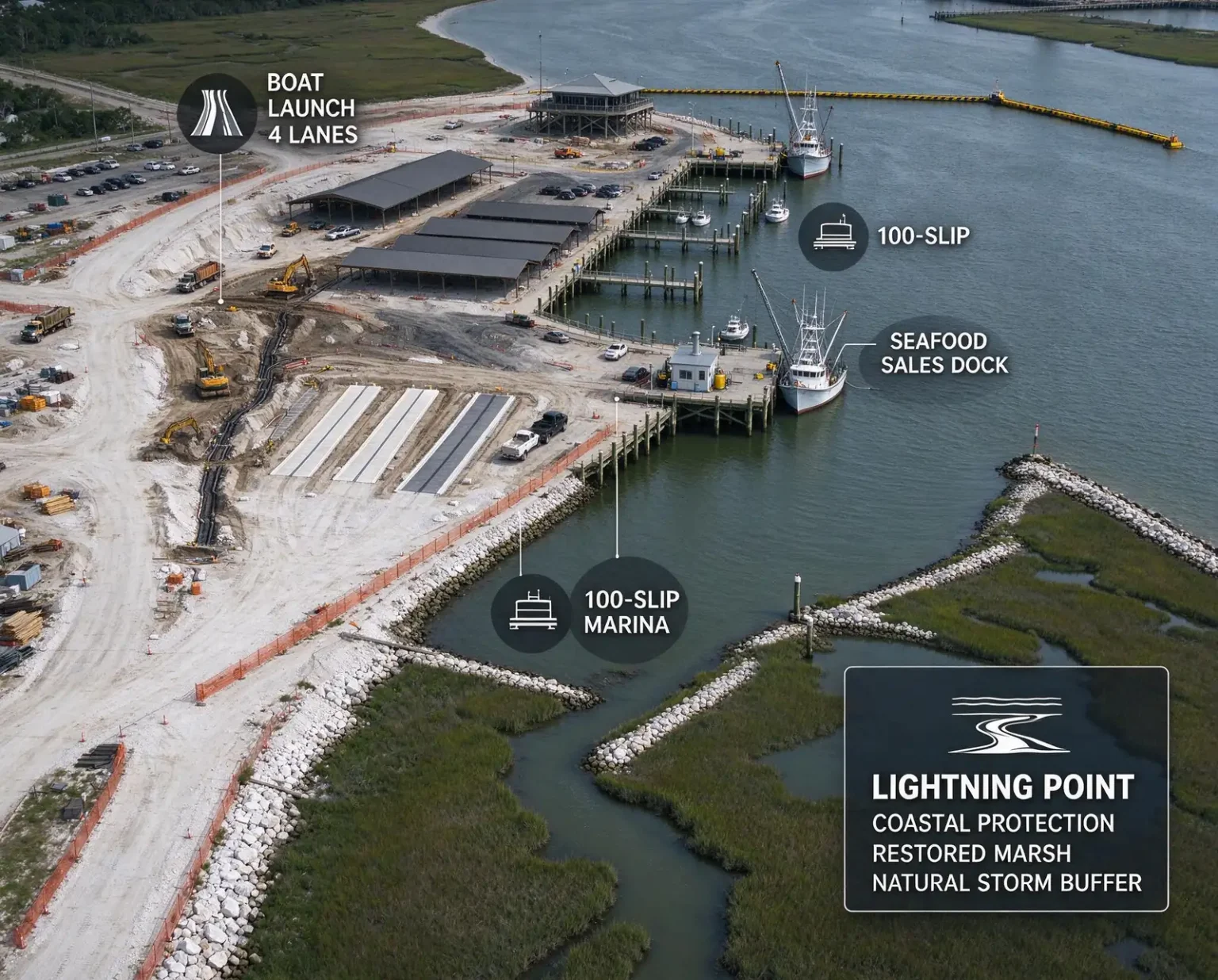
BAYOU LA BATRE, Ala. — Mobile County expects to finish a $24.4 million rebuild of the Bayou La Batre public harbor near the mouth of the bayou in August 2027, and local officials say construction has now moved past its midpoint. The overhaul will turn a once-neglected launch site into a waterfront complex with a 100-slip marina, a four-lane boat ramp, a seafood sales dock and open-air pavilions for markets and community gatherings.
The work is also tied to a second, earlier investment just to the south: the restored marsh at Lightning Point, a roughly $22 million coastal protection project that gave the harbor a natural shield against storm waves. Without that buffer, the site might not have been worth rebuilding at all.
What the finished harbor will include
Design plans for the Bayou La Batre public harbor call for the following features:
- A new boat launch with four lanes
- Parking for 100 vehicles with boat trailers, plus 240 spaces for cars and other passenger vehicles
- A marina with 100 boat slips
- A fixed dock set aside for selling seafood directly from fishing vessels
- A fueling station for boats
- Covered, open-air pavilions totaling about 9,000 square feet
- An elevated building that will house the marina office
- Green space intended for public events
County officials have said the pavilions are meant to host market days, where vendors could sell goods and commercial fishermen could sell their catch, and to serve generally as a public gathering spot at the city docks.
Where construction stands
Ben M. Radcliff Contractors is the general contractor on the job. The engineering firm Moffatt & Nichol is handling construction engineering and inspection. A Mobile County environmental services official said the project is on track to meet its contractual completion date of August 2027 and that the working relationship with the contractor has been good. The city’s mayor has said he believes the work could wrap up ahead of that deadline.
For now, the access road leading to the harbor is closed to most traffic, and a floating boom stretches across the harbor entrance. Boaters passing by on the bayou can see the pavilion roofs already standing, the marina office building rising on its supports toward the back of the property, and heavy equipment grading land that will become paved parking for ramp users and visitors.
Officials formally broke ground in September 2025. Because the site sits at the far southern end of the bayou, away from main roads, the project has drawn relatively little public attention in the months since.
Clearing away the casino barges
Before construction began, the harbor offered little beyond a few rough boat ramps. Two retired casino barges, built to resemble riverboats, had been moored along one side of the basin. Both have since been removed. One was sunk in the Gulf off the Alabama coast to become part of the state’s artificial reef system, and the other was relocated to a less prominent spot nearby.
Alabama maintains one of the largest artificial reef programs in the country, and the state’s conservation department regularly deploys retired vessels, concrete structures and other approved materials offshore to create habitat for reef fish such as red snapper.
Who will run it
The city has not yet decided how the harbor will be operated once it opens. The mayor has said Bayou La Batre is weighing whether to manage the facility directly or bring in an outside group, and that he sees the harbor as a source of revenue for the city.
He has also said he does not expect the tourist-oriented development to push out the shrimp fleet or shipyards that define the local economy. He pointed out that the bayou once supported two marinas without harming either industry, and that visitors from other parts of the country already stop to photograph large shrimp trawlers hauled out of the water for repairs at local yards.
At the September 2025 groundbreaking, state and local leaders described the harbor as a way to preserve and display the town’s maritime heritage. The state’s conservation commissioner at the time said the site would expand public access to the water while linking residents and visitors more directly to the seafood industry through dockside sales. The mayor said the idea of improving the harbor reached back decades, to discussions between a former Bayou La Batre mayor and then-Gov. George Wallace.
The marsh that made the harbor possible
A ridge topped with a line of trees runs along the south side of the harbor. After Hurricane Nate came ashore near the mouth of the Mississippi River in October 2017, very little land remained on the far side of that ridge. Had another storm struck at the right angle, its waves could have eroded the ridge away, leaving the harbor open to Portersville Bay and effectively erasing it from the shoreline.
The answer was the Lightning Point restoration project, which rebuilt a broad band of tidal marsh between the harbor and open water. The Nature Conservancy began acquiring property in the area in 2015. Partners in the effort included the National Fish and Wildlife Foundation, the City of Bayou La Batre, Alabama Power, Mobile County, the Mobile Bay National Estuary Program and the Alabama Department of Conservation and Natural Resources.
Cost and funding
The restoration was carried out in phases. Land acquisition cost $6 million, and constructing the marsh cost another $16 million. Most of the money came through the National Fish and Wildlife Foundation’s Gulf Environmental Benefit Fund, which was established to receive money from the criminal settlements that followed the 2010 Deepwater Horizon oil spill.
Results so far
When Phase II was dedicated in 2022, the site included about 40 acres of new marsh protected by segmented rock breakwaters. The structures had already been tested: they withstood four named storms during the 2020 hurricane season.
The marsh functions as a living system rather than a simple berm. Gaps in the breakwaters open into sheltered pools that researchers have used for oyster-related experiments, and tidal creeks carry water through the marsh, supporting fish, shellfish and birds.
The gaps were also positioned to trap sediment that moves along the shore from east to west. Shrimpers and shipbuilders had long struggled with the navigation channel filling in, which at times made it hard to move boats in and out. At their request, the design included jetties, a feature the conservation group would not typically build. A Nature Conservancy official said the channel has needed dredging only once since the project went in, and that the group now hopes future dredged material will be placed in the marsh to build it up further.
Planning for rising water
Parts of the Alabama coast are subsiding while sea levels continue to rise, so the restoration was designed with future upgrades in mind. The Nature Conservancy official said the group has already discussed with the mayor adding another course of rock to the breakwaters once water levels begin to overtop them. The goal would be to extend the project’s life by about 20 years for $1 million to $2 million, a fraction of the original construction cost.
The official also said Lightning Point has served as a model for the organization’s other restoration work along the Alabama shoreline and on barrier islands, showing that erosion can be reversed and that well-designed projects can sustain themselves over time.
How these coastal projects are structured
Projects like Lightning Point typically involve several layers of government and private landowners. The Nature Conservancy negotiates many of the land purchases and often transfers the property afterward to a county or another public agency. When Deepwater Horizon settlement money is involved, a city or county government usually handles bidding and construction oversight. The group has said it consulted the mayor, county officials, fishermen and shipbuilders while designing Lightning Point and incorporated their requests.
A gateway to western wetlands
The new harbor sits on the east side of the bayou, the more developed bank. To the west lie miles of undeveloped coastal wetlands. With help from The Nature Conservancy, the Alabama State Lands Division holds more than 5,000 acres of that landscape in its Grand Bay Savannah Complex, which is expected to draw kayakers and paddlers launching from the harbor once it opens.
About Bayou La Batre
Bayou La Batre is a small city in southern Mobile County, about 25 miles southwest of downtown Mobile, where the bayou of the same name empties into Portersville Bay and, beyond it, the Mississippi Sound. The city has long been known as Alabama’s seafood capital, home to shrimp and oyster fleets, seafood processors and shipyards that build and repair commercial vessels, including workboats, ferries and offshore supply boats.
The community’s low-lying location has made it vulnerable to tropical storms throughout its history. Hurricane Katrina pushed a major storm surge into the city in 2005, and smaller storms regularly cause flooding along the waterfront. That exposure is a large part of why protective projects such as Lightning Point are viewed as a precondition for public investments along the shore.
Why living shorelines matter
Coastal engineers and conservation groups increasingly favor what are known as living shorelines: designs that combine natural features such as marsh grasses and oyster habitat with structures like rock breakwaters. Compared with seawalls and bulkheads, these designs can absorb wave energy, trap sediment, filter water and provide habitat while still protecting land behind them. Healthy marshes can also build elevation over time as they collect sediment, which helps them keep pace with gradual sea-level rise.
Along the northern Gulf Coast, money from the Deepwater Horizon settlements has paid for many such projects. In addition to the National Fish and Wildlife Foundation fund, other channels include the federal RESTORE Act and the Natural Resource Damage Assessment process, which together direct billions of dollars toward environmental and economic recovery in the five Gulf states.
What comes next
Work on the harbor will continue through the winter and into 2027, with paving, utility work, marina construction and finishing on the pavilions and office building still ahead. The contractual target for completion is August 2027. Before opening, Bayou La Batre will need to settle how the harbor will be managed, including who will oversee the marina slips, the fuel station and the seafood sales dock.
Once complete, the harbor will give recreational boaters a modern launch on the bayou, give commercial fishermen a public place to sell directly to customers and give the city a new venue for markets and festivals, all protected by a restored marsh that has already weathered several storms.