Two-Thirds of the Argosy VI’s Roof Has Collapsed, and Tropical Storm Bertha Is the Likely Cause
A Marine Resources dive team confirmed the damage on the artificial reef sunk in July. Officials say the vessel is still upright at depth — and that the collapse may improve fish habitat.
ORANGE BEACH — Scuba instructor Lila Harris’ first trip to dive the Argosy VI came on July 5, four days after the successful sinking of the 408-foot, three-story ship as an artificial reef 23 nautical miles out into the Gulf.
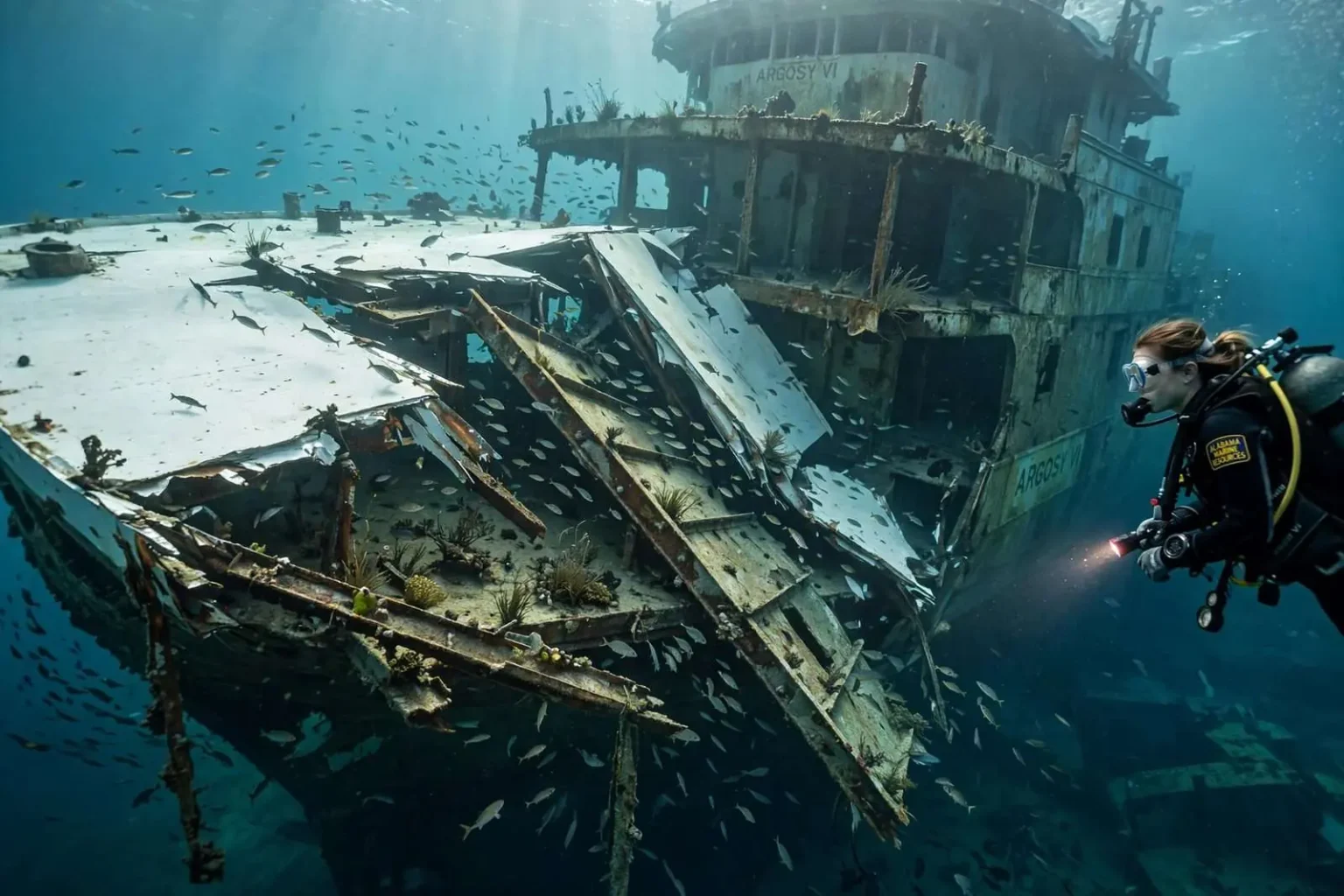
Her second trip was five weeks later, on Aug. 11. She thought she knew what to expect. As she submerged and got closer to what should have been the roof of the vessel, what she saw did not make sense.
“I was just really confused because I was expecting it to have that white flat top… this is definitely different, and to me it reminded me of a sinkhole,” she said. “The top or the roof, whatever you want to call it, had just pulled away from the supporting structures.”
What the Dive Team Found
Last week, a dive team with the Alabama Department of Conservation Marine Resources Division confirmed that approximately two-thirds of the Argosy’s roof has collapsed.
The damage was likely caused by the added pressure of up to 15-foot wave activity from Tropical Storm Bertha, according to MRD Director Kevin Anson — though he said degradation like this is inevitable over time.
“It was not expected that damage would occur this soon,” he said, “but we did expect that over time that the vessel would experience that kind of deterioration.”
Depth and Clearance Are Unchanged
The dive team confirmed there was no change to the Argosy’s depth. The vessel sits in about 120 feet of water, and the top must remain at least 50 feet below the surface to maintain navigational clearance for vessels passing overhead.
“There’s still some roof there, and it’s still about 65-foot depth, the portion of the roof that is still intact,” Anson said. “We have plenty of distance there.”
That margin — 65 feet against a 50-foot requirement — is the number that determines whether the site remains permitted as is. The vessel is also still sitting upright and in the same position.
How the Argosy Got There
The former Indiana casino riverboat was originally towed to Alabama by Orange Beach developer Larry Wireman, who bought it planning to transform it into a hotel and restaurant.
After several roadblocks derailed those plans, Wireman made a deal to sell it to the state. As part of that deal, he was responsible for remediation, working with Orange Beach-based Walter Marine to strip the boat of hazardous materials and prepare it to be sunk.
The Engineering of a Controlled Sinking
To retain the reef’s verticality, the state wanted to sink the stern first, having the vessel settle on its keel and remain upright.
Walter Marine, which has built and deployed thousands of artificial reefs, installed plugs throughout the bottom of the vessel that, once manually pulled at the site, allowed controlled flooding. Vents cut throughout the ship let air escape at the right pace, controlling the speed and angle of the descent.
“Sinking vessels in a controlled manner, it takes a lot of engineering behind it,” MRD biologist Craig Newton said the day after the sinking. “The contractors did a great job.”
The Damage May Actually Help
One of the main goals of the $2.5 million project — funded through the Gulf of Mexico Energy Security Act, which distributes oil and natural gas lease revenue to five Gulf states — was to encourage marine life diversity. Anson said the collapse could aid that at the top of the reef.
“The roof, as it collapsed, in certain areas it has kind of folded over or fallen down at an angle,” he said, “and that actually makes the reef more complex and creates a better habitat for fish rather than just a flat roof.”
The principle is well established in reef ecology. Structural complexity — overhangs, crevices, varied angles — provides shelter at different scales for different species and sizes of fish. A flat surface provides almost none.
‘It Is Always a Diver’s Risk’
During her Aug. 11 trip, Harris — diving with other instructors from along the Gulf Coast as a kind of training for the public dive site — saw a marked increase in marine life from her first visit five weeks earlier.
“I’m looking at the safety [for divers], but I’m looking also at the amazing amount of fish that now had moved in,” she said. “From the outside moving in it, and the inside moving out. They’re just swirling everywhere. That was really cool because that’s a big part of what they prepare these sites for.”
How Officials Pinpointed the Timing
Harris’ trips are largely for recreation and education, but her documentation of the Argosy before and after Tropical Storm Bertha — along with footage from other divers — helped Anson and his team establish when the damage occurred.
“We’ve also received some additional videos taken by other divers at different times — shortly after deployment and then all the way up to a couple of weeks before we actually dove,” he said. “Between those videos, earlier videos, we were able to discern that, again, the damage appeared mostly after the tropical storm.”
Recreational divers effectively functioned as a monitoring network for a site the state had no schedule to inspect.
Diving the Site Safely
Even before any damage, diving a site like the Argosy requires training. With an Advanced Open Water Diver certification, exploring on top of or around a ship of this size is relatively straightforward. Move inside, though, and it gets dark fast, making disorientation easy.
The ship was prepared with open navigation for divers in mind, but as the structure continues to deteriorate, paths could become altered or blocked. The MRD dive team noted no other current internal damage.
Anson said responsibility rests with divers and dive operators. “There’s no guarantees provided or warranties provided with the wreck from us,” he said. “It is always a diver’s risk, diver beware type situation. They need to make the best judgment as to how safe the vessel is.”
Harris, a 27-year veteran with nearly 7,900 dives, said she never felt unsafe on her most recent trip but would not take the site for granted.
“I don’t think the damage is a hazard at this point,” she said. “Will it become a hazard? It will. Anybody that goes inside of a wreck should have a wreck specialty.”
Monitoring Going Forward
According to Anson, there was no set schedule for MRD to monitor the Argosy site before Bertha, and there will not be one going forward. His team will, however, continue to plan dives following any future storms.