Mobile River Bridge Contamination: Lead, Arsenic and PCBs Found at Former Shipyard Site
An environmental assessment found widespread lead, arsenic, cadmium, mercury and PCB contamination at the former Bender Shipbuilding property on the bridge's western approach. ADEM is taking written comments through Nov. 13.
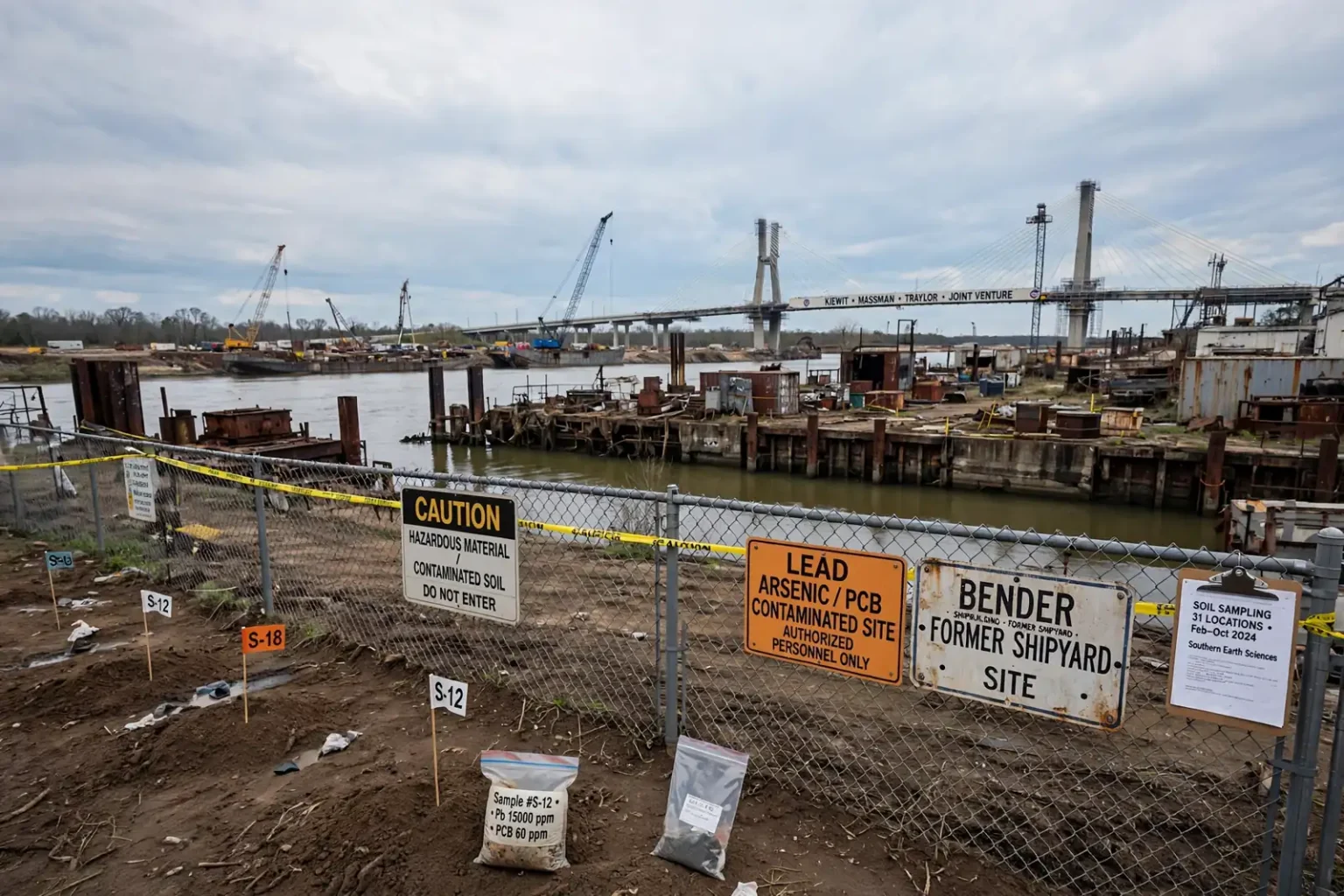
MOBILE, Ala. — Soil at a former shipyard on the west bank of the Mobile River, where crews are preparing to build the western approach to the new Interstate 10 crossing, is laced with lead, arsenic, cadmium, mercury and PCBs, according to an environmental assessment tied to the project. The Mobile River Bridge contamination findings come with a warning that construction workers, and eventually people using public green space planned near the bridge, could be exposed if the property is not properly cleaned up.
The Alabama Department of Transportation has submitted a cleanup plan for the former Bender Shipbuilding property, and the Alabama Department of Environmental Management has found the plan technically adequate. But the documents released as part of ADEM’s review do not say how much the cleanup will cost, how much soil must be dug up and hauled away, or whether the work could affect the bridge construction schedule.
What the environmental assessment found
The assessment was prepared by Southern Earth Sciences for Kiewit Engineering Group and examined two former Bender Shipbuilding parcels near the western bank of the river. The site was historically used for shipbuilding and vessel repairs, and the report directly identifies it as part of the Mobile River Bridge and Approaches project.
Between February and October 2024, consultants collected soil samples from 31 locations and groundwater samples from 11 temporary monitoring wells. Their key findings:
- Lead: Up to 15,000 parts per million in surface soil, or 75 times the EPA residential screening level of 200 parts per million used in the report.
- Arsenic: As high as 71 parts per million in subsurface soil.
- Cadmium: Up to 130 parts per million.
- PCBs: Up to 60 parts per million in subsurface soil.
- Mercury: Up to 6.9 parts per million in surface soil.
Several contaminants exceeded federal screening levels for both residential and industrial properties. Consultants also concluded that about 90% of the property’s surface area could present exposure concerns for construction workers who disturb the soil, and that calculated risks exceeded acceptable targets for residential, commercial and construction-worker exposure scenarios.
The report does not identify a specific source of the contamination.
Why the numbers matter
Screening levels are conservative benchmarks the U.S. Environmental Protection Agency publishes to help decide whether contamination at a site deserves a closer look. A reading above a screening level does not by itself mean people are being harmed, but it signals that exposure should be evaluated and, often, controlled.
The metals and chemicals found at the site are ones regulators watch closely. Lead is especially dangerous for young children, whose developing brains and nervous systems are vulnerable even at low levels of exposure; public health agencies say there is no known safe blood lead level in children. Arsenic, cadmium and mercury are toxic metals, and PCBs, or polychlorinated biphenyls, are industrial chemicals that were banned from manufacture in the United States in the late 1970s but persist in soil for decades. The report notes that PCBs are associated with potential long-term health risks.
Contamination of this kind is common at older industrial waterfront sites, where paints, fuels, solvents, metal work and electrical equipment were used for many years before modern environmental rules.
Concerns about future green space
The assessment raises particular concern about the possibility that parts of the property could become public green space once the bridge and its approaches are finished. Because children could eventually have access to those areas, the consultants evaluated potential exposure using residential standards, the strictest category.
The report warns that lead and other contaminants in surface soil could pose risks to children through direct contact or by breathing in contaminated dust.
What cleanup could involve
The report recommends that ALDOT and its contractors work with ADEM to decide what additional steps are needed to protect workers and the public. Options it lists include:
- Removing contaminated soil
- Covering contaminated areas with protective barriers
- Controlling dust during construction
- Restricting access to certain portions of the property
Consultants also recommend testing excavated soil to determine whether it must be handled and disposed of under hazardous-waste regulations, which carry stricter and typically more expensive requirements for transport and disposal.
Groundwater contamination was less significant than the soil contamination, according to the report. ADEM indicated the groundwater findings did not appear to require an individual discharge permit for construction-related dewatering, the routine pumping of water out of excavations.
How ADEM’s review works
ADEM is reviewing the proposed cleanup under Alabama’s Voluntary Cleanup Program, which allows property owners and other applicants to address contaminated sites through an approved remediation process rather than through an enforcement action. Under such programs, an applicant investigates a site, proposes a cleanup plan, and carries it out under state oversight, with the state confirming the work meets agreed standards.
The agency’s fact sheet says the proposed cleanup plan has been found technically adequate, but a final decision is still part of the review process. The fact sheet lists Nov. 13, 2026, as the deadline for written public comments, although it also references an earlier comment period that ended Aug. 25.
- What: Public comment on ALDOT’s proposed cleanup of the former Bender Shipbuilding property
- Agency: Alabama Department of Environmental Management, Voluntary Cleanup Program
- Comment deadline listed: Nov. 13, 2026, in writing
The bridge project behind the cleanup
The Mobile River Bridge is intended to carry Interstate 10 across the Mobile River, giving drivers an alternative to the George C. Wallace Tunnel and relieving congestion on one of the Gulf Coast’s busiest corridors. Officials ceremonially broke ground on the project on Oct. 2 at Cooper Riverside Park in downtown Mobile.
ALDOT issued a notice to proceed on Sept. 25 to the design-build team of Kiewit Massman Traylor, a joint venture of Kiewit, Massman Construction Co. and Traylor Bros. Inc. The first phase, which state officials have put at $3.2 billion, includes a six-lane, cable-stayed bridge rising 215 feet above the river and a connection to the existing Bayway across Mobile Bay. Construction is expected to take about five years, with the new bridge projected to open in late 2031. Tolls will be collected electronically once it opens, while the Causeway, the tunnels and the existing bridges remain free.
Gov. Kay Ivey said at the groundbreaking that the current crossing was built to handle 35,000 vehicles a day but now sees as many as 95,000 at its peak.
Questions still unanswered
The environmental findings add a new layer to the work required to prepare the bridge’s western approach. Based on the documents released so far, it is not yet known:
- How much the cleanup will cost, and whether taxpayers or project contractors will bear that cost
- How much contaminated soil will have to be excavated, and where it will be taken
- Whether cleanup activities could affect the construction schedule
- What caused the contamination
Residents who want to weigh in on the cleanup plan can submit written comments to ADEM before the Nov. 13 deadline listed in the agency’s fact sheet.