St. Louis Encephalitis, West Nile Found in Mobile County Sentinel Chickens in Theodore and Wilmer Areas
Sentinel chickens in the Theodore and Wilmer areas tested positive for West Nile virus, and one Wilmer-area bird tested positive for St. Louis encephalitis, prompting more mosquito spraying in Mobile County.
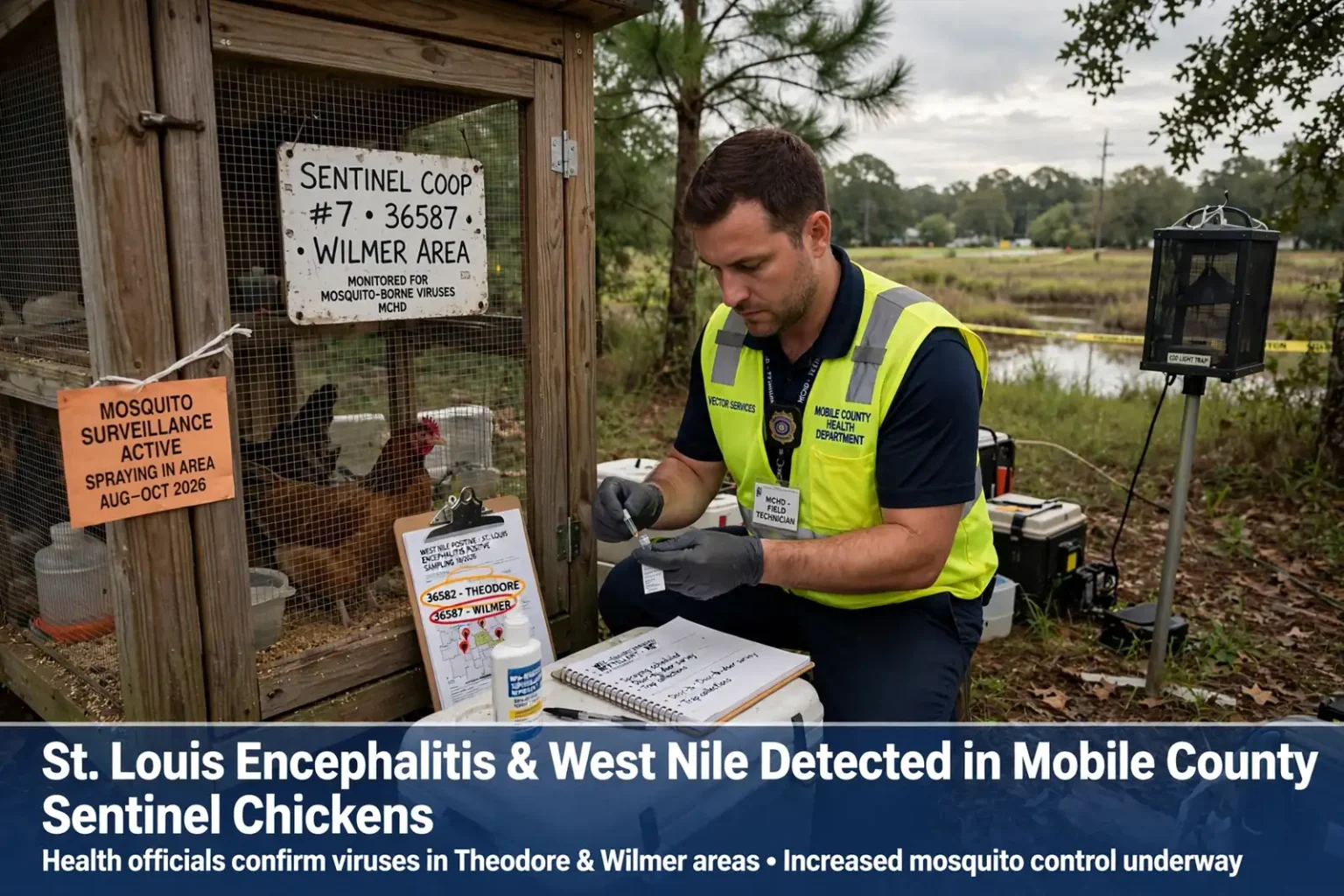
MOBILE, Ala. — Sentinel chickens in west and south Mobile County have tested positive for West Nile virus, and one bird has also tested positive for St. Louis encephalitis, confirming that both mosquito-borne viruses are circulating in the county, the Mobile County Health Department said this week.
Laboratory results confirmed West Nile virus in sentinel chickens at coops in the 36582 and 36587 ZIP code areas, according to Dr. Kevin Michaels, health officer for Mobile County. A chicken in the 36587 area also tested positive for St. Louis encephalitis. The 36582 ZIP code covers the Theodore area, and 36587 covers the Wilmer area in west Mobile County.
“These viruses are present in our county, and this detection is an important reminder for residents to protect themselves from mosquito bites,” Michaels said. “Vector Services will increase mosquito-control activity in and around these areas, continue monitoring our sentinel chicken flocks, and work to identify mosquito populations that may be carrying these viruses.”
What the health department is doing
The health department’s Vector Services program said it will respond in the affected areas with:
- Additional spraying to reduce adult mosquito populations
- Door-to-door surveys in nearby neighborhoods
- Trapping adult mosquitoes and testing them for West Nile virus and St. Louis encephalitis
Each step has a different purpose. Spraying targets mosquitoes that are already flying and able to spread disease. Door-to-door surveys help crews find breeding sites and talk with residents about standing water. Trapping and testing mosquitoes shows whether infected insects are present and in what numbers, helping crews decide where to focus next.
The new detections come as Vector Services was already stepping up spraying after Hurricane Isaias. The health department said over the weekend that morning, evening and weekend spraying would continue, weather permitting, until nuisance mosquito levels come down. Heavy rain and flooding from the storm left standing water in ditches, low spots, gutters and debris across the area, conditions in which mosquito populations can grow quickly. Read the health department’s post-storm mosquito advice.
A season of detections
This is not the first West Nile activity of the year in Mobile County, but the St. Louis encephalitis result adds a second virus to the picture. Earlier this month, the health department confirmed the county’s second human West Nile virus case of 2026 and reported four positive chickens in the 36521, 36587 and 36613 ZIP code areas.
Before that, positive sentinel chickens had turned up in ZIP codes including 36509, 36575, 36582, 36587, 36605 and 36613, showing the virus has been active in several parts of the county rather than confined to one neighborhood. The Wilmer area, 36587, has now recorded positives repeatedly this season.
Protect yourself from mosquitoes
The health department urges residents, especially those who spend time outdoors, to take these precautions:
- Use an insect repellent registered with the U.S. Environmental Protection Agency that contains DEET or another approved active ingredient.
- Wear long-sleeved shirts and long pants outdoors, particularly around dawn and dusk.
- Stay and sleep in places with air conditioning or intact window and door screens.
- Empty, cover, clean or treat containers that hold standing water around homes, yards, worksites and outdoor event locations.
Mosquitoes can breed in very small amounts of standing water. Common sources include buckets, flowerpots, tires, birdbaths, pet bowls, gutters, tarps and other outdoor containers. A weekly walk around the yard to dump and scrub anything holding water can make a real difference, since many of the mosquitoes that bite people at home hatch nearby.
Those steps carry extra weight in the days after a hurricane. Storm debris piles, ruts left by utility trucks and holes from uprooted trees can all hold water. Households without power may also be opening windows at night, so screens in good repair matter.
About West Nile virus
West Nile virus is maintained in a cycle between birds and mosquitoes. Mosquitoes become infected when they feed on infected birds and can then pass the virus to people, horses and other animals through later bites.
Most people infected with West Nile virus do not develop symptoms. Some may have fever, headache, body aches, nausea, vomiting or rash. In rare cases, infection can cause serious neurologic illness, with symptoms such as:
- High fever
- Severe headache
- Stiff neck
- Confusion or disorientation
- Muscle weakness
- Tremors
- Paralysis
- Seizures
Anyone with severe symptoms should seek medical attention promptly. West Nile virus cannot spread from person to person or from horses to people. Horses can be vaccinated against the virus, but there is no vaccine for humans, so preventing bites is the main defense. Horse owners in affected areas should check with their veterinarians about keeping vaccinations current.
About St. Louis encephalitis
St. Louis encephalitis is caused by a virus spread by infected mosquitoes. It is closely related to West Nile virus and, like West Nile, circulates between birds and mosquitoes. The number of cases reported in the United States each year varies widely. Most U.S. cases occur in Eastern and Central states, though sporadic cases and outbreaks have also occurred in the Southwest.
Most people infected with St. Louis encephalitis virus have no symptoms. Those who become ill may have fever, headache, nausea, vomiting and tiredness. Some people develop severe neuroinvasive disease, such as encephalitis, which is inflammation of the brain, or meningitis, which is inflammation of the membranes surrounding the brain and spinal cord. Older adults face a higher risk of severe illness, according to the Centers for Disease Control and Prevention.
There is no vaccine and no specific antiviral treatment for St. Louis encephalitis. Care focuses on relieving symptoms, and people with severe illness may need to be hospitalized.
How sentinel surveillance works
Since 1985, MCHD Vector Services has kept sentinel poultry flocks at locations across Mobile County to detect mosquito-borne viruses. Blood samples are collected from the chickens every Monday and sent to a laboratory, with results typically available later in the week.
The approach works because the mosquitoes that carry these viruses feed heavily on birds. When an infected mosquito bites a sentinel chicken, the bird develops antibodies that show up in its blood test. The chickens generally do not become seriously ill, and their results show health workers where infected mosquitoes have been active, often before any human cases appear.
In addition to monitoring 13 sentinel chicken coops, Vector Services traps mosquitoes and tests them for West Nile virus, St. Louis encephalitis and Eastern equine encephalitis.
Results are reported by ZIP code rather than exact location. A positive chicken means infected mosquitoes have been active somewhere in that area; it does not mean the risk stops at a ZIP code boundary.
Fall is still mosquito season
Health officials have said the risk of mosquito-borne encephalitis viruses is generally highest from August until the first fall freeze. On the Gulf Coast, that freeze often comes late, so the season can stretch well into autumn. Football games, festivals and evening yard work all put people outside around dusk, when many mosquitoes are biting.
Report mosquito problems
- MCHD Vector Services: 251-690-8124
- Online: The health department’s website offers a service request form for mosquito and rodent concerns.
- Medical care: Anyone who develops high fever, severe headache, stiff neck, confusion or unexplained weakness should seek care promptly.
Weekly sentinel testing will continue, and more detections are possible until colder weather arrives.