Storied SS United States Docks in Mobile as Crews Prepare Historic Liner for New Life as Artificial Reef
The SS United States, the fastest ocean liner ever built, has docked at the Port of Mobile to be prepared for sinking off the Florida coast as the world's largest artificial reef.
MOBILE – One of the most celebrated ships in American maritime history has a new, if temporary, home along the Mobile River. The SS United States, the fastest ocean liner ever built, arrived at the Port of Mobile this week, marking the start of a lengthy process that will transform the storied vessel into what is expected to become the world’s largest artificial reef.
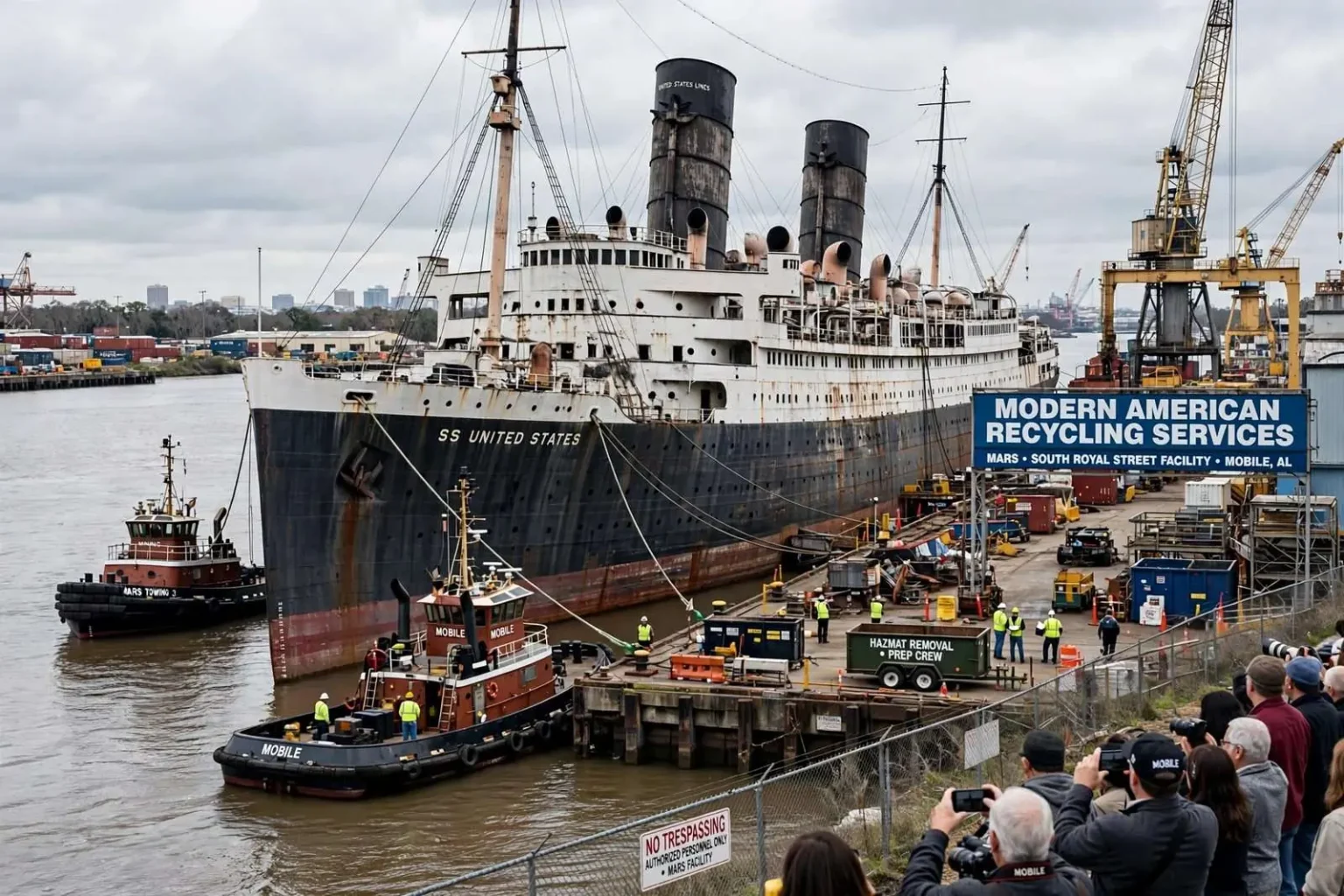
The 990-foot liner made its way up Mobile Bay early in the morning before docking at the Modern American Recycling Services (MARS) facility on South Royal Street around midday. Tugboats guided the massive hull through the bay and into position along the pier, a journey that drew crowds of onlookers eager to catch a glimpse of the historic ship before it begins its transformation.
The arrival gave Mobile’s waterfront one of the most remarkable sights in its recent memory: a nationally famous ocean liner, stripped of most of its interior fittings, riding at a working shipyard pier beneath the cranes of a modern recycling operation. From downtown vantage points and the banks of the river, residents gathered through the morning to watch the last cruise of a vessel that once crossed the Atlantic faster than anything afloat.
A ship built for glory
The SS United States has sat largely dormant for decades, most recently moored along the Delaware River in Philadelphia, after a career that once made it a symbol of American engineering and maritime prestige. Built in the early 1950s, the ship set transatlantic speed records that still stand today and carried presidents, celebrities and everyday travelers across the Atlantic before commercial air travel made ocean crossings obsolete.
Her speed was the product of deliberate national ambition. The liner was designed to be convertible in wartime and fast enough to outrun anything that might pursue her, and her builders wrapped military-grade engineering in the luxury of a passenger flagship. On her maiden voyage she took the transatlantic Blue Riband in both directions, averaging speeds no commercial liner has matched since, and she held that record through the jet age and every decade after.
For a generation of travelers, a crossing aboard the SS United States was the way to reach Europe – four days of dining rooms, decks and rituals aboard a ship whose speed could compress the ocean. Presidents, film stars and emigrants alike booked passages, and the liner’s arrivals in New York drew crowds and cameras the way airport terminals never would.
For years afterward, the vessel’s future remained uncertain as preservation groups and prospective buyers debated whether it could be restored or repurposed. Decades of proposals – a hotel, a casino, a floating museum, a redevelopment project – came and went, each foundering on the enormous cost of returning a 990-foot ship to service, while the hull quietly rusted at its Philadelphia pier and preservationists fought periodic scrap sales.
A buyer and a new mission
That uncertainty ended when Okaloosa County, Florida, purchased the ship with plans to sink it off the coast near Destin-Fort Walton Beach, creating an artificial reef intended to draw divers, support marine life and boost tourism in the area.
The purchase closed the long argument over the ship’s future with a compromise between memory and practicality. No buyer could be found to restore the SS United States to anything resembling her original condition, but as a reef she would remain whole, recognizable and useful – a structure whose famous profile, recognizable through clear Gulf water, would become the centerpiece of a diving destination rather than a memory lost entirely to the scrapyard.
Okaloosa County has invested for years in the artificial reefs that dot its stretch of the Gulf, and local officials calculate that every sunken vessel draws divers, charter boats and fishing trips that spend money on the coast. A reef carrying the name and shape of the fastest ocean liner ever built gives that program a centerpiece no other destination can claim.
Mobile was chosen as the staging site for the extensive preparation work required before the ship can be safely and legally sunk. The choice made sense on practical grounds: the city sits within easy tow of the Florida coast, and its working shipyards and heavy-marine contractors have exactly the skills the job demands.
Preparing the liner
Once docked, crews at the MARS facility will begin the meticulous process of preparing the liner for its new purpose. Workers must strip the vessel of hazardous materials, fuel residue and any remaining fixtures that could pose environmental risks once it rests on the Gulf floor.
The work is part demolition, part decontamination. Decades of accumulated fluids, insulation and fittings must come out before any regulator will approve a sinking, and the ship’s vast interior – engine rooms, passenger decks, galleys that once fed two thousand diners a night – must be reduced to clean steel that the Gulf can accept.
Engineers will also need to ensure the ship is properly ballasted and reinforced so that it lands upright when it is eventually towed offshore and sunk, a step considered critical to making the site safe and accessible for recreational divers.
An upright, stable resting position is what separates a diving destination from a hazard. A ship that lands on its side or rolls after settling can trap lines, shift in storms and close off interior passages, so the ballasting plan – hundreds of calculations about weight, flooding and the Gulf floor itself – is among the most important engineering work of the entire project.
A year on the Mobile waterfront
Officials overseeing the project have said the preparation work is expected to take about a year to complete. During that time, the ship will remain a fixture along Mobile’s waterfront, offering local residents and visitors a rare opportunity to see a piece of maritime history up close before it disappears beneath the Gulf of Mexico for good.
For roughly a year, the great liner will ride at the South Royal Street pier while crews work through her compartments – a sight that many residents remember from the ship’s legendary era and that younger visitors know only from photographs. When the preparation is finished, the SS United States will be towed out of Mobile Bay for the last time and sunk in her permanent position off the Florida coast.
The year of work also means business for the port. Shipyard employment, marine services, towage and the contractors who handle hazardous-material removal all flow through a project of this scale, and Mobile’s maritime industry is built for precisely this kind of heavy, specialized job.
Part of a larger reef tradition
The project is the latest in a string of large vessels sunk off the Alabama and Florida coasts to create artificial reefs, a practice that has become an increasingly popular way to repurpose retired ships while giving a boost to local diving and fishing tourism.
The northern Gulf has long been a working laboratory for artificial reefing. Retired ships, barges and even military vessels have been sunk along the coast for decades, and marine life colonizes them within months – baitfish first, then the predators that draw anglers, then the coral growths and residents that make a wreck a destination. Alabama’s own reef program, one of the most active in the nation, has deployed hundreds of structures off its coast over the years.
When complete, the SS United States is expected to surpass other sunken vessels in the region to become the largest ship ever turned into an artificial reef anywhere in the world.
The scale matters for more than records. A reef the length of three football fields creates habitat in layers, from the sand-producing bottom community to the midwater fish schools that follow a wreck’s superstructure, and its interior passages give divers years of exploration. As a diving site with a famous name, the ship is expected to draw visitors from across the country to the Destin-Fort Walton Beach area for decades.
Mobile’s role in the ship’s final chapter adds another entry to the city’s long history as a working port with deep ties to shipbuilding, cargo and maritime trade.
The last port of call
Mobile’s waterfront has launched, repaired and retired ships for three centuries – from the wooden shipyards of the colonial era to the Navy and merchant vessels that rolled down the ways during World War II, and on to the aerospace-scale shipbuilding that anchors the port today. Hosting the SS United States during her transformation puts the city alongside the final story of the most famous liner ever built in America.
There is a fitting symmetry in the ship’s choice of ports. She was built for speed on the open ocean and spent her working life between New York and Europe; Mobile, a port built on the slow work of cargo, ship repair and shipbuilding, is where she will be made ready for a slower, permanent service as the largest reef in the sea.
For the year she spends at the pier, the liner will be more than a worksite. Schools will bring students to see her, maritime historians will document her condition, and the crowds that lined the river for her arrival will return to watch the work progress – a last chance to stand near a ship whose like the country never built again.
For now, the liner sits quietly at its dock along South Royal Street, awaiting the next phase of a journey that will ultimately carry it far from the ports and shipping lanes it once called home.
When the work is done, tugboats will take her out of Mobile Bay as they brought her in, and the crowds will gather one more time. Beyond the barrier islands, in clear water off the Florida coast, the fastest ocean liner in history will settle upright onto the Gulf floor – no longer crossing the sea, but becoming part of it, and drawing to her hull the divers and fishermen who will keep her story alive for generations.