Mobile Fire-Rescue Emergency Vehicle Alerts Warn Drivers Through Dashboards and Apps
Mobile Fire-Rescue is using technology that sends emergency vehicle alerts to compatible car screens and apps like Waze and Google Maps when a unit is within two miles, giving drivers time to move right and stop.
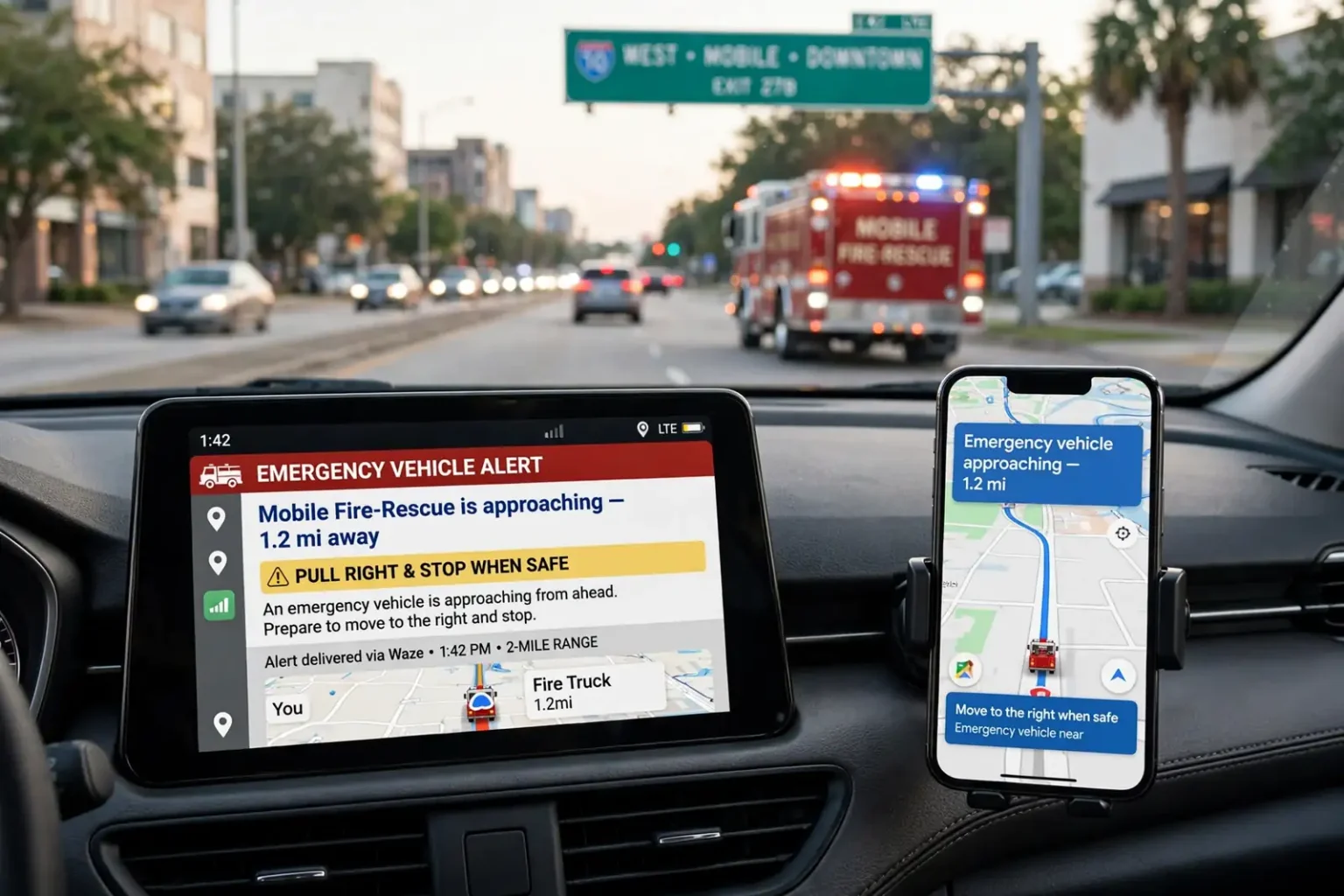
MOBILE, Ala. — Drivers in Mobile may soon notice something new on their dashboards or phone screens: a warning that a fire truck or ambulance is on the way. Mobile Fire-Rescue is using emergency vehicle alerts technology designed to tell motorists that first responders are approaching, often before the drivers can see flashing lights or hear a siren.
The goal is straightforward. When someone calls 911, crews need to reach the scene as quickly and as safely as possible. Heavy traffic and busy intersections can slow them down and raise the risk of collisions. By giving drivers an early heads-up, the department hopes to clear the way sooner and reduce dangerous encounters on the road.
“There is an emergency for someone, somewhere, and our job is to get there quickly and safely as possible,” said Firemedic Capt. Steven Millhouse of Mobile Fire-Rescue.
How the emergency vehicle alerts work
According to Millhouse, the alerts can appear on compatible vehicle screens as well as in navigation apps, including Waze and Google Maps. When a Mobile Fire-Rescue unit equipped with the system is responding and comes within range, nearby drivers can receive a notification.
“If an emergency vehicle is within two miles of you and it’s approaching, it will pop up on your screen, right on your dash. And it will let you know if an emergency vehicle is approaching, and that way you can start to look and listen for the emergency vehicle and make preparations to move to the right and stop.” — Firemedic Capt. Steven Millhouse
The two-mile range is meant to buy drivers precious seconds. Instead of reacting suddenly when a siren becomes audible or lights appear in the mirror, a motorist who sees the alert can begin scanning the road, slowing down and planning a safe place to pull over.
That early notice can be especially useful in modern traffic. Today’s vehicles are often well insulated against outside noise, and drivers listening to music, talking on a hands-free call or running the air conditioning may not hear a siren until an emergency vehicle is close. In dense traffic or at intersections with buildings and other obstructions, flashing lights can also be hard to spot until the last moment. A notification on the screen a driver is already using can help close that gap.
The system is designed to help drivers recognize that emergency crews are nearby even before the vehicles come into view or their sirens can be heard.
The system can also warn drivers about nearby emergency scenes, such as a crash or fire response. That gives motorists the chance to avoid the area altogether and choose another route, which can ease congestion around the scene and keep traffic away from crews working there.
Which drivers can receive the alerts
Millhouse said the alerts are available in certain Chrysler, Dodge, Jeep and Mazda vehicles, and through compatible navigation apps when drivers are actively using them. In practice, that means:
- Owners of some Chrysler, Dodge, Jeep and Mazda models may see the warnings on their vehicle’s in-dash display.
- Drivers using Waze or Google Maps for navigation may see the alerts in the app while it is running.
- Drivers who are not using a compatible vehicle or app will not receive the digital warning and should continue relying on traditional cues such as sirens and lights.
Because availability depends on vehicle model and app use, not every motorist on the road will get an alert. The technology is intended to add an extra layer of warning, not replace the basic attentiveness every driver needs. Motorists should still keep their eyes on the road and avoid handling a phone while driving; an alert should prompt a driver to look and listen, not to look down.
Traffic is the biggest obstacle for responders
Millhouse said traffic remains one of the biggest challenges crews face when responding to calls. Part of the problem, he said, is that some drivers simply don’t know what to do when an emergency vehicle approaches.
“Traffic is usually what holds us up the most, and a lot of people don’t know what to do when an emergency vehicle is approaching,” Millhouse said. “So once the alert populates, it will let you know that an emergency vehicle is approaching you. You can make your quick decision to move to the right and stop.”
Confusion behind the wheel can lead to dangerous situations. Drivers sometimes stop abruptly in the middle of a lane, swerve unpredictably, or pull to the left, any of which can block the path of a fire engine or ambulance or cause a crash. The alerts are meant to give drivers time to make a calm, correct decision.
Protecting crews on the interstate
The technology may also help protect firefighters, medics and other responders once they arrive. Millhouse said crashes involving emergency vehicles at incident scenes are a persistent concern, especially on interstates, where crews often work just feet from moving traffic.
“We see it far too often where emergency vehicles are involved in major wrecks at the scene of incidents on the interstate, so this will help reduce some of that risk,” Millhouse said.
Mobile is crossed by heavily traveled routes including Interstate 10 and Interstate 65, where high speeds and heavy volumes can make roadside incident scenes especially hazardous. A warning that arrives well before a driver reaches a crash scene gives that driver more time to slow down and, when it is safe, change lanes away from emergency vehicles parked on the shoulder or in a travel lane.
Expanded across more frontline units
Mobile Fire-Rescue has been using the alert system for about a year, according to Millhouse. The department has since expanded it to more of its frontline emergency units, and the number of drivers receiving alerts has increased since the system was more widely implemented in September.
Mobile Fire-Rescue provides fire protection, emergency medical services and rescue response for the city of Mobile, Alabama’s port city on Mobile Bay. Its crews respond to a wide range of calls, from structure fires and medical emergencies to vehicle crashes on city streets and interstates. Expanding the alerts across more units means a greater share of those responses can trigger warnings for nearby drivers.
What drivers should do when an emergency vehicle approaches
Whether the warning comes from a dashboard alert, a phone app, a siren or flashing lights, the expected response is the same. Millhouse’s advice is simple: move to the right and stop. Other widely recommended practices include:
- Stay calm and signal. Use your turn signal to show other drivers and the responder what you intend to do.
- Pull to the right edge of the road and stop when it is safe to do so, and remain stopped until the emergency vehicle has passed.
- Don’t stop in an intersection. If you are in or near an intersection, continue through it before pulling over.
- Watch for more units. Fire engines, ambulances and police vehicles often travel in groups; check for additional vehicles before pulling back into traffic.
- Don’t follow too closely. Keep a safe distance behind emergency vehicles that are responding to a call.
- Move over or slow down for stopped responders. Alabama’s Move Over law requires drivers approaching stationary emergency vehicles with flashing lights to move out of the adjacent lane when it is safe, or to slow down if they cannot.
Following those steps helps first responders reach people in need faster and helps keep everyone on the road safer.
Why seconds matter
For fire and medical emergencies, response time can make a significant difference. A fire can spread quickly, and in medical emergencies such as cardiac arrest, the speed of care can affect a patient’s chances of survival. Every delay at a clogged intersection or behind a driver who doesn’t know how to react is time taken away from the person waiting for help.
That is why Mobile Fire-Rescue is betting on early warnings to complement sirens and lights. As more drivers receive the alerts and more frontline units are equipped, the department hopes motorists will clear the way sooner and avoid crash scenes altogether.
Drivers who want to take advantage of the alerts can check whether their vehicle supports the feature or use a compatible navigation app such as Waze or Google Maps while driving. But even without the technology, the message from Mobile Fire-Rescue remains the same: when an emergency vehicle approaches, look, listen, move to the right and stop.