Alabama Power Restoration After Hurricane Isaias Complete; Escambia, Monroe Hit Hardest
Alabama Power says it has completed restoration after Hurricane Isaias caused more than 400,000 outages, with crews rebuilding parts of the system in hard-hit Escambia and Monroe counties.
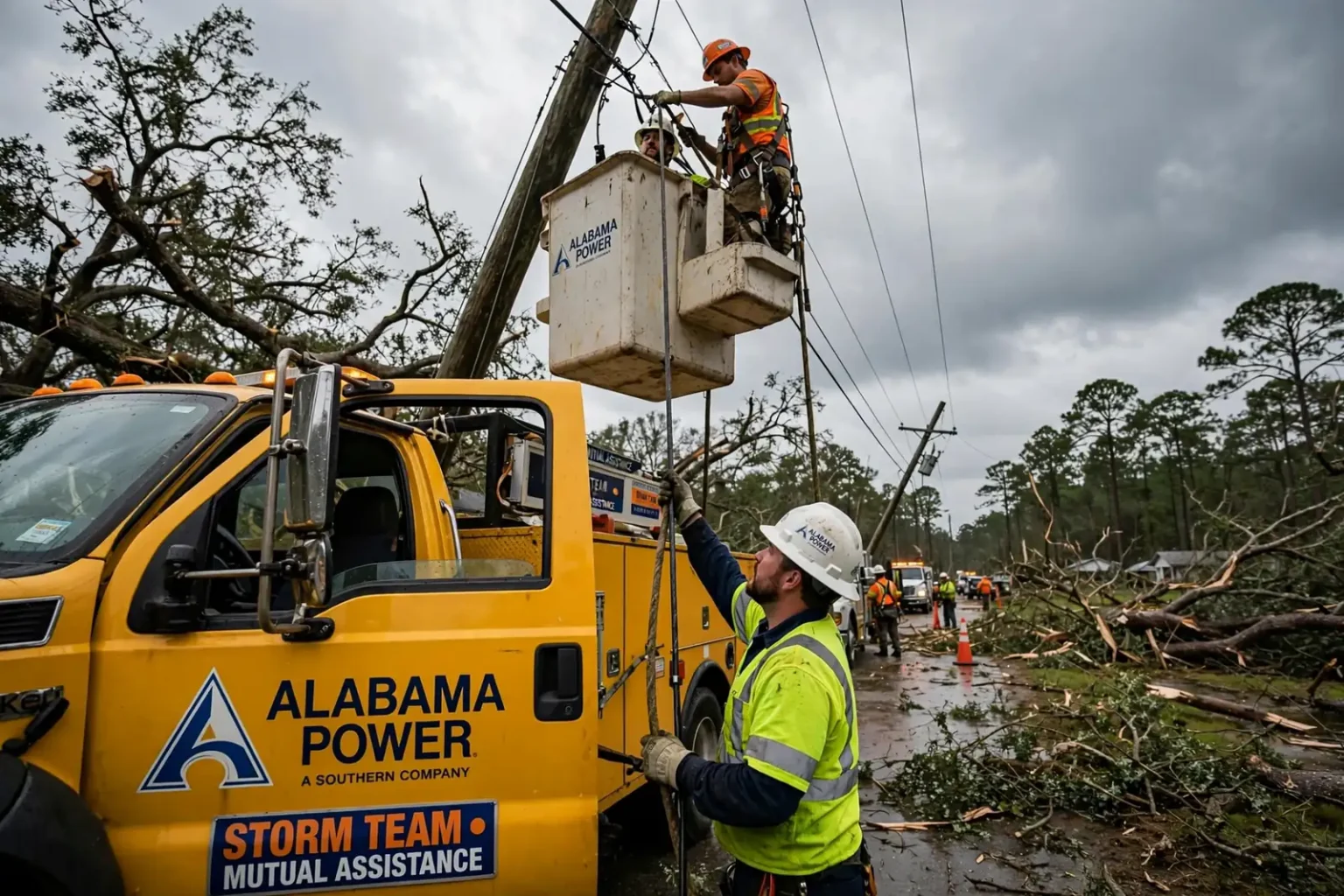
BREWTON, Ala. — Alabama Power restoration crews have finished their work following Hurricane Isaias, a storm that knocked out electricity to more than 400,000 of the utility’s customers and left some of its heaviest damage in Escambia and Monroe counties. The company said its final restoration push wrapped up at 8:30 p.m. on Wednesday, Oct. 14, four days after the hurricane swept across the state.
Company officials credited planning that began days before landfall, a heavy reliance on predictive and automated grid technology, and the arrival of thousands of out-of-state utility workers for what they described as a fast recovery across a broad service area. According to Alabama Power, crews had restored roughly 95% of affected customers within about 36 hours of beginning restoration, and service was substantially back for most customers by the night of Monday, Oct. 12.
The utility also acknowledged that the recovery has not been easy for everyone, noting that some families in south Alabama may still be without power and that the company continues to keep them, and the crews still working in the field, in mind.
A storm felt across most of the service territory
Hurricane Isaias made landfall as a Category 2 hurricane with maximum sustained winds of 105 mph, according to Alabama Power’s account of the storm. On the Saffir-Simpson Hurricane Wind Scale used by the National Hurricane Center, Category 2 storms carry sustained winds of 96 to 110 mph, strong enough to snap or uproot shallow-rooted trees, break utility poles and cause widespread power outages that can last for days.
The storm’s reach was as notable as its strength. The company estimates that about 84% of its service territory experienced tropical-storm-force wind gusts during Isaias. Tropical-storm-force winds begin at 39 mph, and gusts at that level are enough to bring down limbs and weakened trees onto overhead lines. Across much of the state, fallen trees, high winds and flooding were the main culprits behind the damage crews encountered.
Alabama Power, a subsidiary of Atlanta-based Southern Company, serves roughly 1.5 million homes and businesses across the southern two-thirds of the state. With most of that territory feeling at least tropical-storm-force gusts, the company said restoration had to be treated as a company-wide effort rather than a regional one.
Escambia and Monroe counties took the hardest hit
While much of the electric system held up, the company said some areas needed more than repairs. In Escambia and Monroe counties, where the most severe damage occurred, crews had to rebuild sections of the system outright. That work included replacing broken poles, repairing damaged equipment and restringing spans of wire, often in places that were difficult for trucks and workers to reach.
Brewton, the county seat of Escambia County, was among the communities hit hardest. Kaleb Fain, an Alabama Power lineman who both lives and works in Brewton, said the storm’s toll on local families was heavy.
“We know the days following Hurricane Isaias were difficult for many families across this area,” Fain said. “With support from additional crews from across the country, we did everything we could to restore service as safely and quickly as possible to get these communities back on their feet.”
Fain experienced the storm the same way many of his neighbors did. According to the company, his own home sustained significant damage, and he had to cut his way through fallen trees that blocked his property before he could report to work and begin restoring power for others.
Monroe County, home to Monroeville, sits just to the north of Escambia County in the state’s southwestern corner. Both are largely rural counties with long stretches of line running through wooded areas, the kind of terrain where downed trees can cause extensive damage and where access for heavy equipment can be slow.
How the restoration unfolded, hour by hour
Alabama Power released a timeline showing how quickly outage numbers climbed and how quickly crews began bringing customers back online:
- Oct. 10, 6 a.m.: Isaias had moved through parts of Alabama overnight, bringing strong winds, heavy rain and widespread impacts. About 233,000 customers had experienced outages as the storm crossed the state.
- Oct. 10, 11 a.m.: The number of customers who had lost power rose above 267,000, but more than 130,000 had already been restored.
- Oct. 10, 3 p.m.: Nine hours into restoration, more than 60% of affected customers had their service back.
- Oct. 11, 6 a.m.: Roughly 90% of affected customers had been restored, including more than 350,000 customers brought back on Oct. 10 alone.
- Oct. 11, 5 p.m.: The total number of customers who experienced outages had passed 400,000, and power had been restored to more than 95% of them.
- Oct. 14, 8:30 p.m.: Alabama Power announced that restoration efforts were complete.
The pattern reflects how utilities typically approach large-scale storm recovery. Crews generally begin with the backbone of the system, including transmission lines and substations, then move to main distribution lines that serve the largest numbers of customers, before turning to smaller tap lines and individual service drops. That approach tends to restore large numbers of customers quickly in the first day or two, while the final few percent, often in the most heavily damaged or hardest-to-reach areas, take longer.
Technology used before and during the storm
Alabama Power said its preparations started days before Isaias reached the state. As the hurricane approached the coast, the company used outage prediction technology to estimate which areas were likely to see the worst impacts, how many additional workers would be needed and where crews, equipment and materials should be staged so they could respond safely and efficiently once the winds subsided.
The company also pointed to its outage prevention technology, which automatically reroutes electricity around a fault on a line so that customers are not left in the dark for an extended period. Alabama Power said customers who noticed their lights blink off for a few seconds during the storm were likely seeing that system at work.
According to the company, the technology kept more than 69,000 customers from experiencing extended outages during Isaias and avoided more than 11 million minutes of service interruption. This kind of automated switching is part of what the industry often calls a “self-healing” grid, in which sensors and remotely controlled switches detect a problem and isolate the damaged section, allowing power to flow to undamaged portions of the circuit from another direction.
Scott Moore, Alabama Power’s senior vice president of Power Delivery, said the restoration depended on every part of the organization.
“Storm restoration at this scale is truly a team effort,” Moore said. “From the predictive analytics and planning that took place before the storm, to the coordination of crews, equipment and materials during restoration, every part of the organization played a role.”
The company also credited continued investments in grid resiliency, technology and infrastructure with helping much of the electric system withstand the storm.
Thousands of out-of-state workers joined the effort
Alabama Power said more than 7,400 additional workers from 28 states joined its Storm Team to help with restoration. Among them were crews from Mississippi Power and Georgia Power, the company’s sister utilities within Southern Company.
Moore thanked those mutual assistance crews and the Alabama Power employees who supported the effort behind the scenes.
“We were grateful for the support of mutual assistance crews from across the country, including our sister companies Mississippi Power and Georgia Power,” Moore said. “Just as important was the tremendous coordination behind the scenes by Alabama Power employees who worked around the clock to support this restoration effort and help get customers’ lights back on.”
Mutual assistance is a long-standing arrangement in the electric utility industry. Through regional and national networks, utilities agree to lend lineworkers, tree-trimming crews and equipment to one another after major storms, with the receiving utility covering the costs. Because a hurricane can affect one region while leaving others untouched, the system allows companies to bring in far more workers than they could keep on staff year-round.
Inside the company, the effort reached well beyond the bucket trucks. Alabama Power listed its Storm Center team, control center staff and engineers alongside field crews such as lineworkers, damage assessors and logistics teams. Its Customer Operations team handled more than 4.1 million customer interactions during and after the storm, providing outage information, restoration updates and other support to customers statewide.
Hurricane Isaias by the numbers
Alabama Power summarized the scope of the storm and the response with these figures:
- More than 400,000 customers experienced outages.
- More than 7,400 mutual assistance personnel from 28 states supported restoration.
- More than 4.1 million customer interactions were handled during and after the storm.
- More than 69,000 customers were kept from experiencing extended outages by automated technology.
- More than 11 million minutes of service interruption were avoided.
- About 84% of the service territory saw tropical-storm-force wind gusts.
- About 95% of affected customers were restored within roughly 36 hours of the start of restoration.
Safety reminders as cleanup continues
Even with restoration complete, cleanup from Isaias is likely to continue for some time in the hardest-hit communities. Emergency officials and utilities routinely remind residents of several basic precautions after a hurricane:
- Treat every downed or sagging power line as energized and dangerous. Stay well away and report it to the utility or call 911.
- Do not drive over downed lines or through standing water, which can hide debris or electrical hazards.
- Operate portable generators only outdoors and away from doors, windows and vents to prevent carbon monoxide poisoning, and never connect a generator directly to a home’s wiring without a properly installed transfer switch.
- Use caution when removing fallen trees, especially limbs tangled in or near lines, and leave that work to utility crews or professionals.
- Have a licensed electrician inspect any home wiring, meter base or appliances that were damaged by wind or water before power is restored to them.
Customers who believe they are still without service can report an outage to Alabama Power through the company’s website or mobile app. Damage to a home’s weatherhead or meter base, the equipment where power enters a house, is typically the property owner’s responsibility to repair before the utility can reconnect service.
In closing out its restoration update, Alabama Power thanked customers for their patience during the recovery and expressed appreciation for the employees, contractors and mutual assistance crews who worked to restore power safely. The company also noted again that some families across south Alabama may still be dealing with outages and that both those families and the crews still working to help them remain in its thoughts.
For residents in places like Brewton, where lineworkers were clearing their own yards before heading out to restore service to their neighbors, the end of the restoration effort marks one step in what is likely to be a longer recovery from Hurricane Isaias.