Mobile Bay’s 3D-Printed Reef Project Expands After Successful Pilot
The Mobile Bay National Estuary Program has deployed six new 3D-printed reef structures made from dredged sediment, building on a successful six-month pilot project.
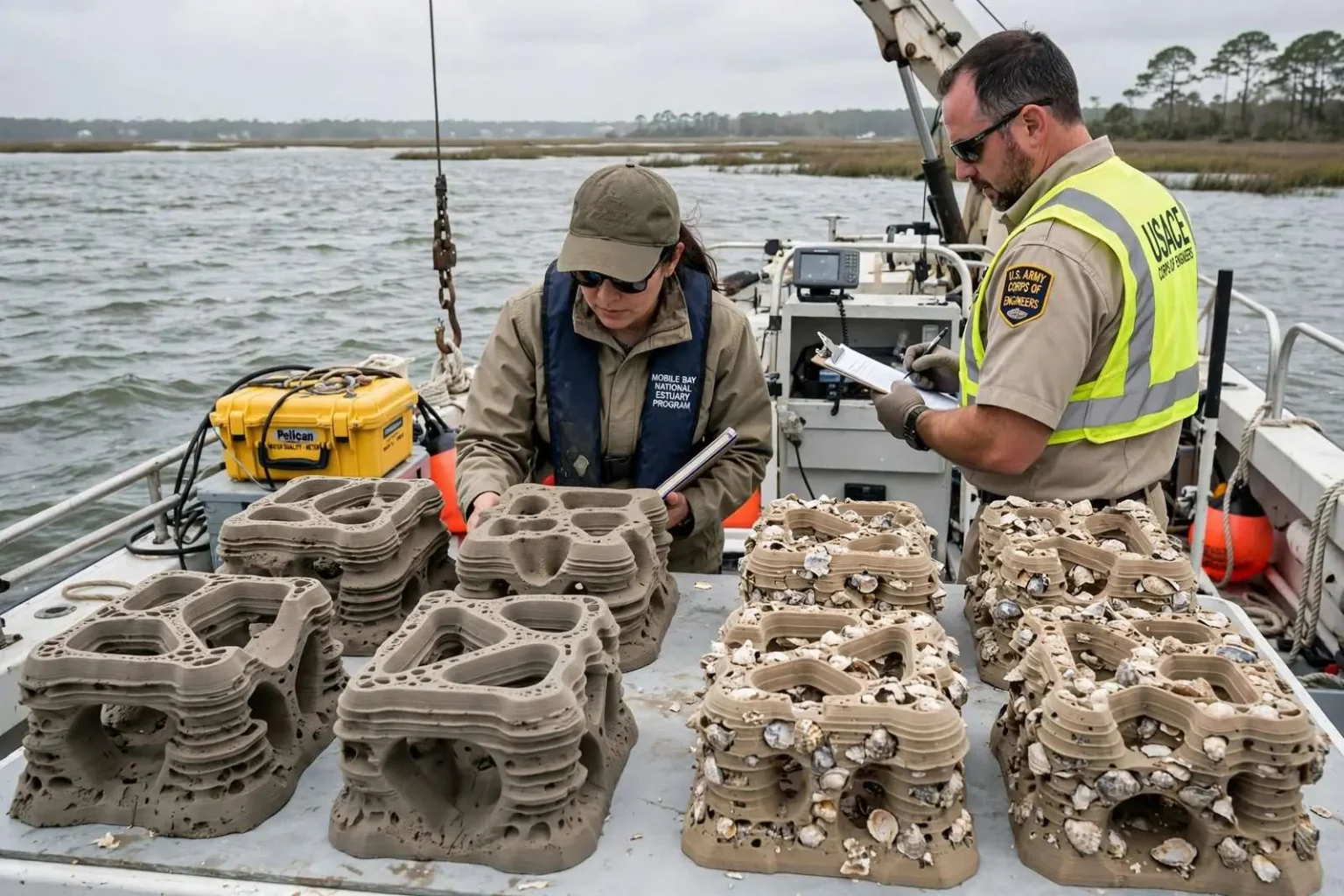
A pilot project that turns dredged sediment into 3D-printed artificial reefs is expanding in Mobile Bay, with researchers hoping the approach can turn a routine waste byproduct into a tool for coastal restoration. The Mobile Bay National Estuary Program, working with the U.S. Army Corps of Engineers, recently deployed six new reef structures at a higher-energy site in the bay following a successful six-month pilot.
The new reefs will be monitored to see how well they hold up under stronger wave conditions than the sheltered pilot location and how effectively they support marine life. The comparison matters because Mobile Bay is a shallow, wind-driven estuary where conditions can swing from glassy calm to choppy chop within hours, and any structure meant to survive there has to tolerate both.
Two materials, one comparison
Half of the newly deployed reefs were built entirely from beneficially reused dredged sediment, while the other half combine that same sediment with ground oyster shells. Researchers plan to compare the two materials to determine whether adding oyster shells improves habitat performance and encourages more oysters to settle on the structures.
The oyster-shell question is central to the project’s promise. Oyster larvae preferentially attach to shell and other calcareous surfaces, which is why traditional reef restoration in Alabama has leaned on recycled shells and crushed limestone. If the blended material outperforms plain printed sediment, the recipe for future reefs could shift toward a mix that gives the bay’s oysters the chemical cue they look for when settling — while still consuming the same mountain of dredged material the shipping channel produces each year.
The reefs themselves are created by dewatering dredged sediment, shaping it using large-scale 3D printers, and firing the material into durable, ceramic-like forms designed to give oysters, fish, crabs and other marine life a place to attach and grow. The process borrows from ceramics and additive manufacturing alike: printers lay down the wet, clay-like material in engineered layers, creating nooks, ridges and voids that a flat concrete slab would never offer, and the firing step hardens the structure into something that can sit on the bay floor for years.
Building on early success
The expansion follows encouraging results from the original pilot reef, which stayed intact through months of shifting tides and weather while drawing a variety of marine life. Researchers will now track how quickly organisms such as oysters, barnacles and algae colonize the new structures at the more exposed site, using colonization speed and species diversity as the clearest measures of whether the printed material functions like the natural reef substrate it is meant to replace.
“This is a U.S. Army Corps-led project and shows the value in collaboration when it comes to resource management,” said Henry Perkins, private sector program lead for the Mobile Bay National Estuary Program. “There’s 4 million tons of sediment dredged from the shipping channel each year, which gives the management community lots of opportunities to discover new and useful ways to reuse this recurring natural resource.”
Perkins’s numbers explain why the Corps is involved. Keeping the Mobile Ship Channel deep enough for the container ships that make the Port of Alabama one of the Gulf’s busiest means dredging on a massive scale, year after year, and the sediment has to go somewhere. Historically that has meant disposal sites in the bay and nearby waters — material managed as waste, at continuing cost, rather than used as a resource.
Why Mobile Bay needs new reef bottom
Mobile Bay once supported extensive natural oyster reefs that filtered the bay’s water, broke wave energy before it reached shorelines, and anchored a fishery that fed generations of Gulf Coast families. Those reefs declined over decades under the combined weight of harvesting pressure, sedimentation, storms, disease and freshwater floods, leaving the bay with a fraction of its historic hard bottom. Every restoration effort since has run into the same constraint: hard substrate — the foundation on which reef habitat is built — has to come from somewhere, and natural sources are limited.
That shortage is what makes the dredged-sediment approach so attractive locally. The bay’s restoration community has recycled oyster shells from restaurants, built cultch piles from limestone, and experimented with concrete and other materials, but all of those inputs are finite and must be bought, hauled and placed. Dredged sediment, by contrast, is produced continuously by the channel-dredging operation itself — a self-renewing supply sitting in disposal areas around the bay, waiting for a use.
The environmental logic cuts both ways. Turning sediment into reef habitat keeps material out of disposal sites, reduces the demand for quarried stone and mined shell, and creates living structures that improve water quality as oysters colonize them. A single adult oyster can filter gallons of water per day, so reefs built at meaningful scale would work on the bay’s turbidity and nutrient problems even as they support crabs, fish and the food web around them.
From pilot to standard practice
If the expanded field trial continues to produce positive results, researchers say the technology could become a standard option for turning dredged sediment into habitat restoration projects instead of treating it purely as waste requiring disposal. The words “standard option” carry real weight in the Corps’s world, where beneficial use of dredged material has been a policy goal for years but often stalls on cost, logistics and the lack of proven end uses.
The monitoring plan for the six new reefs will feed directly into that decision. Survivability at the higher-energy site tests the material’s durability — whether fired printed sediment can take repeated storm-wave action without crumbling. Colonization rates test the biology — whether oysters, barnacles and algae treat the printed surface as home. And the head-to-head comparison between pure sediment and sediment-plus-shell tests the economics, since every additional ingredient added to the mix changes what a future reef costs to produce.
Success would also position Mobile — already a national dredging hub because of its ship channel — as a center for the technology itself. The large-scale printers, the dewatering equipment and the firing process all require industrial capacity, and a region that produces millions of tons of raw material annually has every incentive to develop the expertise to turn it into habitat. What began as a six-month pilot on a sheltered patch of bay bottom could end up changing how coastal engineers across the country think about the sediment their own channels produce.
For now, the six structures sit on the bay floor where the waves run stronger, and researchers will check them through the seasons ahead. The bay’s oysters, barnacles and algae will cast the deciding votes, one settled larva at a time.
The National Estuary Program’s role
The Mobile Bay National Estuary Program is one of the National Estuary Programs established under the Clean Water Act, a network of locally directed offices charged with protecting and restoring the country’s most significant coastal water bodies. Its portfolio spans the bay and the coastal watersheds that feed it — from the Mobile-Tensaw Delta’s bottomland hardwood swamps down through the bay’s open waters and the Gulf beaches beyond — and reef restoration has long ranked among the priorities in the comprehensive management plan the program maintains for the estuary.
The NEP’s position between federal agencies, state resource managers, local governments and the private sector is what makes a project like this possible. The Corps owns the dredging operation and the sediment; the NEP convenes the partners and helps line up monitoring; researchers and contractors bring the printing technology; and state marine resources staff weigh in on where restored reefs belong. Perkins’s emphasis on collaboration reflects that structure — no single agency could have turned channel sediment into printed reefs on its own.
The project also builds on a string of restoration investments the region has made since the Deepwater Horizon oil spill, when penalty funds flowing through the RESTORE Act and the Natural Resource Damage Assessment created new money for Gulf habitat work. Oyster reef restoration, shoreline stabilization and watershed protection projects have been funded across south Alabama under those programs, and each project has sharpened local practitioners’ understanding of what works in the bay’s particular mix of salinity, sediment and storms.
Monitoring what matters
The monitoring to come is more methodical than a simple visual check. Researchers will measure how much of each structure remains after storm seasons, profile the surfaces for settled organisms, and compare growth between the two material types over successive seasons. Oysters that attach in spring, for example, reveal within a year whether a structure is functioning as reef or merely sitting as decoration, and barnacles and algae provide earlier signals because they colonize quickly and indicate surface chemistry.
Water quality measurements around the structures can add another layer, showing whether early colonization is already having a filtering effect in the immediate vicinity. And because the new site is more exposed than the pilot location, the durability data will be more demanding — which is precisely the point. A reef technology that only works in sheltered water would limit where restoration could happen; one that survives higher-energy sites could be deployed along the bay’s open stretches, where historic reefs once ran for miles.
The seasonal rhythm of the bay will shape the timeline. Oyster settlement in Alabama waters peaks in the warmer months, storm season tests structures in late summer and fall, and winter’s cold fronts bring the steadier wave action that wears on any submerged material. A full picture of the six new reefs will take cycles of all three — settlement, storm and calm — before researchers can say with confidence that the material holds and the habitat forms.
Until then, the printed reefs stand as a small experiment with outsized implications: proof, or refutation, that the byproduct of keeping a great port open can be remade into the foundation of the bay’s oldest fishery.