Trinity Gardens Clinic Offers Free Pet Vaccinations to Dozens of Mobile Families
Volunteers and veterinarians brought free rabies vaccines, food and supplies to Trinity Gardens pet owners at a weekend clinic south of Prichard.
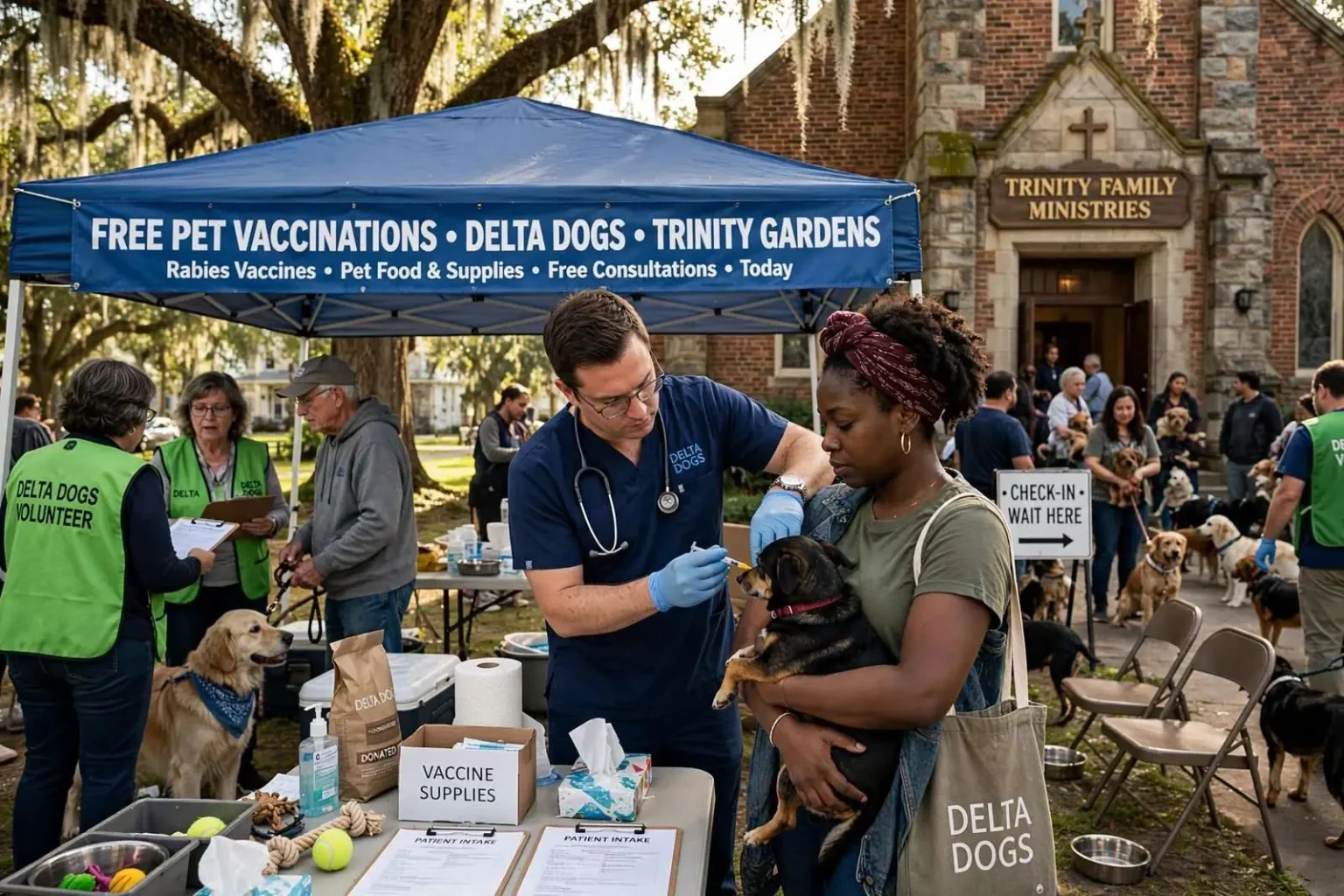
Dozens of dog owners in the Trinity Gardens neighborhood turned out on a recent Saturday for a free vaccination clinic aimed at making basic pet care more accessible in one of Mobile’s historic communities. The event, hosted at Trinity Family Ministries, was organized by Delta Dogs, a volunteer outreach group that partners with local veterinarians to bring rabies vaccines, food, toys and consultations directly into neighborhoods where cost or transportation can be a barrier to regular veterinary care. More than a dozen volunteers, including three practicing veterinarians, staffed the event, which ultimately treated nearly 40 dogs over the course of the afternoon.
Bringing Veterinary Care to the Neighborhood
Residents lined up with pets of all sizes, many of them family dogs that had never received a rabies vaccination despite Alabama law requiring it. State law requires that every dog, cat and ferret be vaccinated against rabies, a rule that has been on the books for decades because the disease is fatal to both animals and humans once symptoms appear. In practice, however, enforcement matters far less than access: a family without transportation to a veterinary clinic, or without the money for an office visit and exam fee, can find it difficult to keep an annual vaccination current even when they want to.
Veterinarians on site said the neighborhood south of Prichard, like many working-class communities around Mobile, includes a large number of pet owners who want to do right by their animals but face real obstacles in affording routine veterinary visits. A standard wellness visit at a private clinic can include an examination fee, the vaccination itself and often charges for heartworm testing or other preventive care, costs that add up quickly for households on fixed or tight budgets. For families in that situation, a free clinic staffed by volunteering professionals removes nearly every barrier at once.
A Model Borrowed from International Outreach
One veterinarian who volunteered, from a clinic in the Tillman’s Corner area, said the event reflects a growing effort among Mobile-area veterinary professionals to extend care beyond their regular practices. He noted that similar outreach models have been used internationally to vaccinate and spay animals in underserved communities, and that Delta Dogs is bringing a version of that approach to Mobile’s own neighborhoods. In countries where veterinary infrastructure is limited, mass vaccination campaigns have long been recognized as the most effective way to control rabies at the population level, and the same logic applies block by block in American cities.
The volunteers handled more than injections during the afternoon. Along with rabies vaccines, the clinic distributed pet food, toys and one-on-one consultations, giving owners a chance to ask questions about diet, behavior and general health that they might otherwise never get to ask a professional. For many of the dogs treated, the visit was their first examination by a veterinarian of any kind, which made the consultations as important as the vaccinations themselves in the eyes of the organizers.
Delta Dogs operates as a volunteer-driven organization rather than a brick-and-mortar clinic, which allows it to meet residents where they live. The group works with practicing veterinarians who donate their time and with host organizations that provide space, and it focuses its efforts on parts of the city where the distance to the nearest animal hospital is matched by the distance between a family’s budget and the cost of routine care.
A Church Grounds Turned Clinic
Trinity Family Ministries leaders, several of whom have adopted rescue dogs through Delta Dogs themselves, said hosting the clinic fit naturally with the church’s mission of serving the surrounding community every day of the week, not just on Sundays. Members helped coordinate the event and welcomed neighbors into the church grounds for the afternoon, handling logistics that ranged from directing traffic and managing the lineup to making sure owners and animals had water and shade while they waited their turn.
The partnership between a congregation and a volunteer veterinary group is an example of the kind of arrangement that public health officials often point to when discussing how to reach residents that traditional institutions miss. Churches and community ministries in Mobile’s older neighborhoods are frequently the most trusted gathering points available, and a familiar, walkable location can draw turnout that no distant clinic could match. Trinity Gardens itself is one of the city’s historic communities, a neighborhood with deep roots southwest of Prichard where many families have lived for generations.
Organizers said the response from the community was strong enough that Delta Dogs planned a follow-up visit the next day to distribute additional pet food and supplies to families who came out, extending the effort beyond a single afternoon. The quick follow-up reflected both the volume of demand on Saturday and the group’s understanding that vaccination is only one piece of what keeps pets healthy in a neighborhood where dog food itself can strain a monthly budget.
Why Rabies Vaccination Matters Locally
Rabies remains present in wildlife populations across Alabama, with raccoons, bats, foxes and skunks all serving as potential carriers that can pass the virus to unvaccinated pets and, from there, to people. The Alabama Department of Public Health investigates animal bites and confirmed rabies cases statewide, and dogs that roam yards or walk neighborhood streets with their owners come into regular contact with wildlife in communities like Trinity Gardens, where green space and drainage corridors thread between homes. A vaccinated dog population forms a buffer that protects both the animals and the humans around them.
For the nearly 40 dogs vaccinated at the clinic, the immediate benefit is compliance with state law and protection from the disease. The broader benefit flows outward: every vaccinated animal reduces the risk of transmission in the neighborhood, lowers the chance that a family faces a quarantine or euthanasia decision after a bite incident, and eases the burden on animal control officers and public health workers who respond when unvaccinated pets are exposed.
What Comes Next for the Effort
The strong turnout in Trinity Gardens suggests a model that could be repeated in other Mobile neighborhoods facing the same combination of pet ownership, limited veterinary access and tight household budgets. Mobile County’s animal welfare challenges are well documented, from stray populations to shelter overcrowding, and preventive care events like this one attack the problem at its root by keeping animals healthy, vaccinated and in their homes rather than surrendering them later.
Organizers with Delta Dogs and Trinity Family Ministries both characterized the event as the beginning of an ongoing relationship rather than a one-time service project. The veterinarians who volunteered indicated they would be willing to participate in similar clinics in the future, and the church’s leaders said their doors are open to hosting again. For the dozens of families who walked to the church grounds with their dogs on Saturday afternoon, the event turned a routine trip to the veterinarian, which for many had never been possible, into something as simple as a short walk down the street.
The Cost Barrier in Plain Numbers
The economics of veterinary access explain why events like the Trinity Gardens clinic matter. Beyond the rabies shot itself, a first visit to a private practice typically involves an examination charge, and any follow-up care multiplies from there. Households across Mobile’s working-class neighborhoods often manage multiple pets, and the choice between a veterinary bill and other necessities is one many owners quietly make every year. Outreach clinics invert that equation: with professionals volunteering and supplies donated, the only cost to a family is the time to attend.
Transportation compounds the problem. A substantial share of households in neighborhoods like Trinity Gardens do not have reliable access to a vehicle during the day, and veterinary clinics are clustered in commercial corridors that are difficult to reach by the city’s limited transit network. Carrying a nervous dog onto a bus or walking miles along arterial roads is not realistic for most owners, which means care is skipped not out of indifference but out of geography. Bringing the clinic into the neighborhood removes that obstacle entirely.
Volunteers at the Center of the Work
The dozen-plus volunteers who staffed the event included the three practicing veterinarians along with assistants and community members who handled intake, restraint, record-keeping and distribution of supplies. Volunteer veterinary events run on precisely this division of labor: licensed professionals perform the medical work while trained and untrained volunteers keep the line moving, freeing each veterinarian to treat a steady stream of animals without administrative delays. Nearly 40 dogs in a single afternoon represents a brisk pace for any clinic, mobile or otherwise.
Several of the ministry’s own leaders came to their roles as hosts through Delta Dogs itself, having adopted rescue dogs through the group before helping to organize the clinic. That connection gave the event a familiar face for neighborhood residents, and it reflected the pipeline the group tries to build between rescued animals, responsible owners and communities that then become partners in future outreach.
A National Problem, a Local Answer
The barriers on display in Trinity Gardens are not unique to Mobile. Studies of veterinary access across the United States have found that cost is the leading reason pet owners skip preventive care, with transportation and clinic availability close behind, and that the shortfalls fall hardest on communities without many practices nearby. Professional organizations in the veterinary field have increasingly promoted community-based outreach as a complement to traditional clinic medicine, citing the same international experience the Tillman’s Corner veterinarian described: vaccination campaigns delivered where animals live are the most reliable way to protect both animal and human health.
Mobile’s version of that model remains small in scale, powered by individual volunteers and host organizations rather than any large institution. But the Trinity Gardens event showed the mechanics working end to end: a trusted host, volunteering professionals, donated supplies and a neighborhood willing to show up. If the follow-up visit and future clinics sustain the momentum, the dozens of dogs treated on that Saturday may prove to be the first wave of a broader effort to close the veterinary access gap across the city’s historic communities, one neighborhood at a time.