A 50-year-old Chickasaw man is facing multiple charges after Mobile police say he refused to pull over for a traffic stop Saturday afternoon and led officers on a short pursuit through the city.
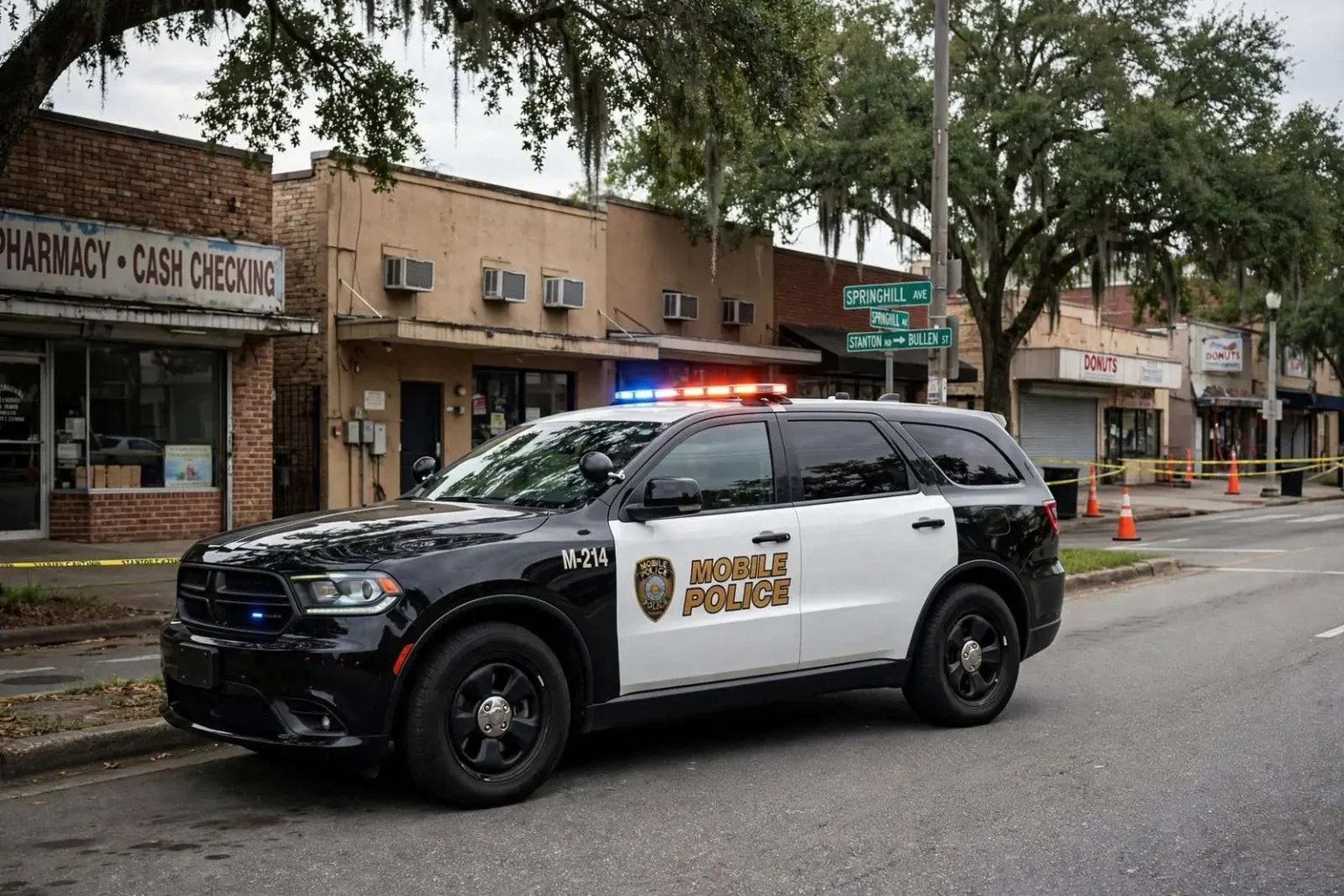
James Cook was arrested and charged with attempting to elude, reckless endangerment and failure to obey, according to the Mobile Police Department. How It Unfolded At approximately 3:43 p.m. Saturday, July 11, officers attempted to conduct a traffic stop on Springhill Avenue — one of Mobile’s principal east-west arteries, running from downtown out through midtown and the medical district.
The driver allegedly refused to stop. The pursuit that followed was brief, ending when the vehicle finally pulled over on Stanton Road near Bullen Street, police said. The Reckless Endangerment Charge Of the three charges, reckless endangerment is the one that carries the most weight in explaining why departments treat refusals to stop so seriously. Under Alabama Code § 13A-6-24, a person commits reckless endangerment when they engage in conduct that creates a substantial risk of serious physical injury to another person. It is a Class A misdemeanor.
Notably, the statute does not require that anyone actually be hurt. The risk itself is the offense. A vehicle refusing to stop on a road like Springhill Avenue — a busy corridor lined with businesses, side streets and pedestrian crossings, on a Saturday afternoon — is precisely the conduct the statute contemplates.
Attempting to elude a law enforcement officer is a separate offense under Alabama law, and failure to obey covers the refusal to comply with a lawful order from an officer. Why Police Pursuits End Quickly The pursuit in this case was short, which is by design. Law enforcement agencies across the country have tightened pursuit policies substantially over the past two decades after research documented how frequently high-speed chases end in crashes injuring uninvolved motorists and bystanders. Many departments now require supervisors to authorize continued pursuit and to weigh the seriousness of the original offense against the danger the chase itself creates.
A short chase that ends with a vehicle pulling over on a side street is, in that framework, the outcome the policy is built to produce. Springhill Avenue: A High-Stakes Corridor Springhill Avenue is one of Mobile’s most heavily traveled thoroughfares, connecting downtown Mobile to the medical district that includes USA Health University Hospital, Infirmary Health’s Mobile Infirmary, and the Springhill Medical Center campus. The corridor also passes through midtown Mobile’s dense commercial and residential areas, with frequent intersections, pedestrian crossings, and driveway access points for businesses and homes.
On a Saturday afternoon, the avenue carries a mix of local traffic, shoppers, medical center employees and visitors, and residents going about weekend errands. A vehicle refusing to stop in this environment creates a moving hazard not only for the pursuing officers but for every other road user. The Mobile Police Department’s pursuit policy, like those of agencies nationwide, is calibrated to this reality: the danger of the chase must be weighed against the gravity of the offense that prompted the stop.
In this case, the original traffic violation — while not specified in the department’s release — was apparently not a violent felony. The decision to terminate the pursuit quickly on Stanton Road, a residential side street, reflects the department’s training and policy emphasis on minimizing risk to the public. Chickasaw and the Mobile Metro Area Chickasaw, a city of approximately 6,000 residents in northern Mobile County, sits just northwest of Mobile along the Mobile River. Many Chickasaw residents work in Mobile and travel the corridor of I-65, U.S. 43, or the Cochrane-Africatown USA Bridge to reach jobs in the city. Traffic enforcement on the arteries connecting Chickasaw to Mobile — including Springhill Avenue via the connecting surface streets — is a routine part of the Mobile Police Department’s patrol responsibilities.
The arrest of a Chickasaw resident on Mobile streets underscores the jurisdictional reality of the Mobile metropolitan area: municipal boundaries matter for administration, but criminal activity and traffic flow cross them constantly. The Mobile County Sheriff’s Office, the Alabama Law Enforcement Agency’s Highway Patrol Division, and the municipal police departments of Prichard, Saraland, Satsuma, and Chickasaw itself all operate in overlapping jurisdictions, coordinated through mutual aid agreements and the Mobile County 911 communications district. The Legal Process Ahead Cook has been charged and is presumed innocent unless and until the state proves its case in court. The charges — attempting to elude, reckless endangerment, and failure to obey — will proceed through Mobile County District Court. Attempting to elude can be charged as a misdemeanor or, under certain circumstances involving injury or prior convictions, as a felony. Reckless endangerment is a Class A misdemeanor carrying up to one year in the county jail. Failure to obey is typically a misdemeanor traffic offense.
If the case proceeds to trial in Mobile County Circuit Court, the prosecution will need to establish that Cook was the driver, that he was signaled to stop by a law enforcement officer in a marked vehicle, and that he willfully refused. The reckless endangerment charge requires proof that his driving created a substantial risk of serious physical injury to another person — a standard that can be met by testimony about traffic conditions, pedestrian presence, and the nature of the roadway.
The Mobile County District Attorney’s Office will handle the prosecution. Cook may retain private counsel or, if indigent, be represented by the Mobile County Public Defender’s Office. Traffic Safety in the Gulf Coast Region Refusals to stop for police are a persistent challenge for law enforcement across the Gulf Coast region. The Mobile Police Department, Baldwin County Sheriff’s Office, and other agencies regularly conduct traffic safety initiatives targeting impaired driving, speeding, and seat belt compliance, often with grant support from the Alabama Department of Economic and Community Affairs and the National Highway Traffic Safety Administration.
For drivers, the legal lesson is straightforward: when signaled by law enforcement, pulling over promptly is not optional. The consequences of eluding — additional criminal charges, increased danger to oneself and others, and the near-certainty of eventual apprehension — far outweigh the inconvenience of a traffic stop. Presumption of Innocence As with every criminal case in the United States, the constitutional presumption of innocence applies. Cook will have the opportunity to present a defense, challenge the state’s evidence, and, if the case proceeds to trial, require the prosecution to meet its burden of proof beyond a reasonable doubt before a jury of his peers. The Mobile County Circuit Court will ensure that the proceedings adhere to the Alabama Rules of Criminal Procedure and the protections guaranteed by both the U.S. and Alabama Constitutions.
Court records for this case will be accessible through the Mobile County Circuit Clerk’s Office once formal charges are filed, and the docket will reflect each procedural step from arraignment through disposition.
Springhill Avenue is one of the longer and more heavily traveled streets in Mobile, running from the western suburbs through the city’s midtown and connecting several major commercial corridors. The street has been the site of numerous police pursuits and traffic stops over the years.
Chickasaw, a city in north Mobile County, has its own police department that handles traffic enforcement and other patrol duties within the city limits. The Chickasaw Police Department coordinates with the Mobile County Sheriff’s Office and the Mobile Police Department on cases that cross jurisdictional lines.
Refusing to stop for a traffic signal or pursuing officer is a separate offense in Alabama, with penalties that include fines, license suspension and possible jail time. Cases in which the suspect leads police on a chase can result in additional charges related to the chase itself.
Local governments and community partners are working through the implications of the situation, and several follow-up meetings have been scheduled for the coming weeks. Members of the public who want to weigh in on the matter can find the meeting dates on city and county websites, and written comments can be submitted through the standard channels used by the relevant agencies. Local news outlets will continue to cover the story as it develops.
Across south Alabama, similar issues are being addressed in other communities, and the lessons learned here are likely to inform how those communities approach their own challenges. Local officials have indicated they are in regular contact with counterparts in neighboring cities and counties, and they expect to share best practices as the situation continues to evolve.
The agencies involved in the matter have committed to keeping the public informed as the work progresses, and residents who want to receive updates directly can sign up for email or text alerts through the relevant city or county websites. Local community organizations have also agreed to share information as it becomes available, and several have scheduled public forums in the coming weeks to give residents a chance to ask questions of the officials involved.
For background, readers can consult the official websites of the relevant agencies, the local newspapers that have covered the story, and the public-meeting archives that document the prior deliberations on related topics. The combination of those resources should give residents a thorough understanding of how the current situation developed and how the agencies and elected officials are approaching the decisions that remain.