Theodore Man Convicted in Deaths of Citronelle Couple in I-65 Bridge Crash
A Theodore man was found guilty of criminally negligent homicide after his truck collided with a crane on the I-65 bridge, killing a Citronelle couple in 2012.
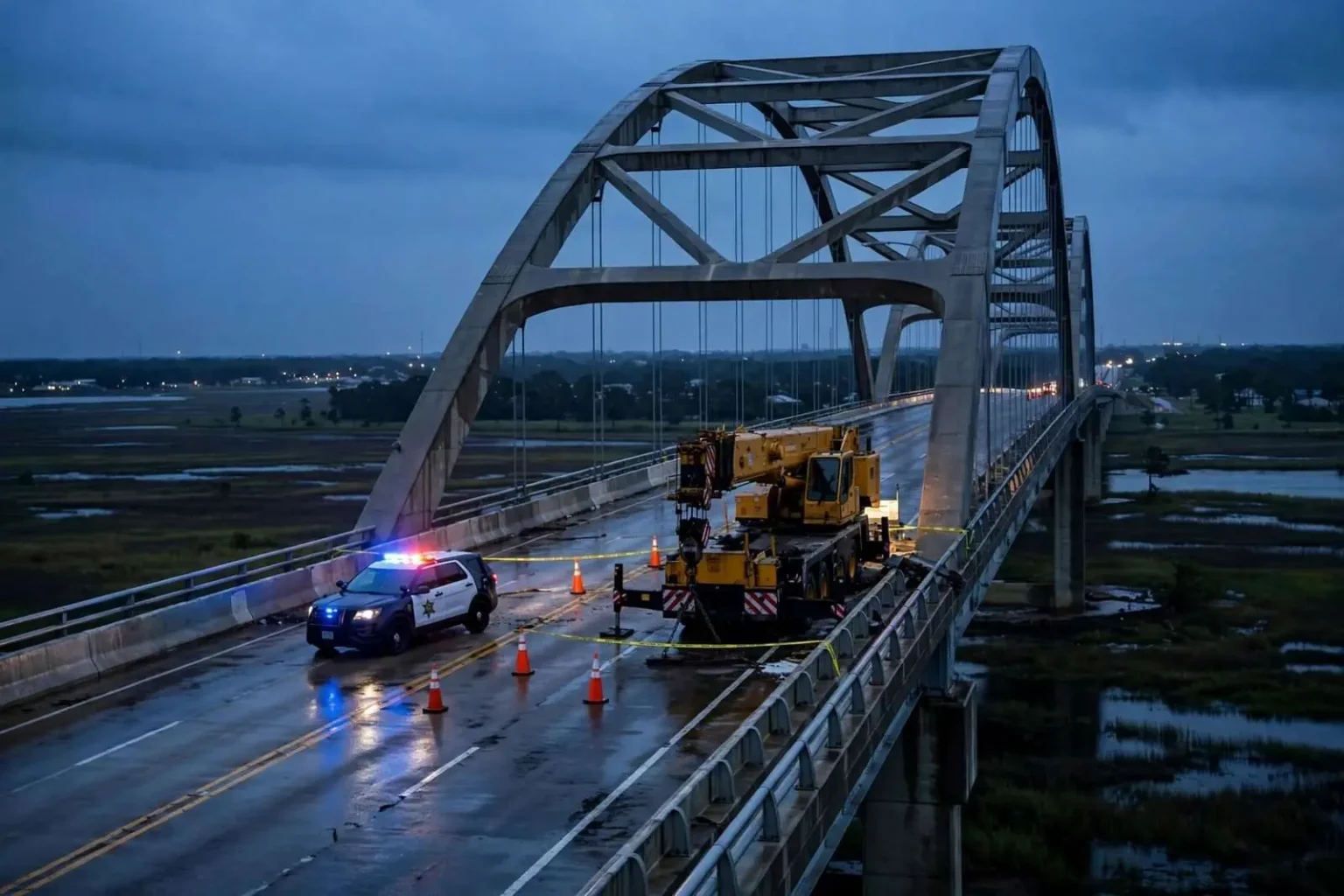
MOBILE, Alabama — A Theodore man was convicted of felony criminally negligent homicide following a jury trial connected to a 2012 crash on the General W.K. Wilson Memorial Bridge that killed a Citronelle husband and wife, closing out a case that had lingered in Mobile County courts for more than two years.
The 39-year-old defendant was found guilty in connection with the deaths of a 74-year-old man and his 65-year-old wife, both longtime Citronelle residents. The couple died after the pickup truck they were riding in collided with the back of a crane the defendant had been operating on the Interstate 65 bridge spanning the Mobile River area on Oct. 26, 2012.
What investigators found
According to the accident report used in the case, the defendant admitted to using methamphetamine before starting his trip that day and showed several indicators of impairment during field sobriety testing. He refused to submit to a chemical test of his blood at the time of the crash.
Investigators determined that he had been driving well below the safe speed for road and traffic conditions and allowed his vehicle to come to a stop directly in a lane of travel, resulting in the fatal collision. The combination — a slow, heavy vehicle stopped in an active interstate lane — left the following driver with little opportunity to avoid the crash.
The refusal of a chemical test is significant in Alabama prosecutions: it deprives investigators of a definitive measurement but does not end the case, since officers’ observations, admissions and field sobriety results remain admissible. Prosecutors in this case built their account from exactly that record.
Criminally negligent homicide, the charge the jury considered, requires evidence that a defendant’s failure to perceive a substantial and unjustifiable risk amounted to a gross deviation from reasonable care. Operating heavy equipment on an interstate after admitted drug use, at speeds far below the flow of traffic, formed the core of the state’s theory.
The bridge where it happened
The General W.K. Wilson Memorial Bridge — known locally as the Dolly Parton Bridge for its arched silhouette — carries Interstate 65 across the Mobile River and its wetlands north of the city, one of the most important links in south Alabama’s highway network. Traffic between Mobile and Montgomery, and between the Gulf Coast and the rest of the state, funnels across its span.
The bridge has seen periodic construction and maintenance work over the years that requires heavy equipment to operate in or near active travel lanes. Those work zones compress traffic into narrow paths at highway speed, and any vehicle that slows or stops in a travel lane creates exactly the hazard this crash demonstrated.
Federal work-zone safety guidance places much of the burden on equipment operators and their employers: warning signs, barrier protection, lighting and — above all — vehicles that remain visible and predictable to approaching traffic. A stopped or crawling vehicle on a high-speed bridge is among the most dangerous conditions a following driver can encounter.
Safety officials recommend that drivers who encounter slow-moving equipment on a bridge or in a work zone change lanes as early as possible, keep their distance until past the equipment, and resist the urge to pass in gaps that leave no margin for a sudden stop. The seconds of foresight are what the following driver in this case never had.
The case underscores the dangers posed by slow-moving or stopped construction and utility vehicles on interstate bridges, where traffic often moves at highway speed with limited opportunity for following drivers to react.
A community waits more than two years
The crash happened in October 2012; the verdict came more than two years later. Cases involving fatal interstate crashes move slowly through the courts for reasons both routine and serious: accident reconstruction, toxicology questions, witness scheduling and the volume of the felony docket in a county as large as Mobile all stretch the timeline.
For the victims’ family, the delay is its own burden. The couple were longtime residents of Citronelle, a small city in the far northwest corner of Mobile County near the Clarke and Washington county lines, where the loss of a married couple of long standing was felt across the community.
Citronelle sits at the end of a stretch of rural highway country, and its residents make regular trips south on I-65 for medical care, shopping and work in Mobile. The bridge where the crash occurred is a road segment many in the community travel often, which made the circumstances of the couple’s deaths land with particular force close to home.
The deaths of the Citronelle couple sent ripples through their small Clarke-Mobile County border community, where the family had deep roots and the circumstances of the crash — a bridge, a crane, an impaired operator — were discussed for months afterward.
Prosecution and sentencing
Prosecutors in Mobile County have pursued the case as an example of the consequences of operating heavy equipment on public roadways while impaired. Jury convictions in criminally negligent homicide cases arising from traffic deaths are far less common than plea resolutions, and the verdict reflected the jury’s weighing of the evidence gathered after the crash.
A sentencing hearing has been scheduled for late February, when a judge will determine the penalty for the negligent homicide conviction. The hearing will consider the standard sentencing factors: the defendant’s record, the circumstances of the offense, and statements from the victims’ family before the court imposes its sentence.
Felony convictions also carry consequences beyond the sentence itself — a permanent felony record affecting employment, licensing and, in a case involving commercial-style equipment operation, the ability to work in the fields the defendant had worked in.
The verdict closed the criminal case’s trial phase, but for the family of the Citronelle couple it represented a milestone rather than an ending: the sentencing still ahead, and after it, the long adjustment of a life in which two people who traveled that bridge together are gone.
The wider problem on Alabama interstates
Crashes like this one fit a pattern that highway safety officials have documented for years: collisions involving slow or stationary vehicles on high-speed roads, often in or near work zones. The difference in speed between a crane crawling at a fraction of the traffic flow and the cars approaching it from behind is itself a hazard, independent of anything else going wrong.
Alcohol and drugs compound the danger in both directions. Impairment slows reaction time and judgment for the operator of the heavy vehicle; for the drivers approaching from behind at 70 miles per hour, there is no compensation for a truck stopped in their lane with no warning. The combination is what investigators reconstructed on the Wilson Bridge that October night.
Alabama law treats refusing a chemical test as a separate administrative matter, with license consequences handled apart from the criminal case. In prosecutions like this one, the state proceeds on the observations officers recorded — the admission of use, the field sobriety indicators, the driving pattern — evidence the jury in this case evidently found sufficient.
Heavy equipment operators and the companies that employ them face their own obligations. Commercial operators are held to stricter standards regarding drug and alcohol use, and crashes involving company equipment on public roads can expose employers to scrutiny over hiring, testing and supervision practices.
What the verdict means
For Mobile County prosecutors, the conviction affirmed the theory they had carried for more than two years: that the crash was not a tragic accident of circumstance but the foreseeable product of choices — the drug use, the decision to drive, the vehicle stopped in a live interstate lane.
The case also stands as a reminder to drivers sharing interstate bridges with work vehicles. Safety guidance for approaching slow or stopped equipment is consistent: reduce speed early, watch for warning signals and workers, and never assume a heavy vehicle will resume its pace in time to matter. On a bridge, there is little shoulder and nowhere to go.
For the Citronelle community, the verdict delivered the legal system’s answer to the question the crash had posed since 2012. The sentencing hearing set for late February will put a final figure on the consequences, and the couple’s family will have the right to address the court before it does.
The Wilson Bridge itself carries on as it has — carrying I-65 traffic over the Mobile River delta every day, through whatever work zones its aging structure requires. The crash and the conviction that followed are now part of its record, a case study in how quickly an ordinary drive across the span can end, and of the choices that separated an evening’s routine from two lives lost and a jury’s verdict two years later.