Mobile Attorney Helps Reunite Stolen Navy Sword With Its Original Owner
A Mobile lawyer's $40 pawn shop find turned into a decades-spanning search that reunited a Korean War Navy pilot with a sword stolen in 1971.
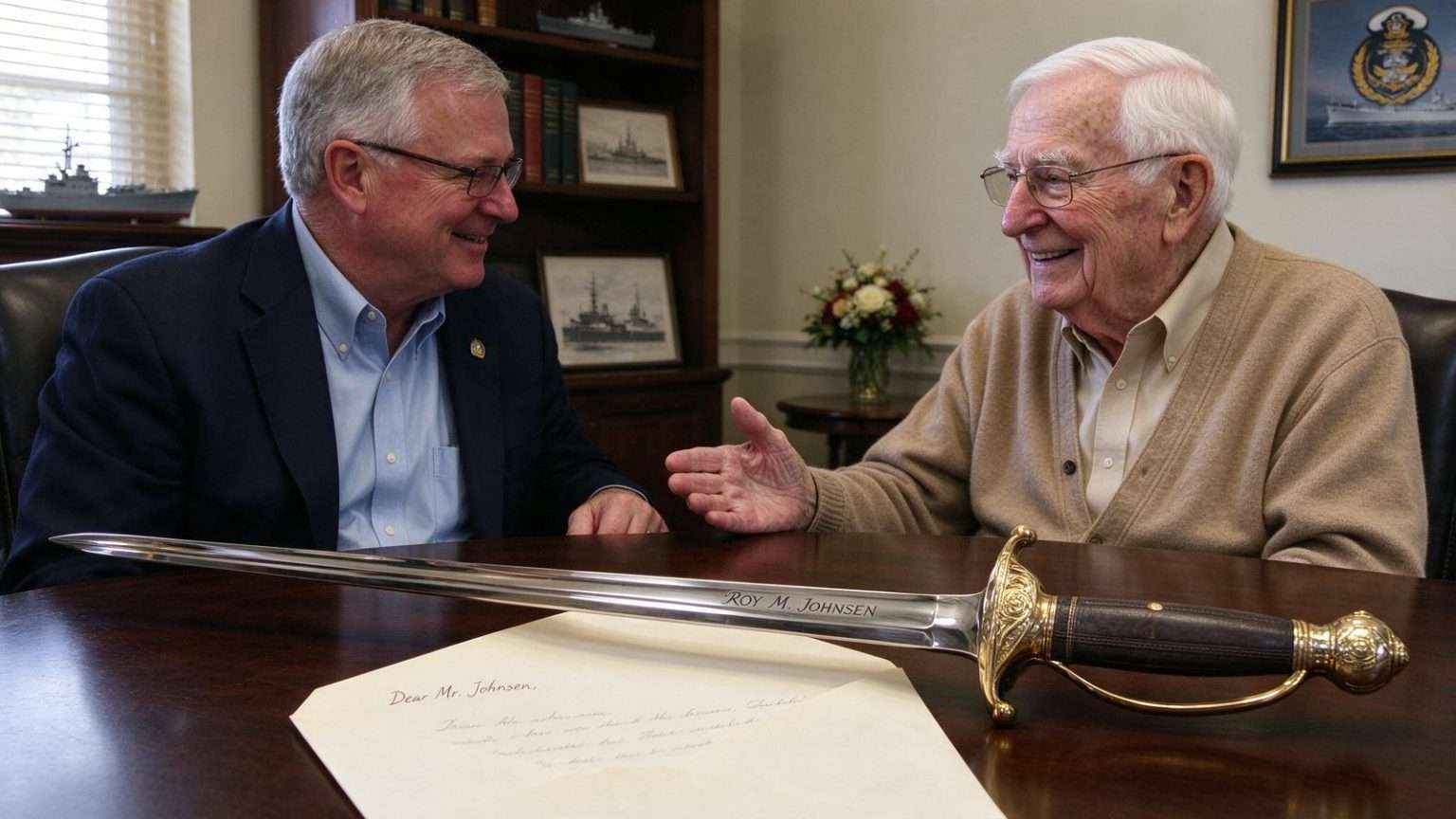
A chance find in a Mississippi pawn shop has turned into a story of persistence and goodwill that started right here in the Mobile area. Mobile attorney Chip Herrington purchased an engraved Navy officer’s sword for $40 at a shop in Ocean Springs, Mississippi, with little more than curiosity about its history. What began as an impulse buy of a piece of military metalwork would end, months later, with a phone call to a retired Navy pilot in Pennsylvania and the discovery that the sword had been stolen from its rightful owner more than four decades earlier.
What Herrington didn’t know at the time was that the sword had been missing since 1971. After examining the engravings and doing some digging, he was able to trace the weapon back to its original owner: Roy M. Johnsen, an 85-year-old retired Navy pilot who flew during the Korean War. The engraving work on a ceremonial sword of this kind typically carries the owner’s name, and that personalization is what made the detective work possible, turning an anonymous pawn shop purchase into a document of sorts, one that pointed directly to the man who had once carried it.
Johnsen, who now lives in Pennsylvania, told Herrington the sword had been stolen from him back in 1971. For more than 40 years, it changed hands without any indication of where it came from or who it belonged to, until it landed on a pawn shop shelf across the bay from Mobile. Swords like this one survive precisely because they are well made and treasured, but that same durability means they can drift through estate sales, collections and resale shops for decades, carrying their story silently along the way.
From Pawn Shop Shelf to National Attention
Herrington’s search for the sword’s rightful owner eventually caught the attention of a reporter with a major national newspaper, who interviewed the Mobile attorney by phone as the story spread well beyond the Gulf Coast. What began as a local curiosity turned into a nationally shared example of quiet generosity and old-fashioned detective work, the kind of story that travels because it runs against the grain of expectations about what happens to lost property.
Tracing a military artifact across four decades is no small task. It required reading the engravings carefully, researching the name they pointed to, and following the trail far enough to connect a name to a service record and a service record to a living veteran. That Herrington did the work without any obligation to do so — having paid $40 for an object he could simply have hung on a wall — is the part of the story that has resonated most with readers in Mobile and far beyond it.
Rather than simply mailing the sword back, Herrington said he hopes to arrange for Johnsen to travel to Mobile so the two can meet and the sword can be returned to him in person. For a piece of military history that spent over 40 years separated from its owner, a face-to-face homecoming felt like the right way to close the story, and it would give the two men a chance to share the remarkable journey the sword took between them.
The Weight of a Ceremonial Sword
Local historians note that engraved military swords like this one often serve as treasured family heirlooms, making Herrington’s effort to track down its rightful owner especially meaningful. Navy officers have long received or purchased ceremonial swords as part of their dress uniforms, and the swords frequently carry engravings marking the owner’s name, commission or milestones in a career at sea. Passed from generation to generation, they end up as some of the most personal artifacts a military family keeps, which is why the theft of one cuts deeper than the loss of the object itself.
For Johnsen, the sword’s story is tied to his own. As a Navy pilot during the Korean War, he served in a conflict that began in 1950 and that Navy aviators flew from carriers operating off the Korean Peninsula, supporting ground forces and interdiction missions in some of the war’s hardest fighting. A ceremonial sword from that era of his life is a marker of a commission earned and a career begun, the kind of object a young officer keeps for a lifetime and expects to hand down one day.
The fact that the sword was stolen in 1971 and resurfaced in a pawn shop in Ocean Springs — a coastal Mississippi town just across the state line from the Alabama beaches — is a reminder of how far and how aimlessly stolen property can travel. Objects stolen in one state routinely surface for sale in another, and without an engraving or a serial number, most never find their way home. In this case, the personalization that made the sword valuable to collectors is exactly what made it traceable.
A Story That Landed in Mobile
The tale is a reminder of how small, personal gestures in a place like Mobile can carry weight far beyond the city limits, and of how much history can be tied up in a single object passed from hand to hand for decades. The Gulf Coast has a deep military heritage, from the Navy and Coast Guard presence around Mobile Bay to the generations of local families with service records reaching back through every American conflict, and stories of lost service artifacts finding their way home tend to strike a chord here.
Pawn shops and resale dealers along the Gulf Coast handle a steady stream of military memorabilia, and encounters like Herrington’s raise an obvious question for anyone who spots a name-engraved piece: who did this belong to? Most such items will never be claimed, but the possibility that an object is a stolen heirloom rather than an abandoned one is what turned a $40 purchase into a months-long effort to find one man in Pennsylvania.
For Johnsen, a decorated veteran of a war often overshadowed by others in American memory, the return of a personal keepsake lost since the early 1970s offers a small but powerful sense of closure, thanks to one Mobile attorney’s willingness to chase down the truth. Whether the homecoming happens in Mobile as Herrington hopes or elsewhere, the sword’s 40-year detour is finally nearing its end, with the man who bought it on a whim determined to put it back in the hands of the officer it was made for.
Why These Reunions Resonate
Stories of stolen military keepsakes finding their way home are rare enough that each one draws attention, and the Herrington-Johnsen reunion has the elements that make such accounts spread: a modest purchase, a patient search, a name on a blade and an owner still living to receive it. Many families never learn what became of the medals, swords and uniforms that disappeared from an attic or a storage unit decades ago, which makes every successful recovery a stand-in for the recoveries that never happen.
The case also illustrates the unusual position hobbyists and buyers of secondhand militaria occupy. Collectors who take the time to research engraved names and service numbers occasionally uncover pieces with contested histories, and the decision to pursue a return — rather than keep quiet about what the research revealed — is what separates a responsible custodian from a mere owner. Herrington’s choice to run the trail all the way to its end turned what could have been a private purchase into a public good.
For the Mobile area, the story has played as a homegrown one even though the sword’s final chapter will be written in Pennsylvania. The purchase happened across the bay in Ocean Springs, but the effort, the persistence and the publicity all ran through Mobile, where the attorney who made the calls and did the digging practices. It is a small point of local pride in a story that has traveled nationally, and a reminder that the region’s military ties run deep enough that its residents notice when a piece of that history turns up for sale down the road.
What Comes Next
The remaining question is logistical: whether Johnsen, at 85, will make the trip to Mobile for an in-person handoff, or whether the sword will travel to him if travel proves too much. Herrington has said he prefers the meeting, and for two men connected by a blade one of them bought for $40 and the other last held half a century ago, the ceremony of a face-to-face return would close the circle in a way a shipping box cannot.
Until then, the sword remains a physical link between a Navy career that began in the Korean War era and a Gulf Coast attorney who happened to recognize that an engraved name was a story waiting to be told. Four decades of silence ended with a phone call, and the object that was stolen in 1971 is finally headed home, carried the last mile by someone who was never obligated to carry it at all.