Mobile Police Investigate Assault Report at Mobile Infirmary Involving Patient Under Anesthesia
Mobile police are investigating a patient's report of an assault at Mobile Infirmary while she was still recovering from anesthesia.
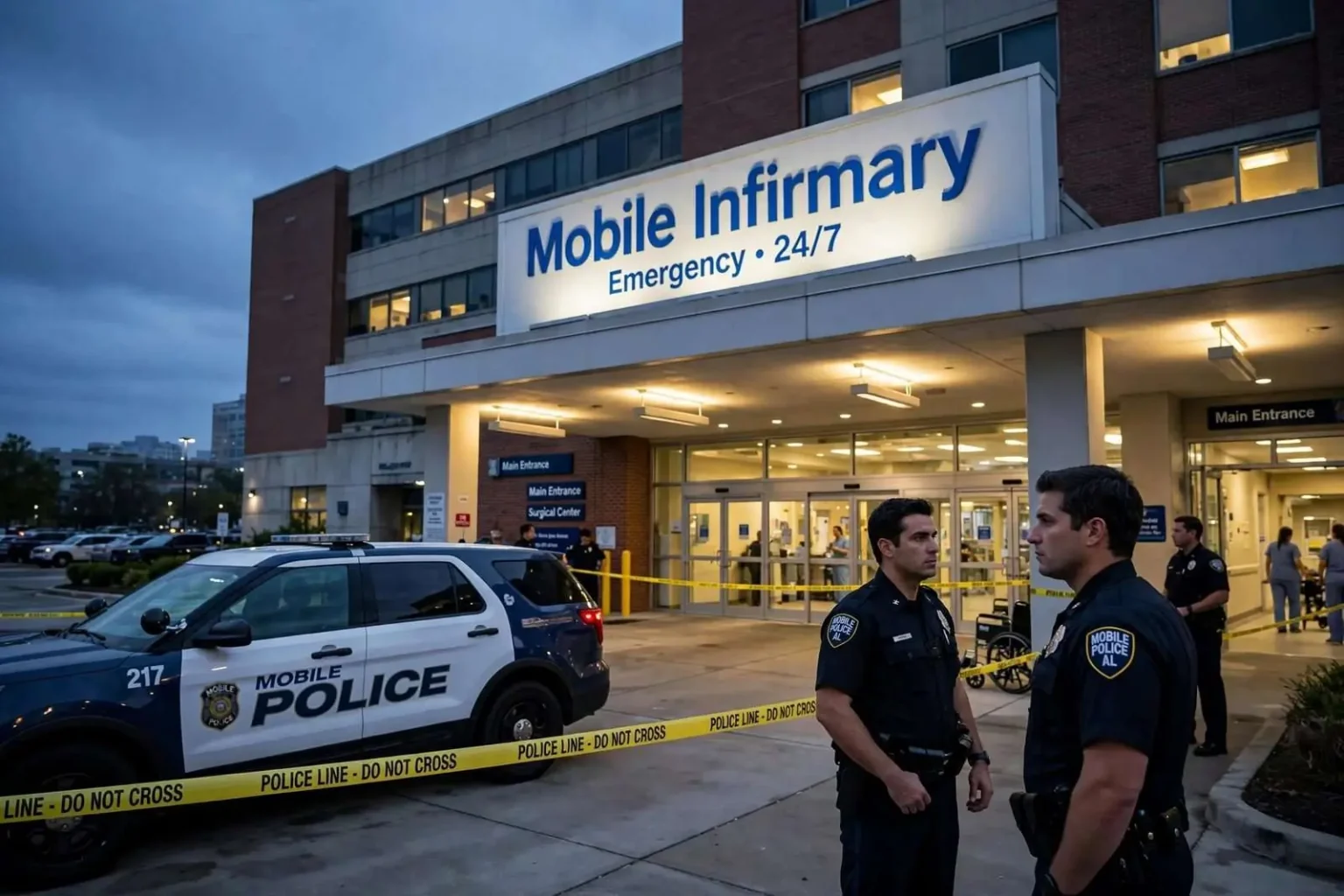
Mobile police are investigating a report that a patient was sexually assaulted at Mobile Infirmary while she was still recovering from the effects of anesthesia following a medical procedure. The allegation involves one of the city’s largest and longest-serving hospitals and has raised difficult questions about patient safety during the hours when surgical patients are at their most vulnerable — sedated, disoriented, and often alone in a hospital room.
According to a police spokesperson, the woman told officers that a stranger entered her hospital room and attacked her around 6:30 p.m. on a recent Thursday evening. The time of the reported attack falls within the evening hours, when visiting schedules wind down and hospital floors grow quieter, though police have not detailed how the person she described gained access to her room or whether the description matches any hospital staff member or visitor.
Investigators were still working Friday morning to determine the circumstances surrounding the report, and police had not said whether the woman had undergone a forensic examination for signs of assault. Such examinations are a standard early step in sexual assault investigations, performed by trained examiners, and their results often figure heavily in how a case proceeds. The department declined to discuss specifics of the evidence in the case while the investigation remained open.
Police noted that the department has responded to similar reports in the past that were ultimately determined to be related to anesthesia-induced hallucinations rather than an actual assault, though officials stopped short of saying whether they believed this case fell into that category. The acknowledgment is a measure of the investigative complexity these cases present: officers must treat every report seriously while also accounting for the physiological state of a patient who was, by her own account, under the influence of powerful anesthetic drugs when the incident allegedly occurred.
The medical reality of anesthesia recovery
Medical literature on the subject, including research published in a European anesthesiology journal, has documented that vivid dreams and hallucinations of a sexual nature are a recognized, if uncommon, side effect for some patients recovering from sedation, and that such experiences can be difficult to distinguish from real events, complicating investigations into these types of reports. Researchers who study the phenomenon note that certain anesthetic agents and sedatives are more associated with vivid dreaming than others, and that patients emerging from sedation may experience a blurred boundary between dream and memory that can persist into full wakefulness.
For investigators, that documented phenomenon does not settle any individual case — patients are assaulted in medical settings, and recovery-room confusion is not assumed — but it adds a layer that does not exist in most criminal inquiries. Detectives typically turn to corroborating sources that do not depend on the patient’s perception: hospital security footage, electronic access logs, staff schedules, the accounts of nurses and aides who were on the floor, and any physical evidence a forensic examination might produce.
That work is painstaking, and it is one reason police departments often move slowly in announcing conclusions in hospital-based reports. The Mobile Police Department has not released details about what, if anything, investigators have found so far, and no timetable has been given for determining whether the report will result in charges.
Hospital administrators at Mobile Infirmary said the facility was fully cooperating with the Mobile Police Department as the investigation proceeded. The hospital, part of a health system that has served the Mobile area for generations, operates a busy surgical program, and administrators emphasized that patient care and safety remained the facility’s priorities while authorities conducted their work. Administrators did not describe any changes to hospital procedures connected to the report.
How these cases proceed
No arrests had been announced as of the initial report, and police described the matter as an active and developing investigation. Until detectives complete their interviews and review of hospital records, the department is unlikely to say publicly whether it considers the account credible, whether a suspect has been identified, or whether the case may be resolved without any criminal act having occurred.
Cases involving reported assaults on medicated or sedated patients present unique challenges for investigators, who must weigh a patient’s account against the medical realities of anesthesia recovery, including confusion, disorientation and altered perception that can accompany the process. The setting itself adds complexity: hospital rooms have a steady flow of legitimate visitors — nurses checking vitals, aides delivering care, dietary staff, phlebotomists — and distinguishing among them requires precise records of who was where and when.
Prosecutors weigh the same questions if a case reaches them. A charging decision would typically rest on corroboration beyond the patient’s account, and defense attorneys in such cases routinely focus on the patient’s sedated state at the time of the alleged events. The result is that hospital-based reports of this kind often take longer to resolve than similar allegations made in ordinary settings.
Hospitals across the country have adopted varying safeguards, including staff monitoring and post-anesthesia care protocols, designed to protect patients during recovery from sedation. Post-anesthesia care units concentrate newly surgical patients in monitored settings with higher staffing ratios for the first hours after a procedure, and many hospitals require that patients recovering in standard rooms remain observable from nursing stations. Policies on visitor access during recovery hours, identification badges for clinical staff, and security patrols of patient floors all figure into the protective framework hospitals have built over time.
For now, the investigation remains in the hands of Mobile police detectives, with the hospital cooperating and no arrest announced. Police say more information will be released as the case develops.
The hospital and the community it serves
Mobile Infirmary occupies a significant place in the city’s healthcare landscape. The facility traces its roots back more than a century, making it one of the oldest hospitals in the region, and it has grown into the flagship of a health system that operates multiple hospitals, outpatient centers, and specialty clinics across southwest Alabama. Thousands of patients pass through its surgical program each year, and the vast majority of them move through the process — admission, procedure, recovery, discharge — without incident.
That scale is what makes a report like this one stand out. Hospital-based allegations of assault are rare relative to the volume of patients treated, which is precisely why they draw intense attention when they surface: patients surrender a degree of control at the hospital door, and the public expects that the most vulnerable hours of a hospital stay — the groggy, sedated hours after surgery — are guarded as carefully as any other.
For patients and families in Mobile, the report is likely to prompt practical questions about what protections exist and what to ask for. Patient advocates generally encourage family members of surgical patients to plan for coverage during recovery hours, to ask where the post-anesthesia recovery will take place, and to speak up immediately with nursing staff if anything about a patient’s care or surroundings seems wrong. Hospitals in turn rely on that vigilance as one more layer alongside their own protocols.
The Mobile Police Department, for its part, has emphasized through its spokesperson that the case is being handled like any other reported assault — meaning the woman’s account is being taken seriously, evidence is being gathered, and no conclusions have been reached. Department practice in sensitive investigations generally limits what can be shared publicly, both to protect the integrity of the inquiry and to avoid prejudicing any eventual prosecution.
What comes next
The immediate next steps in the investigation are routine in form even if the setting is unusual. Detectives will continue interviewing the patient, hospital staff who were working Thursday evening, and anyone else with relevant knowledge. Records requests to the hospital — security video, badge access logs, staffing rosters, room assignment histories — typically follow. If a forensic examination was performed, its analysis becomes a central piece of the file.
Depending on what detectives find, the case could go several directions. If evidence corroborates an assault and identifies a suspect, an arrest would follow and prosecutors would take up the case. If the investigation instead supports the possibility that the experience arose from sedation-related hallucination, police would close the inquiry with that finding explained. There is also the possibility that the investigation produces an inconclusive result — a genuine risk in cases where the only direct witness was under anesthesia at the relevant time and physical evidence is absent.
That uncertainty is familiar to law enforcement agencies nationwide. Departments that have handled comparable reports often consult medical experts on anesthetic agents and their psychological side effects, using pharmacological records from the patient’s procedure to assess whether the specific drugs involved are among those associated with vivid or sexualized dreaming. The patient’s own medical history, dosage, and the timing of her emergence from sedation all become relevant details.
Hospital administrators, meanwhile, will face questions of their own regardless of the outcome. Even a report that resolves into a hallucination case prompts review of floor staffing, visitor management, and room observation policies, and any hospital’s cooperation with police — as Mobile Infirmary’s administrators have promised — is generally accompanied by an internal look at the same questions.
For now, the facts in public view are limited: a patient’s report, an evening hour, a hospital cooperating with detectives, and an investigation described as active and developing. Mobile police say findings will be made public when the inquiry allows, and until then, the department is asking anyone with information relevant to Thursday evening at the hospital to come forward.