
Mobile Families Say One Last Goodbye to Lavretta Park Playground Ahead of $1.1 Million Rebuild
Mobile held a Last Day to Play event at Lavretta Park before the Old Shell Road playground closes for a $1.1 million rebuild expected to reopen early next year.
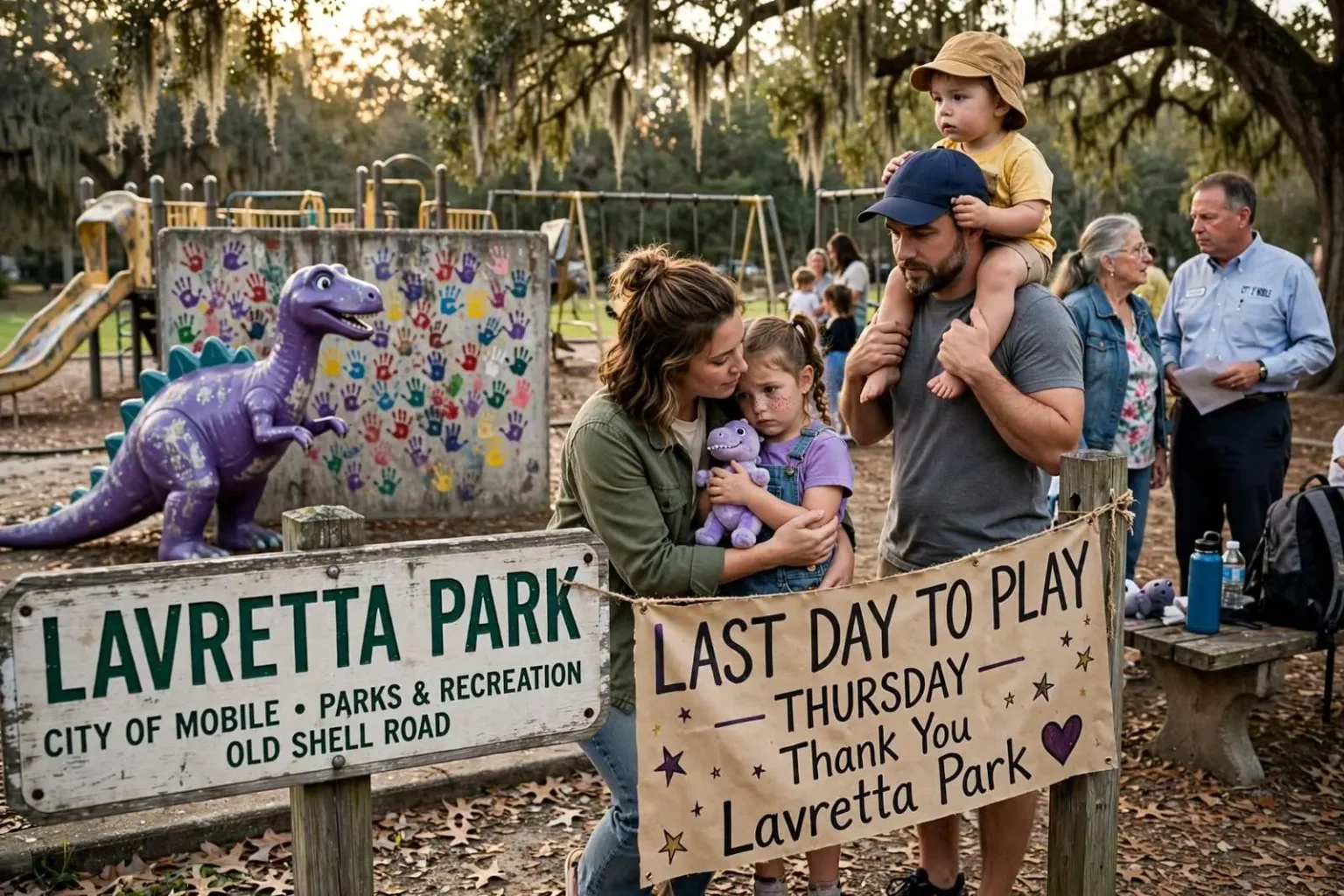
MOBILE, Ala. — Families filled the playground at Lavretta Park on Old Shell Road one final time this week as the city of Mobile marked the closing day of play before construction begins on a $1.1 million replacement.
The “Last Day to Play” event on Thursday gave children and parents a chance to enjoy the existing playground before crews shut it down for the major upgrade. City leaders joined neighbors for the send-off, which doubled as a first look at what is coming next for one of the Spring Hill area’s best-known parks.
A redesign built for every kid
Renderings released by the city show a dramatically reworked play area, with separate zones designed for toddlers and for older children, new swings, a rock wall, a zip track and a mound-and-tunnel feature intended to encourage imaginative, active play.
Mobile Mayor Spiro Cheriogotis said the new layout will let children of different abilities play alongside one another — something he called the heart of the project.
“We’re going to have kids with different abilities able to play right here together at the same time. That just makes my heart sink,” Cheriogotis said. “But there are some pieces of this park that are so special to the people who really invested time, energy and money into it to make it a reality. Like the handprint wall, the purple dinosaur. We want to make sure we preserve those things.”
Keeping the pieces families love
The mayor’s comments pointed to a challenge that often comes with playground rebuilds: balancing modern, inclusive equipment with the familiar features a community has grown attached to. City officials have indicated that beloved touches like the handprint wall and the park’s purple dinosaur will carry over into the new design.
Neighbors say the playground has long served as an easy meeting place for families in the surrounding neighborhoods. Community member Kellie Myers said public playgrounds have a way of turning strangers into playmates.
“This is the thing I love about public parks, is that you can have a child that doesn’t have anyone to play with but if they go out to a playground, they are going to find someone to play and going to find a new friend and that’s one of the things that we found with this one,” Myers said.
What comes next
Construction on the replacement playground is expected to take about four months. City officials say the new play area should reopen early next year, giving families a rebuilt destination in time for spring.
Playground projects like the one at Lavretta Park have become a priority for cities across the Gulf Coast as equipment ages and accessibility standards evolve. Modern designs typically separate play zones by age group, add ground-level and ramp-accessible features, and use surfacing that accommodates wheelchairs and other mobility devices.
In the meantime, families who made the Old Shell Road park part of their weekly routine will need to look elsewhere for a few months. The city says the wait should be worth it: a playground built to serve every child in the neighborhood, with the memories of the old one preserved in place.
What “Inclusive” Playground Design Actually Means
The push toward inclusive playgrounds, like the one planned for Lavretta Park, reflects a broader shift in how cities across the country approach park design over the past decade. Traditional playgrounds were often built around a single central structure reachable primarily by climbing, which effectively excluded children who use wheelchairs, walkers or other mobility devices, as well as children with sensory sensitivities who benefit from quieter, lower-stimulation play areas. Modern inclusive designs generally build in several features at once: ground-level and ramp-accessible pathways so a child does not have to climb stairs to reach elevated platforms, play surfaces made of poured rubber or engineered wood fiber that can support wheelchairs and reduce injury from falls, and separate zones sized appropriately for toddlers versus older children so that equipment scaled for a 10-year-old is not also the only option available to a 3-year-old. Features like the mound-and-tunnel element and zip track described in the Lavretta Park renderings are common in this newer generation of playground design because they offer sensory and physical variety — climbing, sliding, spinning, tunneling — without relying on a single tall structure that only some children can safely use.
National organizations that certify playground safety, including the Certified Playground Safety Inspector program administered through the National Recreation and Park Association, have increasingly incorporated accessibility guidelines alongside traditional injury-prevention standards. Cities that pursue this kind of rebuild are generally working from Americans with Disabilities Act guidance on accessible play areas, which sets specific requirements for the proportion of elevated play components that must be reachable by an accessible route, as well as requirements for accessible ground-level components. For a mid-sized city, a project at Lavretta Park’s scale — with a budget in the seven figures — is typically large enough to meet or exceed those federal accessibility thresholds rather than simply satisfying a minimum requirement, which is consistent with the mayor’s framing of the project as designed for children of different abilities to play together rather than in separate areas.
How Cities Fund Major Park Rebuilds
A $1.1 million playground project is a significant capital expense for a municipal parks budget, and cities typically assemble funding for projects of this size from more than one source rather than a single line item. Common funding streams for park capital projects in Alabama and elsewhere include municipal capital improvement budgets, state or federal recreational grant programs, and, in some cases, private or nonprofit fundraising tied to a specific park’s “friends” group or neighborhood association. Because playground equipment has a finite lifespan — manufacturers and safety inspectors generally estimate 15 to 20 years for most structures depending on materials, usage and maintenance — cities with older parks departments often maintain a rolling schedule of which playgrounds are approaching replacement age, prioritizing the ones with the most significant safety or accessibility gaps first. A rebuild on the scale planned for Lavretta Park frequently involves not just new equipment but updated drainage, new safety surfacing across the entire play area, and, in many cases, ADA-compliant pathways connecting the playground to nearby parking and park amenities, all of which add to the overall project cost beyond the price of the play structures themselves.
Why Neighborhood Parks Matter Beyond Recreation
Public health researchers and urban planners have documented for years that neighborhood-level parks and playgrounds serve a role that goes beyond simple recreation, functioning as one of the few remaining public spaces where residents from different backgrounds and income levels routinely interact without any cost or membership requirement. Studies on childhood development consistently point to unstructured outdoor play as important for physical health, social skill development and emotional regulation, and researchers who study “third places” — settings outside of home and work or school where community relationships form — frequently point to neighborhood playgrounds as one of the most accessible examples of that concept in everyday life. For a well-established park like Lavretta Park, closing the playground even temporarily during construction represents a real disruption to a routine many families in the surrounding Spring Hill-area neighborhoods have built their weeks around, which is part of why cities undertaking similar projects elsewhere have found that a send-off event, along with clear communication about a reopening timeline, helps ease the transition for families who will need to find alternate places to play in the interim.
Balancing Nostalgia With New Safety Standards
City officials undertaking playground rebuilds frequently face a version of the same tension described at Lavretta Park: longtime favorite features, like a handprint wall or a decades-old dinosaur sculpture, were often built to older safety and material standards that would not meet a modern playground’s requirements if left exactly as they are, even though residents want them preserved. In most rebuild projects of this kind, cities and their contractors handle this by relocating or restoring beloved non-play elements — art installations, memorial features, community-built additions — outside the fall-zone area governed by current playground safety standards, while replacing the actual play equipment entirely with new, code-compliant structures. That approach lets a rebuilt playground meet current Consumer Product Safety Commission guidelines on things like fall height, spacing between structures, and surfacing impact ratings, without erasing the features that gave a specific park its identity within the neighborhood.
Parks departments that have gone through similar projects elsewhere on the Gulf Coast say resident input sessions, of the kind Mobile appears to have incorporated into the Lavretta Park redesign process, tend to surface exactly this kind of preference early enough in the design phase to be worked into final plans, rather than after equipment has already been ordered. That is part of why cities increasingly hold “last day” events or design unveilings well before construction begins: they give residents a final chance to flag anything they feel strongly about preserving, while also building public buy-in for a temporary closure that can otherwise generate frustration among families who rely on a specific park as part of their weekly routine.


