Employee Cut During Late-Night Robbery at Mobile Papa John’s
A Papa John's employee on Schillinger Road was cut by robbers demanding money while he was taking out the trash late Wednesday night, Mobile police said.
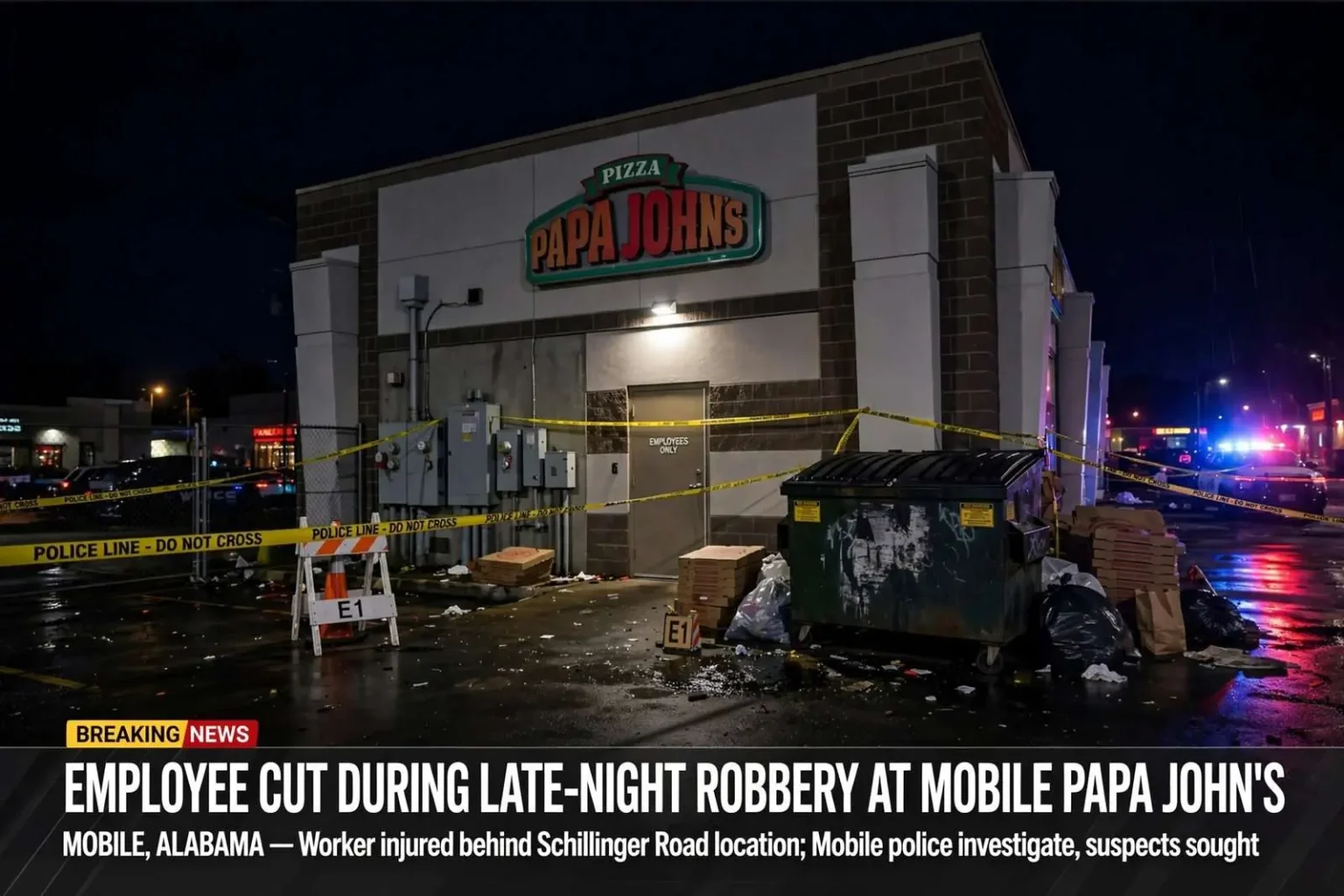
MOBILE, Alabama – An employee at a Papa John’s pizza location on Schillinger Road was injured during a robbery late Wednesday night, according to Mobile police.
The incident occurred around 11:30 p.m. when the worker stepped outside to take out the restaurant’s trash and was approached by two men, according to a Mobile Police Department spokesman. One of the men was described as white and the other as Black; both remain unidentified.
Police said the pair demanded property from the employee while one of them brandished a sharp, metal object. When the worker told the men he did not have anything of value on him, he was cut across the arm and chest during the confrontation.
The attack behind the restaurant
The employee’s injuries were described by police as non-life-threatening, and he was able to seek treatment following the attack.
The sequence described by investigators is one that public-safety officials in the area have warned about for years: an employee alone, behind a business, at the end of the night, performing a routine task that pulls him out of public view. Taking out the trash at a restaurant means stepping away from the register, the cameras and any customers — often through a rear door into a dimly lit service area. For anyone watching, it marks both a moment of vulnerability and a predictable one, which is why the dumpsite behind a food-service business is among the most common locations for after-hours robberies.
That the worker was cut across the arm and chest despite having nothing to hand over illustrates the volatility of these encounters. Robbers who expect cash and find none sometimes escalate rather than withdraw, and an employee who cannot produce valuables is exposed to violence that has no practical purpose. The non-life-threatening outcome was, in the circumstances, a matter of luck as much as anything the worker could control.
Investigators have not announced any arrests in connection with the robbery. Mobile police asked anyone with information about the incident, including possible descriptions of the suspects or a vehicle used to flee the area, to contact investigators.
The Schillinger Road corridor
The Schillinger Road corridor is home to numerous restaurants, retail stores and other businesses that operate into the evening hours, making it a frequent area of focus for Mobile police patrols.
Schillinger Road runs through west Mobile, one of the fastest-growing parts of the city, where residential subdivisions built out over the past three decades are served by strip centers and standalone businesses clustered along the thoroughfare. Fast-food restaurants, convenience stores, pharmacies and grocery-anchored shopping centers line the road and its crossings, and several of them operate until 11 p.m. or midnight. That combination — long hours, scattered parking lots, limited lighting between storefronts — makes the corridor busy at exactly the hours when staffing inside is thinnest and the streets outside are quietest.
Late-night robberies targeting employees taking out trash or closing up businesses have periodically prompted local restaurants and retailers to review security procedures for staff working after dark.
What businesses change after an attack like this
Business owners in the area have at times worked with law enforcement on safety measures such as improved lighting near rear entrances and dumpster areas, where employees are often most vulnerable during trash removal or other routine tasks performed outside public view.
The playbook that follows incidents like Wednesday night’s is well established among restaurant operators. Floodlighting at rear doors and dumpster enclosures comes first, because lighting is cheap, visible and effective. Some stores pair the rear door with a camera trained on the walk-out route, and others adopt policies that no employee takes out trash or unlocks the back door alone — the task waits for two people or moves to daylight hours. Timed door locks, drop safes and “no late-night cash” policies reduce the payoff for a would-be robber, and managers train closing crews to keep sightlines clear and to call in anything unusual before stepping outside.
Mobile police have encouraged precisely these steps in commercial corridors across the city, and officers who work west Mobile’s evening shifts know the Schillinger Road businesses well from routine checks. The department’s message to owners is consistent: most after-hours robberies are crimes of opportunity, and the opportunity narrows dramatically when a rear area is lit, visible and never accessed by a single person.
The investigation continues
The case remains open, and police continue to encourage residents and business patrons in the area to report suspicious activity promptly. Investigators noted that even minor details from witnesses can assist in developing leads in robbery cases where suspects are not immediately apprehended.
Robbery cases of this kind are often solved from the periphery rather than the center. The two men who approached the employee left behind no immediate arrest, but they almost certainly arrived and departed somehow — on foot from a nearby parking spot, or in a vehicle that passed through the lot at 11:30 on a Wednesday night. Anyone who was in the Papa John’s lot or driving along Schillinger Road at that hour may hold a fragment that matters: a partial plate, a direction of travel, a description of clothing that matches a stop police made elsewhere that night.
Detectives will also pursue the routine tools: camera systems at neighboring businesses, which in west Mobile increasingly cover parking lots and access roads, and any pattern in other area robberies that might connect the incident to a series. A sharp metal object used in an armed robbery, and a description covering two suspects of different races, are the kind of details that stand out in tip lines when the public knows to look for them.
For the employee, the injury is expected to heal. For the restaurant and its neighbors along the corridor, the robbery is a reminder that closing time — not the middle of the night, but the last hour of business — is when west Mobile’s commercial strips are most exposed. Police have not released the suspects’ descriptions beyond the broad outline, and anyone with information is urged to come forward while the details are still fresh.
How Mobile police work a late-night robbery
When the initial call came in, the response follows a pattern the department has refined across hundreds of robbery cases. Patrol officers secure the scene and check the surrounding blocks for anyone matching the suspects’ descriptions, on the chance the pair is still nearby. Paramedics evaluate the injured employee. Detectives then take over, walking the route the worker traveled from the restaurant’s back door, photographing the dumpster area, and collecting whatever physical evidence the confrontation may have left behind.
From there, the work moves to canvassing and cameras. Officers ask nearby businesses to preserve their footage from the preceding hours, because robbery suspects frequently scout a location beforehand or can be tracked to and from the scene on neighboring systems. The police department’s regional camera partnerships in west Mobile make that task faster than it once was, though coverage still varies block to block along the corridor.
The interview with the victim anchors everything. An employee who has just been cut across the arm and chest is asked, as soon as he is able, to walk through the encounter: which of the two men spoke, where they stood, what the metal object looked like, what words were used, and in what direction the men went when it was over. Those details, cross-checked against footage, give detectives the description they ultimately release to the public — in this case, two men, one white and one Black, one armed with a sharp metal object.
What residents along Schillinger Road can do
The department’s appeal for prompt reporting of suspicious activity is not a formality. In corridor business districts, the people best positioned to notice something wrong are the ones already there: customers in a drive-through line, employees on a smoke break, residents whose back fences face a shopping center’s rear lot. A car idling behind a restaurant at closing time, a person loitering near a dumpster enclosure, footsteps around a corner where no one should be — those observations, called in when they happen rather than recalled days later, are what turn robbery cases.
Police note that callers do not need to be certain anything criminal is occurring. Dispatchers would rather log a dozen calls that amount to nothing than miss the one that describes a robbery in progress or a suspect vehicle leaving the scene. In cases where an armed suspect has already shown willingness to cut an employee who had nothing to give, the next encounter could be worse, and each report helps officers saturate the area before a repeat.
Anyone with information about Wednesday night’s robbery — the suspects, the metal object, or any vehicle seen leaving the Papa John’s lot around 11:30 p.m. — can contact Mobile police investigators or leave an anonymous tip. The case remains open, and the details that seem smallest to a witness may be the ones that identify the men responsible.