Three Arrested in Fatal Prichard Convenience Store Shooting
Three men from Mobile face murder charges after a robbery at a Prichard convenience store turned deadly in November, according to authorities.
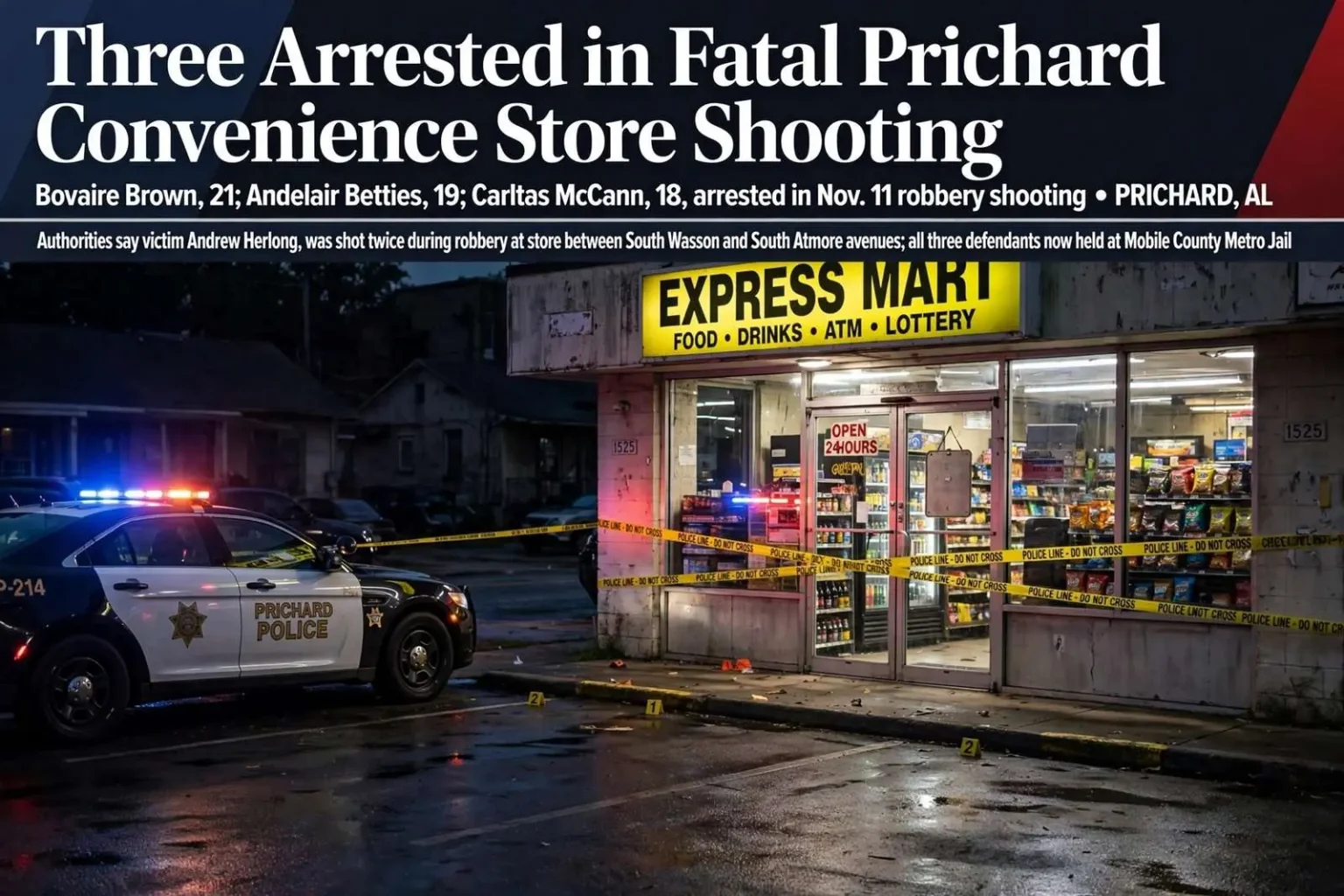
Authorities have arrested three men in connection with a fatal shooting outside a Prichard convenience store that left one man dead during what investigators describe as a robbery gone wrong.
Bovaire Brown, 21, Andelair Betties, 19, and Carltas McCann, 18, all of Mobile, were taken into custody and booked into the Mobile County Metro Jail in connection with the Nov. 11 shooting death of Andrew Herlong. Brown and Betties face felony murder charges, while McCann was charged with murder, according to court records. The arrests came after weeks of investigative work that followed the deadly encounter at the neighborhood store.
Investigators said Herlong was shot twice at a convenience store located between South Wasson and South Atmore avenues in Prichard. Court records indicate his wallet was taken during the encounter, pointing investigators toward robbery as a motive in the killing. The area is a residential and commercial stretch of the city where small neighborhood stores serve residents throughout the day and into the evening hours, and where encounters that turn violent can unfold in a matter of seconds.
Weeks of detective work preceded the arrests
The nearly monthlong gap between the shooting and the arrests suggests investigators spent weeks building a case before taking the three men into custody. Prichard police and Mobile County investigators have not publicly detailed what evidence ultimately led them to identify and arrest the three suspects. Investigators frequently hold back specifics in the early stages of a homicide case, both to protect the integrity of the prosecution that follows and to avoid tipping off anyone else who may have been involved or who may have information still needed for the case.
Convenience stores in Prichard and other parts of Mobile County have periodically been the scene of violent robberies, and cases like this one often hinge on surveillance footage, forensic evidence and tips from the community to help investigators identify suspects who flee the scene. Cameras covering store entrances, parking areas and checkout counters often capture the moments before, during and after an encounter, giving investigators a visual record to work from even when no witness comes forward in the immediate aftermath of a crime.
Robbery homicides also tend to draw heavily on forensic work collected at the scene, from physical evidence left behind to items that can be submitted for laboratory analysis. In cases involving multiple suspects, that physical record can become especially important as prosecutors work to establish what part each individual played in the events that unfolded, since defendants in a group case often point fingers at one another as proceedings move forward.
Tips from residents have historically played an outsize role in clearing robbery cases along the Gulf Coast, where investigators regularly appeal to the public for help identifying suspects captured on store cameras. Even small details, such as a description of a vehicle seen leaving a parking lot or the direction suspects fled on foot, can give detectives a thread to pull as they work to connect suspects to a scene weeks after the fact.
The legal theory behind the charges
All three men remained held at the Mobile County Metro Jail as the case moved forward. Felony murder charges typically apply when a death occurs during the commission of another serious felony, such as robbery, even if the underlying intent was not necessarily to kill. Under that legal theory, prosecutors do not necessarily have to prove who fired the fatal shots, only that the death occurred in the course of the alleged robbery that brought the men to the store that night.
The distinction between the felony murder charges faced by Brown and Betties and the murder charge filed against McCann is spelled out in the charging documents filed in Mobile County District Court. Prosecutors will ultimately have to lay out the evidence supporting each count as the cases proceed, and the charging structure in multi-defendant homicide cases often reflects differences in what investigators believe each participant did during the encounter.
The case is expected to proceed through the Mobile County court system, where prosecutors will need to establish each defendant’s specific role in the robbery and shooting. Cases involving multiple co-defendants often result in staggered court proceedings as each defendant’s case is handled individually, with separate hearings, separate defense attorneys and, in some instances, separate trials depending on how the evidence develops and how the defense strategies align.
How multi-defendant cases move through the courts
Multi-defendant prosecutions place a heavier load on the court system than single-defendant cases, because every hearing must be coordinated across defense attorneys whose schedules rarely align. Judges in Mobile County typically handle that complexity by setting separate trial dates, hearing pretrial motions individually, and resolving severance questions early so that one defendant’s strategy does not force repeated delays in the others’ cases.
Defense attorneys in robbery-homicide cases commonly focus on their client’s degree of participation, arguing over who was present, who acted and who merely accompanied the others. That focus makes the investigative record all the more important, since prosecutors will need to tie each defendant to specific actions through witness accounts, physical evidence and any statements collected during the investigation.
Plea negotiations are also common in cases with multiple co-defendants, and prosecutors sometimes use resolutions with one defendant to strengthen their position against the others. Until those decisions are made, all three men remain held without resolution of their cases, and the court file in each matter will grow as motions, discovery and hearing records accumulate in the months ahead.
Prichard’s ongoing struggle with violent crime
Prichard, a working-class city that borders Mobile to the north, has long contended with elevated rates of violent crime, and its police department has worked alongside county, state and federal partners on violence reduction efforts over the years. The city’s mix of residential neighborhoods and small commercial strips means an incident like the Nov. 11 shooting tends to reverberate quickly through the surrounding community, particularly when it involves a business that residents rely on for everyday needs.
The stretch of Prichard where the shooting occurred sits among a network of numbered avenues and residential blocks that local drivers use to cut between major corridors, which means foot and vehicle traffic through the area remains steady even in the evenings. Residents in neighborhoods like this one often describe convenience stores as de facto gathering points, and violent incidents at those locations tend to leave a lasting mark on how safe people feel running ordinary errands close to home.
Store owners in the area have responded to the pattern of robberies in recent years by investing in additional cameras, better exterior lighting and early-closing hours during overnight stretches when incidents are most likely. Those measures cannot prevent every encounter, but investigators say they frequently make the difference in whether a case can be solved, because clear footage and well-preserved scenes dramatically shorten the path from an anonymous suspect to an arrest.
The Mobile County Metro Jail, where all three defendants are being held, serves as the county’s central detention facility and processes arrests from every law enforcement agency in the county, from the Mobile Police Department to smaller municipal departments like Prichard’s. Defendants booked into the facility typically appear before a district court judge for an initial hearing, where bond matters are addressed and the next steps in the court process are set.
What comes next in the case
Victim services staff and prosecutors also work with surviving family members throughout the process, from arraignment through any trial, explaining court procedures and keeping them informed as hearings are scheduled. Families in homicide cases frequently attend every proceeding, and the pace of the court calendar means the road from arrest to resolution can feel slow even when investigators made their arrests quickly relative to the timeline of the underlying crime.
If the case is presented to a grand jury and indictments are returned, the defendants’ cases would move to Mobile County Circuit Court, where felony matters are tried. Homicide cases of this kind can take many months, and sometimes more than a year, to move from arrest to trial as both sides work through evidence, forensic reports and witness testimony, and as courts work through crowded dockets that handle everything from violent crime to civil disputes.
Robbery-motivated killings carry some of the most serious penalties in Alabama’s criminal code. Under state law, a death that occurs during the course of a first-degree robbery can form the basis of a capital murder charge, though any such decision would rest with the Mobile County District Attorney’s Office, which reviews the evidence before determining how charges ultimately proceed through the system.
Investigators in cases like this one typically continue to ask anyone with information about the events of Nov. 11 to come forward, even after arrests have been made, since witness accounts can strengthen the case as it moves toward trial. Community members with information can generally reach Prichard police directly or leave tips through regional crime stoppers programs that allow callers to remain anonymous while still providing details that may prove important to prosecutors.
For now, the three defendants await the next steps in a case that began with a late-night encounter outside a neighborhood store and grew into a monthlong investigation that ended with three arrests and three sets of charges moving through the Mobile County courts.