How a Generator Shortage After Hurricane Ivan Almost Canceled Bellingrath’s Lights
Bellingrath Gardens staff nearly lost power for the Magic Christmas in Lights display after Hurricane Ivan strained the region's generator supply.
Two decades after it first lit up for the holidays, Bellingrath Gardens’ Magic Christmas in Lights carries a history full of near-misses and behind-the-scenes craftsmanship that most visitors never see, according to staff at the Theodore garden estate. The display has become one of the Gulf Coast’s defining holiday traditions, drawing tens of thousands of visitors each season to a property better known for its azaleas and bayou views — but the glow that greets guests each November conceals a year-round operation, and a survival story most of them never hear.
The display got its start in 1995, when staff realized the gardens’ grounds offered an untapped opportunity to showcase the estate during the Christmas season. The gardens, created by Mobile Coca-Cola bottler Walter Bellingrath and his wife Bessie and opened to the public in 1932, had long drawn spring crowds for the azalea bloom; the question was whether the same landscape could carry a winter event. That first year’s display did not yet include the themed scenes visitors see today; instead, individual lighted pieces stood largely on their own throughout the property, more a scattering of holiday sculptures than a designed walk.
Built by Hand, One Piece at a Time
Nearly every piece in the display is hand-built by Bellingrath’s own staff, a process the garden’s executive director said typically takes about two months per piece, from initial sketch to a fully wired metal frame. The workshop approach means the display is less a purchased product than a growing collection — an inventory of shapes and scenes assembled over decades by the same small staff that maintains the gardens through the rest of the year. Fabricators sketch a design, bend and weld the frame, wire the light runs and test the piece in the dark before it earns a place on the grounds.
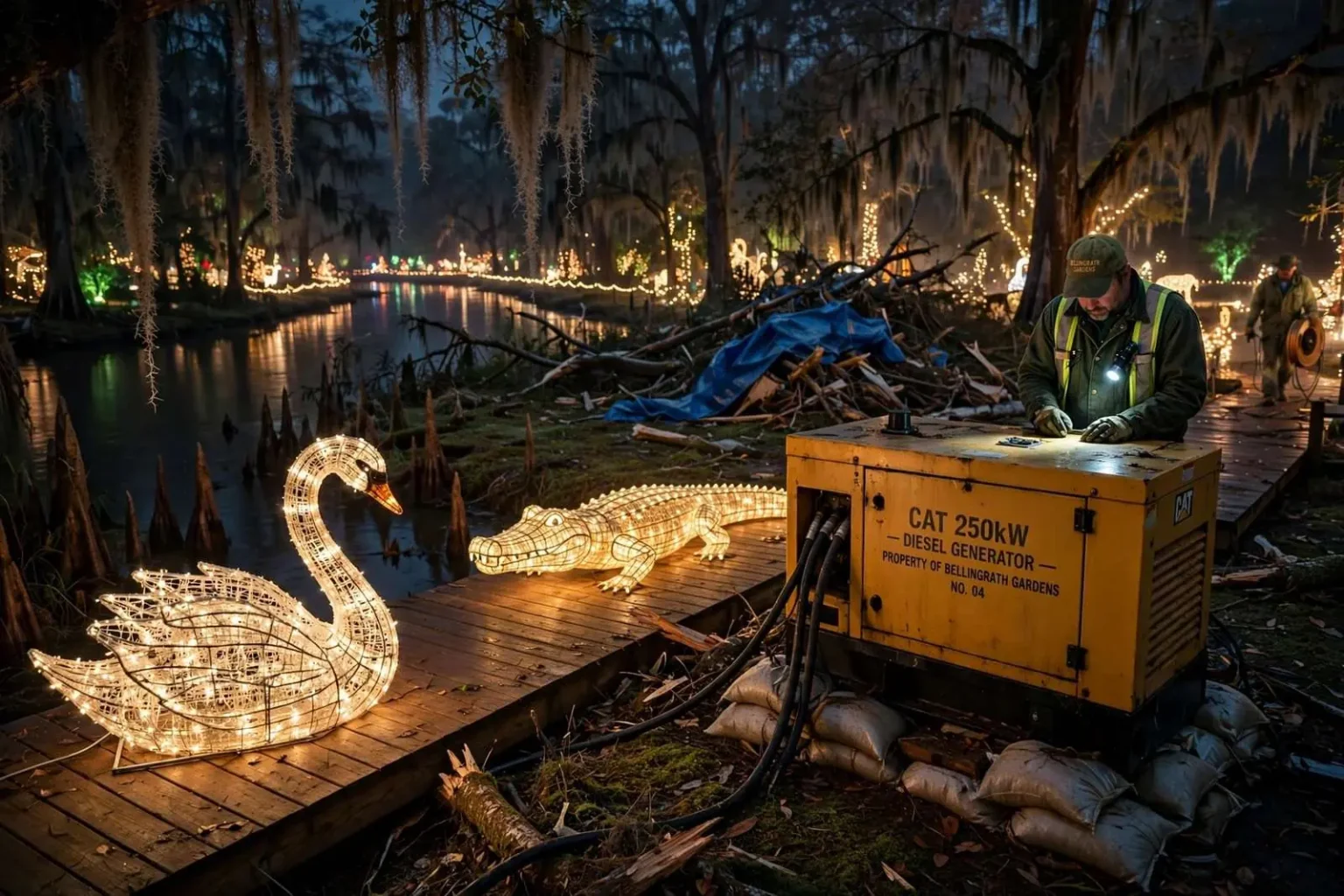
Over the years, that in-house workshop has produced more than 1,300 individual set pieces spread across 14 distinct scenes throughout the gardens. Some of the earliest pieces built for the original 1995 display, including swans, flamingos, butterflies and alligators, remain part of the show today, refurbished season after season rather than retired. The Gulf Coast wildlife motifs are no accident: the collection favors the creatures visitors might spot on the estate’s bayou boardwalk by day, reimagined in light by night.
The display got a significant creative overhaul heading into the 2000 season, when a former Disney designer who had seen the show in 1999 helped rearrange existing set pieces into more cohesive scenes. Rather than scattering the collection across the grounds, the redesign grouped pieces into narratives and vignettes — the difference, staff say, between a lighted garden and a walk-through story. That collaboration also produced a five- to seven-year build-out plan for future additions, some of which staff say they still draw from today when planning new scenes, a rare case of a seasonal attraction operating on a design roadmap two decades old.
Three Million Lights — and One Generator
By 2014, the show had grown to include more than three million individual lights. Despite that scale, staff note the display does not draw as much power as visitors might assume, since the lights run off a diesel fuel generator rather than pulling directly from the local power grid. The independence was originally practical — it spared the estate’s older electrical infrastructure and gave the show freedom to run long hours without straining utility capacity — but it also created a hidden vulnerability that nearly ended the tradition entirely.
That generator dependency very nearly ended the tradition a decade before the 2014 season. In the aftermath of 2004’s Hurricane Ivan, demand for generators across the region spiked as homes and businesses scrambled to restore power, and supplies vanished from dealers across the Gulf Coast for months. Ivan had come ashore just west of Gulf Shores in September 2004 as a major hurricane, raking Mobile Bay with destructive winds and knocking out electricity to hundreds of thousands of customers across south Alabama, leaving the region hungry for every generator that could be found.
For a Christmas display that could not open without diesel generation, the post-Ivan market was a genuine crisis. The estate faced the prospect of canceling or severely limiting its signature event — a blow not only to its own calendar but to the Theodore community and the wider Mobile area, where the show’s opening had become a fixture of the holiday season. Staff ultimately secured the equipment needed to open that year, but the episode left a lasting lesson about the fragility of infrastructure that most visitors never think about, and it made generator planning a permanent line item in the show’s annual preparation.
The near-miss also underscored how intertwined the region’s attractions are with its storm cycle. Along the northern Gulf Coast, every institution that depends on power, water or roads builds its plans around hurricane season, and Bellingrath’s experience with Ivan became part of that shared playbook: secure critical equipment early, know your dependencies and assume that in the weeks after a landfall, everything is scarce.
A Year-Round Operation Behind a Six-Week Show
Visitors who walk the display see only the finished product, but the season it represents stretches across the entire year. Staff fabricate and repair pieces in the workshop during the warmer months, test wiring and bulbs as the weather cools, and spend weeks each fall installing the scenes across the grounds — climbing, wiring and securing more than a thousand pieces before the night the gates open. When the show ends in the new year, the process reverses: pieces come down, are inventoried and are stored until the cycle begins again.
The hand-built inventory is also the show’s signature. Because the collection belongs to the estate rather than to a rental company, scenes can be reimagined from year to year using the same pieces in new combinations, and one-of-a-kind figures — the original swans among them — carry a local history no purchased display could match. Staff describe the workshop’s output as the estate’s second garden, one that grows a little every year in metal and light rather than soil.
Why the Tradition Endures
Three decades on from that first experimental lighting in 1995, Magic Christmas in Lights has survived hurricanes, generator shortages and the steady wear of coastal weather on wired steel. The show’s endurance owes as much to the behind-the-scenes culture staff describe — the two-month pieces, the design plan from a former Disney hand, the lessons of 2004 — as to the three million lights themselves. Each season, when the switch is thrown and the gardens light up over Fowl River, visitors are seeing the accumulated work of a staff that has spent the year getting ready, and a tradition that came close to going dark and didn’t.
The Estate Behind the Lights
The gardens themselves are as much a part of the story as the display. Walter Bellingrath, who built his fortune as president of the Mobile Coca-Cola Bottling Company, and his wife Bessie spent the 1920s and early 1930s transforming their fishing retreat along Fowl River into a showplace garden, opening it to the public in 1932 and establishing a foundation to carry it forward after their deaths. The 65-acre estate became famous for its spring azalea season, its rose garden and its bayou boardwalk, and it remains one of the Mobile area’s most visited attractions in any season.
That institutional longevity is part of why the Christmas display matters so much to the estate’s calendar. Winter had long been the quiet season on the river — after the camellias and before the azaleas — until 1995, when the first lighting turned the slowest weeks of the year into a second high season. The show now anchors holiday itineraries for families across Mobile, Baldwin County and the Pensacola side of the coast, and its opening nights have become an annual occasion in their own right.
The display’s growth also mirrors the evolution of holiday lighting itself. The 1,300-plus pieces and three million bulbs of the modern show rely on lighting technology that barely existed when the first swans and alligators were wired in 1995, and staff have continuously upgraded to more efficient bulbs that cut power draw and heat while brightening the scenes. The diesel generator that powers the show runs a load far smaller than visitors imagine precisely because of those efficiency gains — a quiet lesson in how the modernization of a display happens incrementally, one piece and one bulb at a time.
Staff say the goal each season remains what it was in the beginning: to give the Gulf Coast a place where the landscape it treasures in daylight becomes something new after dark. The near-misses along the way, from a hurricane-driven generator shortage to the endless maintenance of hand-built steel against coastal humidity, have become part of the show’s institutional memory — the stories the staff tell each other while they climb ladders each October, stringing up a tradition that refuses to go dark.