Church Street Graveyard: Mobile’s City of the Dead and the Fever That Filled It
Behind mossy brick walls a few blocks from downtown Mobile lies Church Street Graveyard, where yellow fever epidemics of the 1800s filled the ground faster than headstones could be carved.
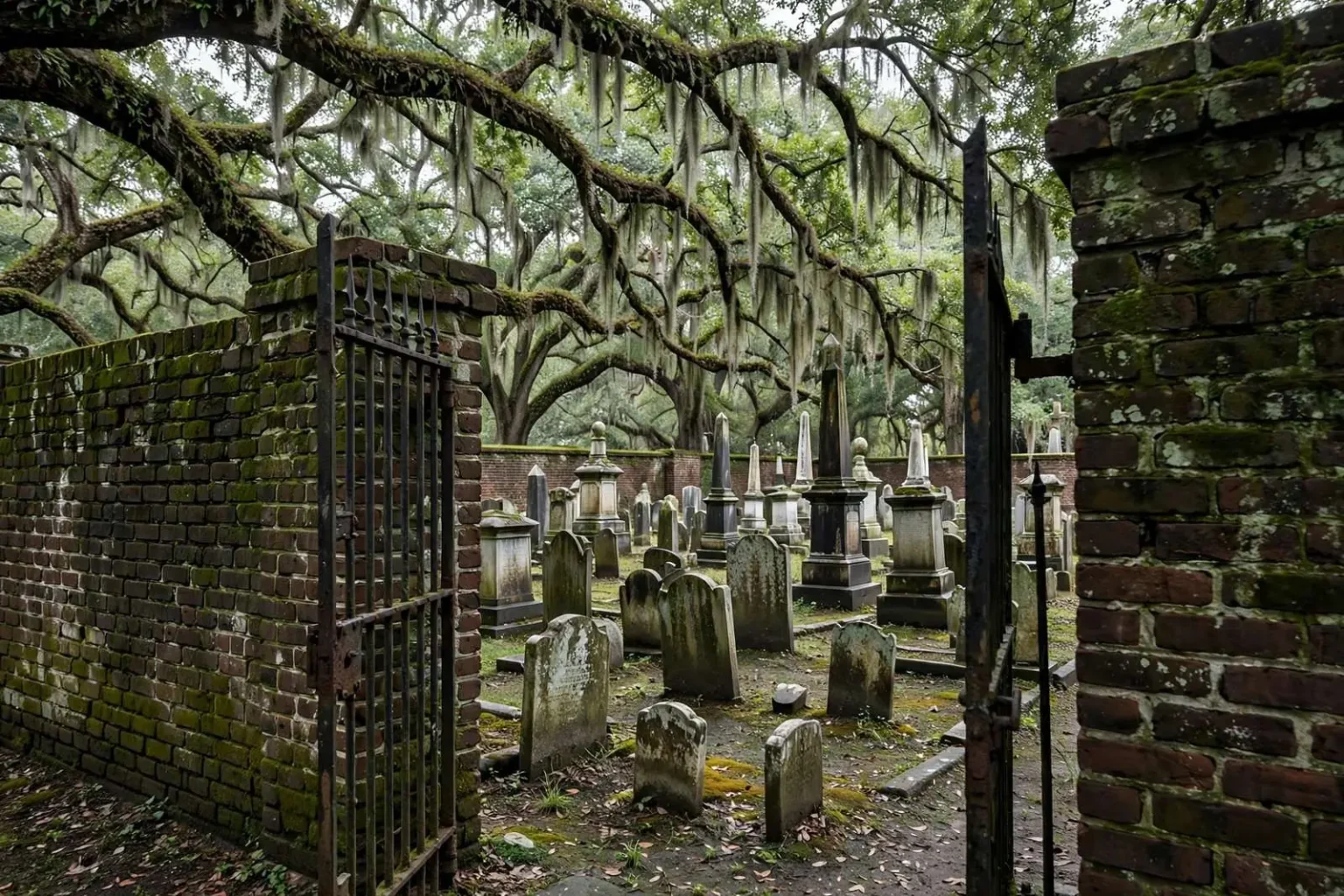
Five minutes from the noise of downtown Mobile, behind mossy brick walls that have stood since the early 1800s, sits a place locals have long called the City of the Dead. Church Street Graveyard is not large by the standards of American burying grounds. It is, however, one of the most crowded, and the reason is written plainly on its stones: yellow fever.
Set just west of the central business district, the walled burying ground dates to the years shortly after Mobile passed from American to American hands in the early nineteenth century, when the old colonial town — French, then British, then Spanish — finally needed a proper city cemetery of its own. The walls went up first; the stones followed, generation after generation, until there was no room left to follow with.
A graveyard unlike other graveyards
Every cemetery is a place of grief. Church Street is a place of a particular kind of grief, the kind that arrives all at once and does not stop. Through the middle decades of the 1800s, yellow fever swept Mobile in waves. The disease killed quickly and indiscriminately, and for its victims, death often came as relief from the suffering that preceded it.
The fevers arrived with the warm months and left with the first hard frost, and no one in the city knew why. Each summer brought a gamble: whether the ships arriving at the port would carry the sickness inland, whether the low-lying neighborhoods would be spared, whether the season would pass as a scare or as a catastrophe. In the bad years, it was a catastrophe. During the worst of the epidemics, the graveyard is said to have received roughly 250 burials a month.
There were not enough hearses to carry the dead. Bodies were loaded onto horse-drawn carts for the short trip to the burying ground. Business stopped, the newspapers filled with lists of the dead, and families who could leave fled inland; those who could not stayed behind shuttered houses, and neighbors who were healthy one week buried each other the next. The city’s burying ground absorbed all of it — season after season, wave after wave — until the walls that had once enclosed a quiet churchyard came to enclose something closer to a ledger of the city’s darkest summers.
That is the arithmetic that set Church Street apart from other American cemeteries of its era. Most burying grounds fill gradually, one family plot at a time, over a century of ordinary attrition. Church Street filled in eruptions — months when the ground received more dead than it might otherwise see in years, separated by seasons of relative calm that never lasted long enough for the city to catch its breath.
The children
What stops most visitors is not the volume but the ages. Walk the rows and the dates repeat with a terrible rhythm: infants, toddlers, children who never reached school age. The youngest on record in the graveyard died at eight hours old. Entire families lie together, having died within months of one another.
One marker, set over the grave of a young mother, reads: “Come with me my family three, prepare for death and follow me.” The stone compresses an entire catastrophe into fourteen words — a household erased, and an epitaph written by the survivors who understood exactly what they had witnessed.
By some accounts, more infants may be buried at Church Street than in almost any other graveyard in America. The pattern reflects more than the fever alone. Nineteenth-century medicine had few answers for the diseases of childhood — cholera, whooping cough, diphtheria, typhoid and the waterborne illnesses of a port town without modern sewers — and yellow fever simply intensified a mortality rate that was already staggering by modern standards. In Mobile’s epidemic summers, children were among the most frequent victims, and the stones around the graveyard’s older sections record the toll name by name, month by month.
How many are buried here?
Nobody knows. A caretaker interviewed at the site said the true number may run into the thousands. For every grave that is visibly marked, as many as ten may be unmarked.
During the epidemic years there was simply not enough time, nor enough stone, nor enough labor to carve headstones for everyone who needed one. Burial was triage: the dead went into the ground in whatever order the carts delivered them, and the markers were cut later — if they were cut at all. Wooden markers rotted. Immigrant families, enslaved people and the poor were laid to rest with little record at all. The result is that the graveyard’s official count of burials is, at best, an estimate, and the true population of the City of the Dead has never been established.
The ground, in other words, holds far more people than the monuments suggest — a fact that gives the place its unsettling quiet. Visitors walking the rows are reading not a census but a fraction of one, and the knowledge that the crowd is larger than it appears is part of what makes the atmosphere here different from that of any park-like rural cemetery of the same era.
A photograph in black and white
Visit on the brightest day of the year and Church Street Graveyard still resembles a black-and-white photograph. There is little color in it. The oaks throw shade, the moss hangs, and the gray granite absorbs whatever sunlight gets through. It is a landscape that refuses to be cheered up.
The palette is the product of age and of stone. The Victorian markers that crowd the older sections were cut from gray and white marbles that have weathered soft and dark, lichen blotting out the older inscriptions. Spanish moss drapes the live oaks along the walls, and the canopy keeps the interior in a permanent cool dusk. Nothing about the place has been landscaped toward cheer. What restoration work the city and preservation groups have performed over the years has aimed at stabilizing the walls and the stones, not at softening the mood — and visitors generally agree that softening the mood would be beside the point.
Why it still matters
Mobile’s yellow fever epidemics shaped the city in ways that outlasted the disease. They drove sanitation reforms, emptied neighborhoods, shaped who stayed and who fled each summer, and left a generation of families broken.
The fevers remade the city’s public life in concrete ways. Epidemic years forced Mobile to build and rebuild its boards of health, its quarantine stations at the port, and — eventually — the drainage and sewer systems that ended the summer reign of terror. The fear of the fevers influenced where the wealthy built their homes, why the city’s summer social calendar emptied, and why the decades of outbreaks became the period against which every later public health crisis in Mobile has been measured. Business leaders learned that commerce, too, caught the fever: shipping stalled, neighboring towns quarantined themselves against Mobile goods and travelers, and a single bad season could idle the port.
The fever was not understood as mosquito-borne until the turn of the twentieth century; for most of Church Street’s active years, physicians could offer little beyond comfort and the advice to keep the sick as easy as possible. The discovery that ended the mystery came from a U.S. Army commission working in Havana in 1900, and among the officers whose work proved the mosquito theory was William Crawford Gorgas — a Mobile native, born at Toulminville, who had grown up knowing the fever’s toll and would go on to wage mosquito eradication campaigns that made the building of the Panama Canal possible. It is one of history’s closer ironies that the answer to the disease that filled Church Street Graveyard was carried out of Mobile itself.
Once the mosquito connection was proven, the disease retreated quickly from cities willing to fight it. Mobile’s last serious outbreaks came in the early years of the new century, and within a generation the yellow fever seasons that had terrified the city for a hundred years were a memory. The graveyard, meanwhile, had long since filled — its work done by the time medicine caught up with the illness.
Today the graveyard sits within Mobile’s historic district, a few blocks from the restaurants and offices of Dauphin Street. It is open to visitors, and it remains one of the most instructive places in the city — a reminder of how thin the margin of survival once was here, and how recently.
Historians and preservationists point to Church Street as a document that cannot be rewritten: a physical record of what a nineteenth-century port city suffered before modern public health. Genealogists still come hunting for Mobile ancestors the records cannot place, knowing that an unmarked square of ground may hold what they are looking for. And school groups touring the historic district are shown the walls and the stones as a lesson in why the city’s sewers, health department and quarantine history exist at all.
A word to anyone having a bad day
The people buried at Church Street had reason to complain, and mostly did not get the chance. For those of us who walk out through the gates and back into the present, the contrast is worth carrying. Whatever is going wrong this week — a job that went to someone else, a plan that fell through — the residents of the City of the Dead faced a different order of trouble entirely.
That is, in the end, what the graveyard offers a modern visitor. Not gloom, exactly, but proportion. Mobile’s founders and their children endured summers when death walked the streets openly, and they built a city on the other side of it. Step outside the brick walls, and the twenty-first century resumes, already in progress.