George Callahan Launched a Shrimp-Boil Campaign to Retake His South Mobile County Senate Seat
Former state Sen. George Callahan opened his 2006 bid to reclaim south Mobile County's District 35 seat with a shrimp boil in Coden that he said drew more than 200 people.
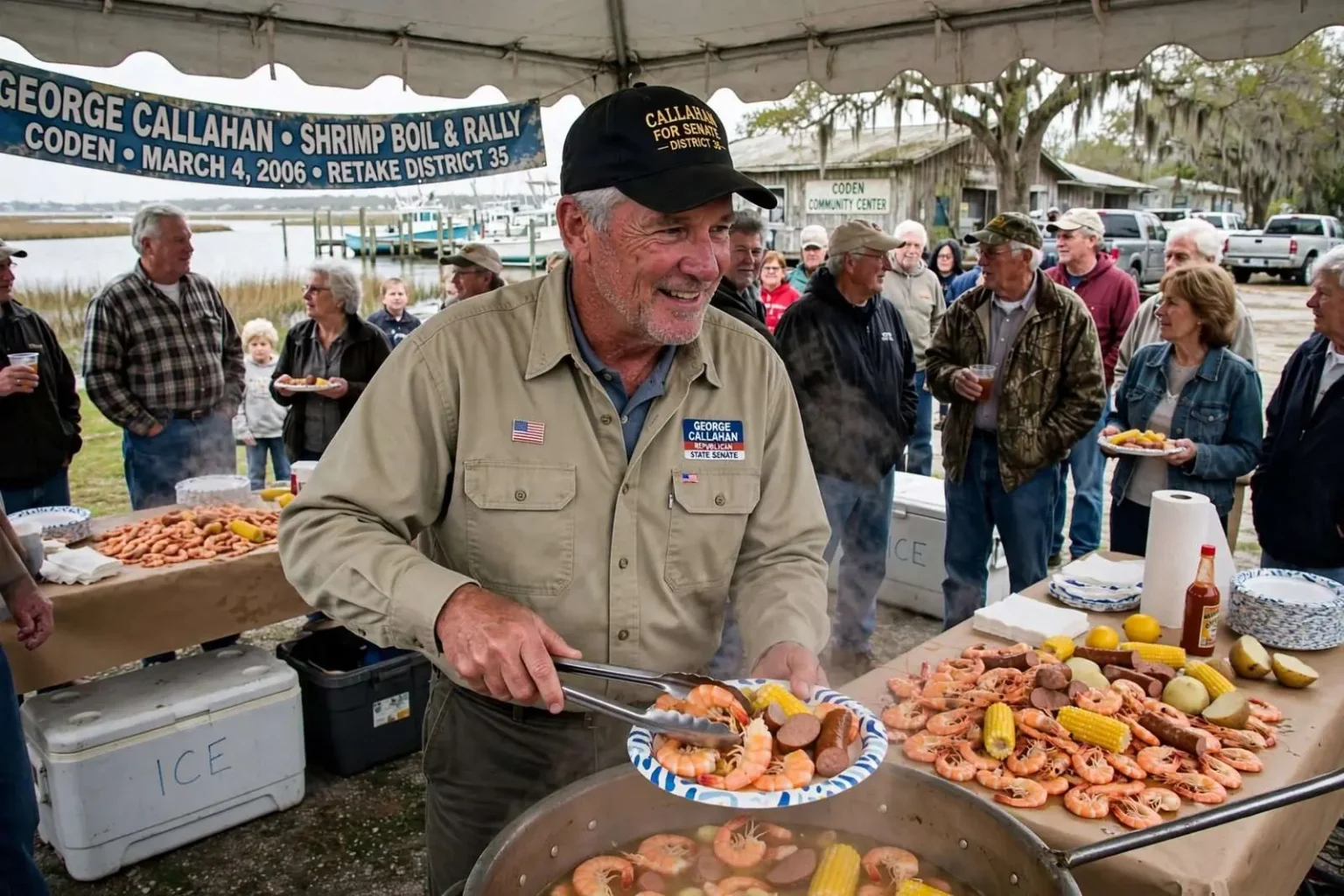
Former state Sen. George Callahan was off and running in the spring of 2006 in his Republican bid to reclaim the south Mobile County seat he had lost four years earlier, and he began the way south Mobile County campaigns have traditionally begun: with a shrimp boil.
Callahan had held the District 35 seat until 2002, when he was defeated by Democratic challenger Gary Tanner of Theodore, who was the incumbent senator as the 2006 cycle opened.
The rematch framing was obvious from the moment Callahan filed. In a decade when south Mobile County’s legislative districts were trending steadily Republican, a former senator running against the man who beat him was the kind of race operatives on both sides circle early — the incumbent with the record and the incumbent’s edge in fundraising and name ID, the challenger with the history, the network and four years of watching from the sidelines.
Three rallies, one district
The first of three planned kickoff rallies was held Saturday, March 4, at a shrimp boil in Coden. Callahan said a crowd of more than 200 turned out.
“We had over 200 people at the Coden event,” Callahan said.
A second shrimp boil and rally was scheduled for Saturday, March 25, from 11 a.m. to 3 p.m. at the community center in Tillmans Corner. Arrangements were still pending on a third rally somewhere along Dauphin Island Parkway.
The campaign’s website, georgecallahan.com, was up and running as well, a detail worth noting in a cycle when a candidate’s web presence was still something to announce rather than assume. In 2006, political websites were transitioning from novelty to necessity, and a functioning campaign site signaled a professional operation even in a county-level legislative race. Voters who wanted Callahan’s positions, biography or volunteer information no longer had to wait for a mailbox flyer.
The rally format itself is a deliberate piece of south Alabama campaign craft. A Saturday shrimp boil — plates of Gulf shrimp, sausage, corn and potatoes served outdoors — does what no TV commercial can do: it puts the candidate shaking hands for three hours with exactly the constituents whose votes he needs, in communities where showing up in person is the currency of credibility. More than 200 attendees at a March kickoff in Coden is a serious number for a legislative district event, and campaigns publicize such turnouts precisely because they read as a measure of organizational strength.
The geography of District 35
The three rally sites amount to a tour of the district’s identity. Coden sits on the bayou country of south Mobile County, in the heart of the seafood communities that stretch along the coast toward Bayou La Batre, where shrimping, oystering and boatbuilding have supported families for generations. Tillmans Corner is the sprawling commercial and residential crossroads west of the city. Dauphin Island Parkway runs south from Mobile down the peninsula toward the bay.
Together they describe a district that is neither urban Mobile nor rural Alabama but something particular to the Gulf Coast: working waterfront, suburban subdivisions and highway commerce, bound together by water on three sides and by an economy that has always depended on it.
That a campaign would open with a shrimp boil rather than a hotel ballroom reception is not incidental. It is the district’s own food, bought from its own docks, served in the communities whose livelihoods ride on the same water. In a district where the seafood industry is both heritage and paycheck, the choice of launch event is a message about priorities delivered without a speech.
The timing of the kickoff carried its own weight. The rallies came only months after Hurricane Katrina had slammed into the Gulf Coast in late August 2005, devastating Bayou La Batre’s shrimping fleet and boatyards and leaving coastal communities from Coden to the bay still sorting through debris, insurance claims and federal recovery paperwork. For a candidate courting south Mobile County’s waterfront, the recovery effort — state disaster aid, low-interest loans, the slow replacement of lost boats and processing capacity — was not an abstract policy topic but the dominant fact of life for a meaningful share of the district’s voters. Campaign stops in bayou country in early 2006 inevitably became listening sessions about what government had and had not done since the storm.
The seafood economy those communities depend on was also under long-term pressure beyond the storm. Imported shrimp had driven dockside prices down for years, squeezing boat owners already facing rising fuel, insurance and regulatory costs. Alabama’s coastal seafood industry — concentrated in Bayou La Batre, the state’s self-described seafood capital — had been losing boats and processing jobs well before Katrina finished the job for a portion of the fleet. Any candidate for a district that includes the bayou towns would be asked what he would do in Montgomery about marketing, inspection standards, fuel tax relief and the industry’s future.
What a senator for District 35 actually does
The Alabama Senate’s 35 seats each represent roughly 130,000 people, and District 35’s senator sits in the Mobile County legislative delegation — the six senators and House members who, under Alabama’s traditional delegation customs, carry outsized influence over local legislation affecting the county, from road and bridge bills to municipal boundary matters and local tax questions.
For constituents, the job is part lawmaking and part ombudsman. A south Mobile County senator fields calls about driver’s license offices, DOT road projects and state agency problems; helps communities navigate grant applications; and carries the district’s requests into budget negotiations for items such as beach renourishment, park funding, volunteer fire departments and school construction. In a district stitched together by causeways and coastlines — Dauphin Island Parkway, Alabama 188 out to Bayou La Batre, the bridges to Dauphin Island itself — state road and bridge money is a perennial and personal concern, never more so than after a hurricane season.
Those practical stakes help explain why the incumbency matters so much in legislative politics. Four years in the State House gave Tanner the committee posts, the relationships and the record of constituency service that voters in a district like this one can see and touch. Callahan’s task was to argue that his own prior service represented the same kind of access — and that a change of parties in the seat would carry advantages of its own in a legislature where his party held the majority and controlled the Senate’s agenda.
The 2006 landscape
The 2006 election cycle opened with Republicans increasingly confident across south Alabama. Mobile County’s legislative delegation had been shifting toward the GOP for a decade, and statewide, the party had held the governor’s office and both U.S. Senate seats through the previous term. Legislative races in the county drew the donor networks and PAC infrastructure of county Republican politics — the same circles of developers, physicians, contractors and business figures whose checks appear in every Mobile County campaign report — while Democrats defended shrinking turf with incumbency and personal followings.
Against that backdrop, Tanner held the seat Democrats most wanted to keep in the county’s southern tier, and Callahan represented the type of challenger GOP leaders preferred: a proven former officeholder with instant name recognition, no primary fight to spend money on if the field cleared, and a ready-made narrative — the shrimp-boil guy, taking his message back to the district one plate at a time.
Between March and November, the shrimp boils would give way to the standard machinery of a modern legislative campaign: yard signs along Highway 90 and the parkway, forums hosted by civic clubs from Tillmans Corner to the bayou, mail pieces and, increasingly, campaign websites doing the work that once required a phone bank. But the image the campaign chose for its opening — a candidate serving Gulf shrimp to hundreds of neighbors in Coden on a Saturday afternoon — was the one built to last through the fall, because it told the district exactly what it wanted to hear: that this race was about the coast, its water and its people, and that the candidate planned to be there in person for every plate of it.
Shrimp boils and southern political tradition
The shrimp boil occupies a place in south Alabama politics that rib suppers and barbecue plates fill elsewhere — a ritual that doubles as a test of whether the candidate belongs. Boiling shrimp for a few hundred people requires volunteers, community halls, a supply of local catch and the kind of institutional goodwill that a former officeholder can still call in. It also puts the candidate’s family, his workers and his supporters on display to a crowd that knows them all personally; in bayou communities, audiences at political socials are effectively credentialing committees.
The three-site plan — Coden, Tillmans Corner, the parkway — spread the opening message across the district’s distinct constituencies in a single month: the seafood communities first, the suburban-commercial center second, the peninsula corridor third. Campaigns that sequence their launches this way are telling internal supporters and outside observers alike where their coalition lives and in what order the candidate intends to secure it.
Whatever the November result in 2006, the March kickoff captured both the candidate and his district accurately: a former senator rebuilding from a loss, one plate of Gulf shrimp at a time, in the part of Alabama where the water — not the courthouse — sets the agenda.