University of South Alabama Mobile
Jeff Glidewell Sought the Juvenile Judgeship Again, This Time as a Republican
Mobile attorney Jeff Glidewell confirmed in March 2006 that he would seek the Republican nomination for Mobile County juvenile court judge, four years after running for the same seat as a Democrat.
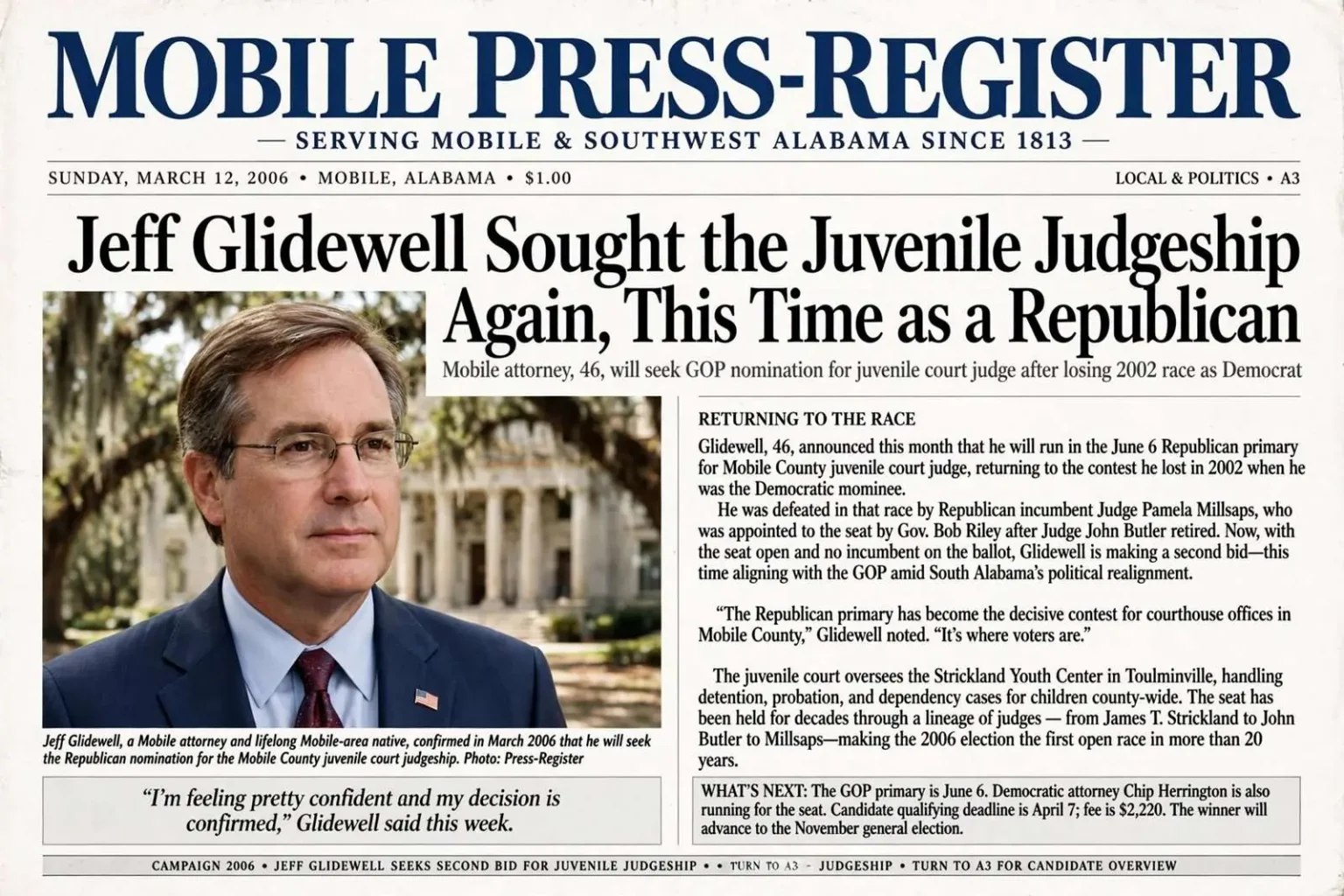
Mobile attorney Jeff Glidewell confirmed in March 2006 that he would seek the Republican nomination for the Mobile County juvenile court judgeship in the GOP primary set for June 6, returning to a race he had lost four years earlier under a different party label. Glidewell, then a 46-year-old Mobile-area native, had sought the same judgeship as the Democratic Party’s nominee in 2002. He was defeated in that contest by Republican incumbent Mobile County Circuit Judge Pamela Millsaps.
The second campaign made Glidewell part of one of the most visible patterns in early-2000s Alabama politics: the judicial candidate who switches parties and runs again. In a county where the Republican primary had become the decisive contest for courthouse offices, a second attempt as a Democrat had little realistic path to victory, and Glidewell’s move to the GOP column reflected that arithmetic as much as any change in his own views.
A seat with a long institutional memory
Millsaps had been appointed to the juvenile court seat by Gov. Bob Riley, serving out the remainder of the term of Juvenile Judge John Butler after the veteran jurist retired. Butler had overseen the Strickland Youth Center in Toulminville for more than 20 years, having succeeded his own mentor, the late Judge James T. Strickland, for whom the center is named.
That lineage matters in understanding what the office is. The Mobile County juvenile court is not simply a courtroom. Through the Strickland Youth Center it administers detention, intake, probation and counseling services for children who come into contact with the justice system, along with dependency cases involving abuse and neglect. The judge who holds the seat runs an institution, sets its philosophy and decides where the balance falls between confinement and rehabilitation for some of the county’s most vulnerable young people.
The succession chain — Strickland to Butler to Millsaps — gave the seat a continuity of leadership unusual even among Alabama’s juvenile benches, and candidates for the office have traditionally been measured against that institutional memory. Whoever won in November 2006 would inherit not only a docket but a campus, a staff and a set of programs built across decades.
Switching parties
Glidewell was candid that he and his wife, the former Cynthia Smith Kirk, had found a more comfortable political home. He said they were now more at ease in the Republican Party.
“I’m feeling pretty confident and my decision is confirmed,” said Glidewell, who had been engaged in a general law practice in the Mobile area for the previous 20 years. His move mirrored a broader realignment then well underway across South Alabama, in which candidates who had once run as Democrats, particularly for judicial and courthouse offices, migrated to the Republican column as the GOP consolidated its hold on countywide races.
In practical terms, the Republican primary was becoming the contest that mattered in much of Mobile County, and a candidate serious about winning had to compete in it. The realignment reshaped judicial races especially, since judicial candidates are barred from making the policy promises that define other campaigns and instead compete on reputation, party label and name recognition. When one party’s primary draws the decisive electorate, candidates follow the voters.
The field and the calendar
Mobile attorney Chip Herrington was campaigning for the same judgeship as a Democrat, setting up a potential general election matchup. The deadline to qualify as a candidate was Friday, April 7. The qualifying fee for the juvenile judgeship ran to roughly $2,220, a not-inconsiderable sum that functions as one of the first filters in any judicial race.
Alabama’s party qualification process, in which candidates pay a fee calculated from the office’s salary and file with their party’s executive committee, tends to clear the field early in judicial contests. By the April deadline, the shape of both primaries would be settled, and the campaigns would move into the months of bar receptions, civic club speeches and street-sign placement that make up the visible portion of a judicial campaign in Mobile County.
The June 6 primary fell into a year crowded with contests — governor, legislature, county offices — which meant judicial candidates were competing for attention on a long ballot. Low-profile races at the end of the ballot often turn on whatever campaign organization and name recognition a candidate carries into the spring, which is why Glidewell’s 2002 run, though a loss, was itself an asset: he had been through the county’s courthouses and civic halls once already.
The 2006 cycle also marked a generational passing in the county’s judiciary. Butler’s retirement after more than two decades closed out an era in which the juvenile court’s leadership had been continuous across generations of Mobile legal families, and the 2006 election would be the first in years in which no incumbent who had inherited the seat through that lineage stood for it. Candidates in both parties were effectively running for a newly open institution, even if the incumbent they sought to replace held it under an appointment meant to keep it warm.
For Glidewell, the timing cut both ways. The open nature of the seat made a second run more plausible than a challenge to a entrenched incumbent would have been, but the crowded 2006 ballot meant his campaign would have to earn attention in a field of louder contests. His answer was the same one judicial candidates have always given in Mobile: show up, shake hands and let the biography carry the argument.
Who Glidewell was
Glidewell graduated from Satsuma High School and earned his undergraduate degree from the University of South Alabama. He belonged to Mobile United, the Downtown Mobile Optimist Club, the Toastmasters Club and the American Legion. He and his wife attended Spring Hill Presbyterian Church.
The resume was that of a candidate running on local roots and civic involvement, the standard currency of a judicial campaign in which the canons of judicial conduct sharply limit what a candidate may say about how they would rule. Judicial ethics rules in Alabama, as elsewhere, prohibit candidates from committing themselves on issues likely to come before the court, which reduces campaigns to biography, endorsements and organization. Civic club memberships, church affiliations and hometown credentials do the work that issue positions do in other races.
For a juvenile court seat in particular, that biography-driven campaign has an added layer. The office deals with children from every ZIP code in the county, and candidates typically emphasize their understanding of families, schools and the institutions — churches, scouts, youth sports — that stand between a child and the courtroom. Glidewell’s decades in a general Mobile law practice would have included exactly the mix of domestic, criminal and probate matters that feed a juvenile docket.
The stakes in a low-profile race
Judicial elections rarely draw the attention that legislative and executive contests command, and juvenile court races draw less than most. Yet few offices touch families more directly. The juvenile judge’s decisions determine whether a teenager is detained or diverted, whether a child is removed from a home, and how the county’s youth services are structured and funded.
In a June primary crowded with contests for the state Senate, the sheriff’s office and statewide offices, the juvenile judgeship was the kind of race that turned on name recognition, bar association reputation and a candidate’s willingness to spend months in church halls and civic club luncheons explaining what the job actually entails. Turnout in a June primary favors candidates with organized support and the money to reach a broad but inattentive electorate.
Glidewell, on his second attempt and under a new party banner, was preparing to make that case again. Whatever the outcome in June and November, the campaign itself illustrated how thoroughly the realignment of South Alabama politics had reached even the quietest courthouse offices — and how a candidate who lost a race in one party’s column could find the same seat waiting in the other’s.
The Strickland Youth Center itself carries a history worth noting for voters weighing the office. Named for James T. Strickland, the judge whose decades on the juvenile bench set the model his successors followed, the Toulminville campus houses the detention, intake and probation operations that the juvenile judge supervises. Its location, serving a county of more than 400,000 people spread from downtown Mobile to the Washington County line, means the judge’s administrative choices — staffing, transport, diversion programs — reach families from Grand Bay to Satsuma, from Midtown to Chickasaw.
Dependency work is the part of the docket the public rarely sees. Cases involving abuse and neglect run alongside the delinquency docket, and the juvenile judge presides over removal hearings, foster care reviews and terminations of parental rights — decisions that, unlike criminal sentences, have no fixed sentencing structure and rest almost entirely on the judge’s judgment of what a child’s circumstances require. It is for this reason that bar observers have long treated the juvenile bench as among the most demanding seats in the county courthouse.