The University of South Alabama’s Foreign Recruitment Pipeline: How the School of Computing Prioritizes Saudi and International Students While American Applicants Are Left Behind
The University of South Alabama's School of Computing has built an extensive international recruitment network reaching Saudi Arabia and India, raising questions about transparency and whether American applicants are being left behind.
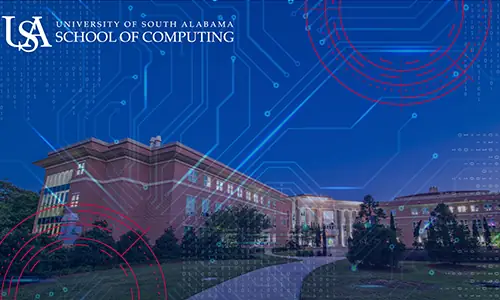
MOBILE, Ala. — The University of South Alabama’s School of Computing has quietly built a recruitment machine that reaches deep into Saudi Arabia, India, and other foreign countries, even as American students in Alabama and across the Gulf Coast face an increasingly competitive—and opaque—admissions landscape. Internal university documents, recruitment partner lists, and enrollment data reviewed for this article reveal a sustained, well-funded strategy to court international students, raising serious questions about whether qualified American applicants are being sidelined in their own backyard.
A Global Recruitment Apparatus
The university’s own materials make no secret of its international ambitions. The Office of Global Outreach “oversees and implements the University of South Alabama’s strategic plan for international student recruitment,” working “closely with various educational organizations, institutions, consultancies and partners abroad”. This is not a passive effort. The university maintains a dedicated International Student Recruiter whose job description explicitly requires a willingness to “travel internationally extensively”. The Global Outreach office also coordinates “international and domestic recruitment travel,” but the scale and resources devoted to the foreign pipeline are unmistakable.
The university has enlisted a network of paid agents and “recruitment partners” across the globe. A publicly posted partner list includes agencies such as Divinelinks Educational Consultant, Foreign Education Consultants, IACC Consultants Pvt. Ltd., and UMS – University Marketing Systems. These agents are incentivized to steer students toward South Alabama. According to the university’s own instructions, agencies can “tag a student as theirs during the application process” and receive credit—and presumably commissions—for enrolling them. A separate partner list for another Global USA portal names additional agencies including Collab Circle, Crizac Limited/Raj Consultants, and Studee, Ltd.
This is a commission-driven model of international enrollment, one that critics say can create perverse incentives to prioritize volume of foreign applicants over the quality and fairness of the domestic admissions process.
The Saudi Connection
Saudi Arabia is not a peripheral market for South Alabama. The university’s Class of 2026 profile lists Saudi Arabia among the home countries of incoming freshman international students, alongside Azerbaijan, Bangladesh, India, Kenya, and others. A separate university page confirms that students sponsored by the Saudi Arabian government—along with those from Kuwait, the UAE, Oman, and Iraq—receive a waiver from the university’s health insurance requirement if they are covered by their government’s plan, a clear accommodation for Gulf-state sponsorship pipelines.
Enrollment data from CollegeFactual shows that Saudi Arabian students have been a significant presence at South Alabama. In one analysis, Saudi students constituted as much as 15% of the university’s international student body, and the university was ranked as the “best affordable school for Saudi Arabian students in Alabama”. While the overall international student proportion at South Alabama has hovered around 1.2% to 2.1% of the total student body, the School of Computing has its own dedicated recruitment pages targeting students from India, a country that—like Saudi Arabia—has become a key source market for the university’s graduate computing programs.
Where Are the American Students?
The university has publicly celebrated enrollment growth, noting in 2023 that “international enrollment rose 5 percent” while the School of Computing grew by 8 percent. But what has happened to domestic students? Faculty Senate minutes from 2019 acknowledged that the university was “in the midst of a historic enrollment contraction,” with transfer student numbers down dramatically. While that contraction has been partially offset by overall enrollment gains in recent years, the strategic emphasis on international recruitment raises a fundamental question: if the School of Computing is growing, and international enrollment is rising, how many of those new seats are going to Alabamians?
The university’s own Fact Book for 2025-2026 includes tables on “International Student Enrollment” and “Student Origin by State,” but the data presented in publicly accessible summaries does not break down admission rates or seat allocation by citizenship at the program level. This lack of transparency makes it impossible for the public—or for prospective American students—to know whether they are competing on a level playing field for seats in the School of Computing.
What is clear is that the university has built an infrastructure that actively funnels foreign applicants into its programs. The School of Computing maintains a dedicated page welcoming graduate students from India, complete with detailed program descriptions and a 13:1 student-to-faculty ratio. There is no comparable page for students from Alabama. The Office of Global Outreach has even launched a “Faculty Ambassador” program in which professors travel abroad—including to India—to recruit prospective students on behalf of the university. Faculty members are being deployed as salespeople for the international pipeline.
The Scholarship Question
The university offers a “Global Freshman Scholars Award,” a merit-based scholarship “awarded to a limited number of well-qualified international students each year”. There is also a “Dr. Richard and Angela Carter Global USA Endowed Scholarship” established specifically for “an incoming freshman international student”. These scholarships reduce the cost of attendance for foreign students—sometimes by thousands of dollars—at a public university funded in part by Alabama taxpayers.
No equivalent scholarship program for Alabama residents was identified in the university’s public materials. American students who do enroll at South Alabama face tuition and fees that, while lower than out-of-state rates, remain a barrier for many working-class families in the Mobile area. The university’s decision to direct philanthropic and institutional scholarship dollars toward international recruitment—rather than toward need-based aid for Alabamians—is a policy choice with real consequences for the state’s own students.
The Transparency Gap
The University of South Alabama has declined to release program-level admissions data that would show whether domestic applicants to the School of Computing are being denied admission at higher rates than international applicants. The university’s public statements emphasize that it “does not discriminate on the basis of age” and that the Office of International Admissions processes “all non-citizen applications,” but these boilerplate assurances do not address the core concern: whether the active recruitment of foreign students, supported by agent commissions and dedicated scholarships, is crowding out qualified American applicants.
The university’s International Student Recruiter position is funded and staffed. The agent network is contracted. The recruitment travel is budgeted. The scholarship dollars are allocated. What is not publicly accounted for is the impact of this foreign-focused strategy on the educational opportunities available to the young people of Alabama.
A Public University’s Public Mission
The University of South Alabama is a public institution. Its mission, as stated in its strategic plan, is to be “a leading comprehensive public university internationally recognized for educational” excellence. International recognition is a worthy goal. But a public university’s first obligation is to the public that funds it—the taxpayers of Alabama, the families of Mobile and the surrounding region, and the students who grow up in the shadow of the university’s campus.
When a public university builds a commission-based recruitment pipeline to Saudi Arabia and India, when it deploys faculty ambassadors to recruit abroad, and when it creates scholarship programs exclusively for international students, it is making a choice about who its priority students are. The University of South Alabama has made that choice. The question now is whether Alabama’s lawmakers, taxpayers, and prospective students will demand an accounting of what—and who—has been lost in the process.