Bayou La Batre Councilman Signaled Challenge for Mobile County Commission Seat
Henry Barnes Sr., a Bayou La Batre city councilman and commercial truck driver, said he was 99 percent sure he would run for the Mobile County Commission, whether the body stayed at three members or grew to five.
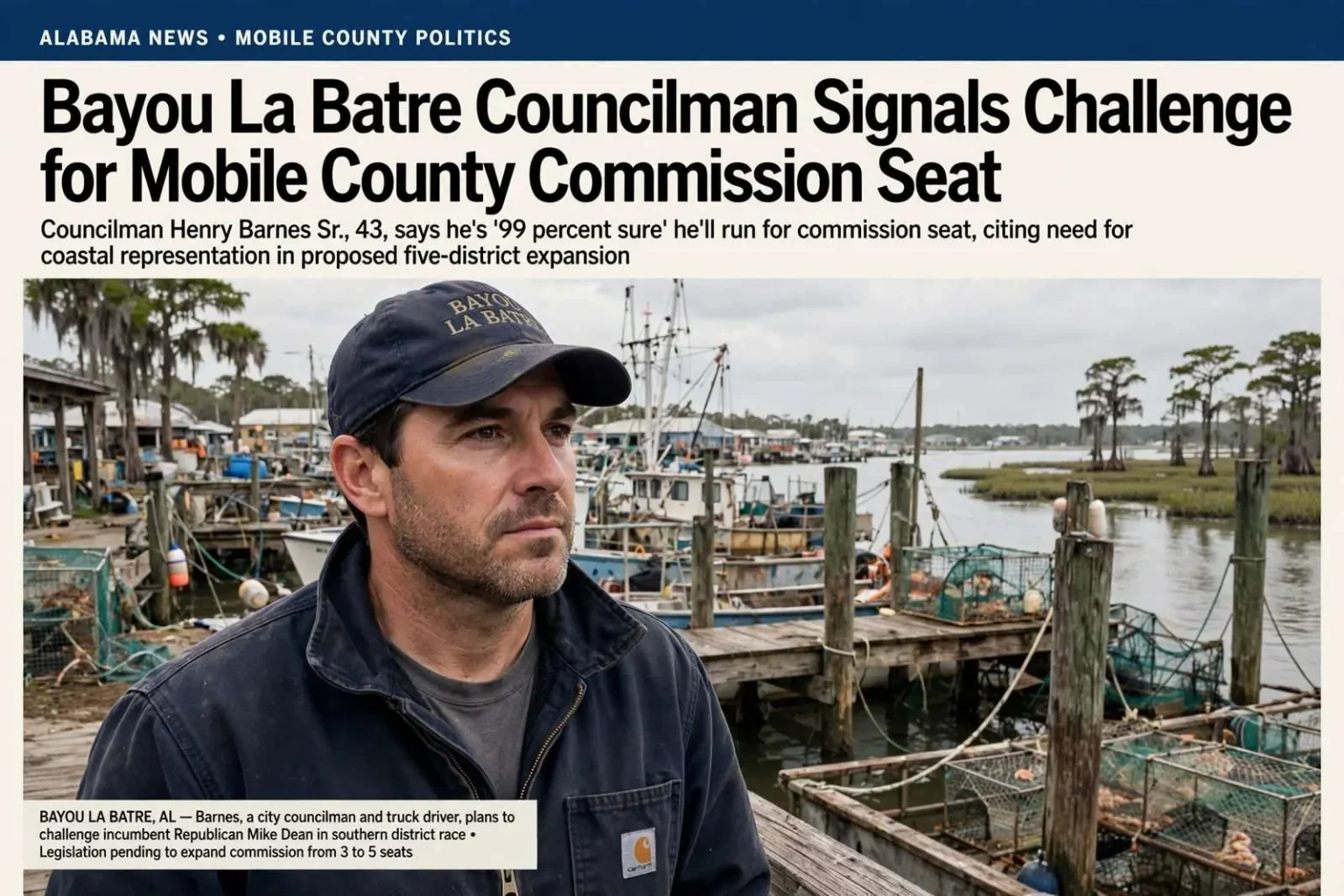
A city councilman from Alabama’s most storied fishing village said he was “99 percent sure” he would seek a seat on the Mobile County Commission, setting up a potential intraparty fight in the county’s sprawling southern district. Henry Barnes Sr., 43, a Bayou La Batre native and a member of the city council there, said he would almost certainly run whether the commission remained a three-member body or expanded to five, as proposed in legislation set for consideration in the upcoming session of the Alabama Legislature.
Barnes’s statement amounted to a challenge with a shape-shifting target. If the commission stayed at three seats, he would take on the incumbent in the existing southern district; if the Legislature passed the expansion bill, he would run in whatever newly drawn coastal district emerged. Either way, the message to Mobile County’s political class was the same: the bottom of the county intended to field its own candidate, from its own shrimp docks, and the era of the southern district being a line on somebody else’s map was ending.
A district that stretches to the Gulf
Barnes shared a commission district with the Republican incumbent, Mike Dean. Dean, 51, a former state legislator, was first elected to the commission in 2000. Barnes, also a Republican, would be challenging a member of his own party — the kind of primary fight that turns on geography and grievance rather than party labels, and in this case both pointed the same direction.
The geography helps explain the grievance at the heart of the challenge. With only three commissioners serving all of Mobile County, a single member represented a territory running from suburban subdivisions to shrimp docks, taking in communities as different as Theodore, Grand Bay, Irvington, Coden, Dauphin Island and Bayou La Batre. The distances alone made the job hard; the differences made it harder. A commissioner who spent a week on subdivision traffic and sewer extensions had, by Friday, a voicemail box full of shrimpers asking about dock permits and an island mayor asking about a bridge.
Barnes argued that no one person could adequately serve an area that large. “(Each of the three present districts) are too large of an area to be taken care of by one man,” Barnes said, endorsing the push to expand the commission to five single-member districts. He said he had backed the idea from the moment it was raised. The expansion bill was spearheaded by state Rep. Spencer Collier and state Rep. Yvonne Kennedy. “I’m 100 percent in agreement,” Barnes said of the measure.
The bill’s two sponsors represented the idea’s unusual bipartisan breadth — Collier, an Irvington-area Republican, and Kennedy, a Mobile Democrat — and its premise was simple: five smaller districts would put every corner of the county within a reasonable drive of its own commissioner. For coastal communities, the promise was more specific: a commissioner whose district included the water, and whose daily politics began at the bayou instead of at Government Plaza.
A candidate who had taken a beating before
Barnes brought recent scar tissue to the race. He had challenged Collier, a fellow Republican, for the state House the previous year and lost decisively. “I got the hell beat out of me,” Barnes acknowledged, with the bluntness of a man who has spent his working life around boats and concrete trucks. He said supporters had urged him at the time to wait and run for the county commission instead of the Legislature, advice he now appeared ready to take.
The earlier defeat taught Barnes two things he cited going forward. The first was that name recognition cannot be improvised in a long campaign — a lesson he planned to apply by starting earlier and working smaller communities personally. The second was that the people who knew him best, the shrimpers and dockworkers and concrete men of the southern county, had been right about where his race belonged. A commission district that included Bayou La Batre was, on the map of his own life, home ground.
A measured start against Dean
Barnes was careful, at least at the outset, to keep his criticism of the incumbent measured. He said discontent with Dean ran deep in the lower end of the county but declined to attack him directly. “Dean did his best, I guess,” Barnes said. “A lot of people in Coden down there talk some. Like about 80 percent don’t like the job he’s done. But I’m not going to go negative on him. I like ol’ Mike. It goes back to term limits. All these people say two terms and they might be right.”
The “two terms” framing let Barnes press his case without a knife. Dean had served since 2000, and by Barnes’s account the complaint at the bottom of the county was less about any single vote than about years of distance — the sense that decisions about south Mobile County were being made by a government whose center of gravity lay thirty miles north. Dean was not immediately available for comment.
Monthly meetings and a working man’s resume
Barnes said he would campaign on a promise of returning the government to the people, pledging to hold monthly public meetings in different parts of the district so that residents in far-flung communities would not have to drive downtown to be heard. The pledge was aimed directly at the district’s geography — Dauphin Island, Coden and Grand Bay are a long drive from Government Plaza on a weekday, and Barnes argued that a commissioner who made residents come to him had the relationship backward.
His biography was not the standard courthouse ladder. Barnes drove a commercial truck for Gulf States Ready-Mix, hauling ash from Montgomery most every night, and had also worked as a boat captain, an occupational combination familiar in a town where seafood, shipbuilding and hard hours have long defined the economy. It was a resume built at 3 a.m. rather than at civic banquets, and Barnes presented it as a credential: a man who knew the roads, the boats and the payroll of south Mobile County because he had worked all three.
Why the seat mattered
The stakes in south Mobile County were considerable. Bayou La Batre and the surrounding communities were still working through the aftermath of Hurricane Katrina, which in 2005 shoved boats inland, wrecked housing and battered a seafood industry already squeezed by imported shrimp. Decisions about roads, drainage, recovery money and the location of public facilities ran through the county commission, and residents at the bottom of the county often complained that their needs finished last behind those of the metropolitan center.
The proposal to expand the commission to five districts, then pending in Montgomery, would have redrawn that map entirely, creating smaller districts and, in principle, giving coastal communities a commissioner of their own. Whether the Legislature would act, and whether Barnes would follow through on his stated intention, remained to be seen. What was already clear was the shape of the argument Barnes intended to make: that a district stretching from Theodore’s subdivisions to the docks of the state’s oldest fishing village deserved representation that began at the water’s edge.
Office sought: Mobile County Commission, District 3. Incumbent: Mike Dean, Republican, first elected 2000. Wild card: Pending legislation to expand the commission from three seats to five.
Built by storms and shrimp
Bayou La Batre’s identity runs through everything Barnes said on the stump. The village built its economy on oyster boats and shrimp trawlers launched along the bayou’s working waterfront, and it rebuilt that economy after every hurricane that found the coast — Frederic, Georges, Katrina — long before anyone outside south Mobile County paid attention. A city councilman from Bayou La Batre announcing for countywide office carried a story that resonated across the fishing communities of the district: someone who had watched the water decide his town’s fate, year after year, and had watched the county’s government decide what help arrived afterward.
That history also shaped what Barnes meant by representation. In communities where a single road, bridge or drainage project can determine whether a season’s catch reaches market, a county commissioner’s choices are not abstractions. The southern district’s residents judged their government by whether the causeway flooded, whether the shrimp docks got rebuilt, and whether the county’s money reached the coast before the next storm did. Barnes’s promise of monthly meetings in those places was a promise that such questions would be asked where they lived.
Whatever the Legislature did with the expansion bill, the underlying politics were already moving. Southern Mobile County’s population had grown along with the rest of the county, and communities that had once been quiet corners — Grand Bay, Irvington, the Theodore corridor — now carried traffic, schools and subdivisions that expected services. Three commissioners for all of that growth was a formula that critics said was set to fail, and Barnes’s candidacy was the loudest evidence yet that the failure had a constituency.