Gulf Coast Classic Organizers Postpone Promised Briefing on Game’s Finances
A promised press conference on the Gulf Coast Classic's $188,000 deficit was called off, with organizers citing sensitive negotiations. The city put $275,000 into last fall's game at Ladd-Peebles Stadium.
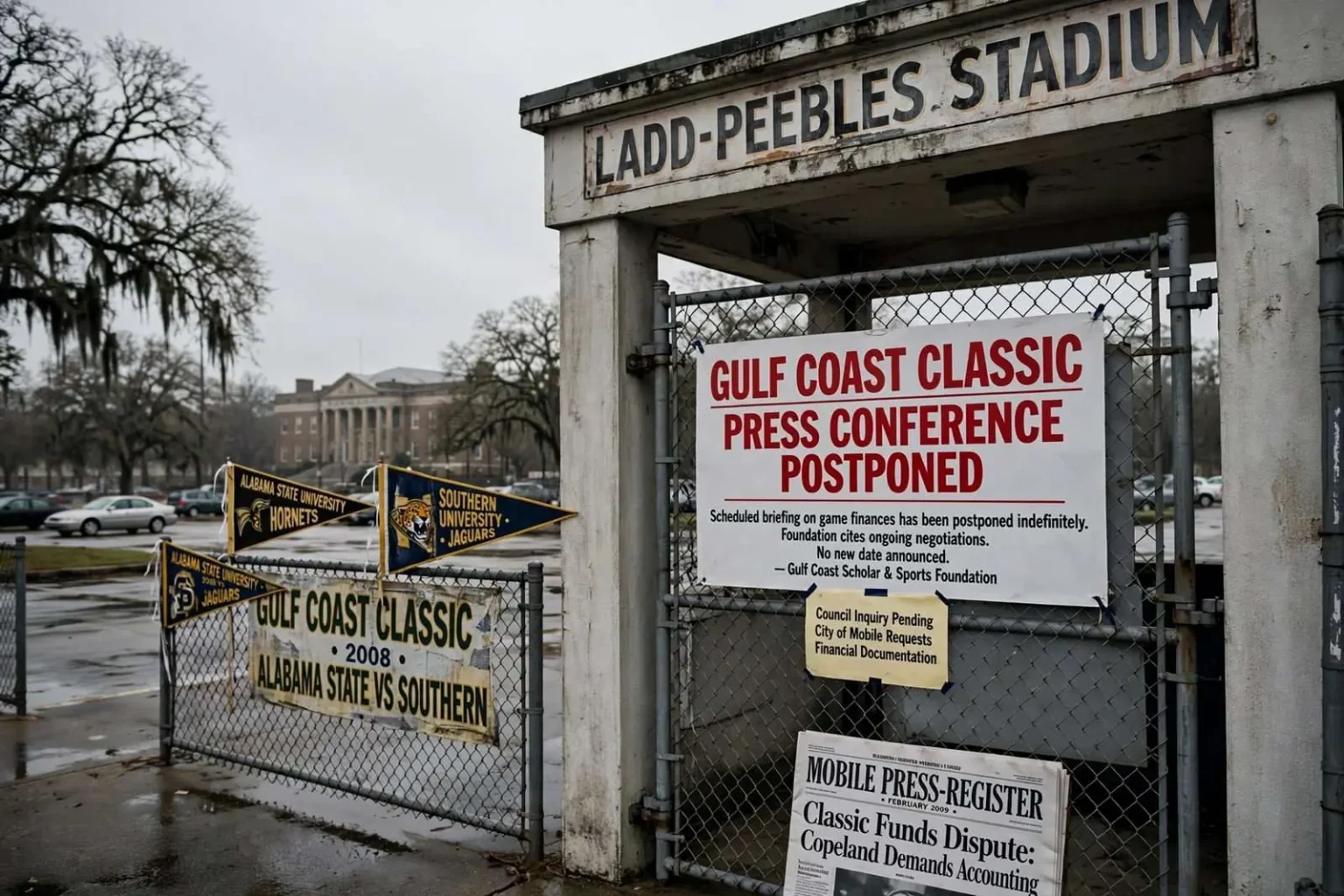
MOBILE – The foundation that runs the Gulf Coast Classic will not hold the press conference it promised to explain the football game’s troubled finances, a spokesman said, leaving unanswered the questions that the president of the Mobile City Council has been pressing for weeks.
The Gulf Coast Scholar and Sports Foundation took over management of the Classic in 2008 and staged it as a marquee matchup between Alabama State University and Southern University at Ladd-Peebles Stadium. The city of Mobile contributed a $275,000 appropriation. When the accounting was done, the event had run a deficit of more than $188,000.
Those numbers set the terms of the dispute. A quarter-million dollars of public money had gone into a first-year game that lost nearly three-quarters of it, and the organization holding the books had promised — then declined — to walk the public through what happened. In city hall, where every dollar of the Classic’s appropriation had been debated line by line, the silence was not being received as a scheduling inconvenience.
What Copeland Wants
City Council President Reggie Copeland has called on the game’s organizers to disclose the Classic’s finances in full and to make the changes needed to give the event a realistic chance of succeeding.
The council had already trimmed the mayor’s original funding request during budget debate, and members were not eager to see public money disappear into a game that could not pay its own bills.
Copeland’s position carried institutional weight. As council president, he was the floor leader for budget questions and the member most responsible for explaining to constituents why the city funds the events it funds. His demand was not simply for an audit of the past — it was a test of whether the Classic could ever be trusted with a second appropriation. An event that cannot explain a $188,000 loss, his argument ran, has not earned the right to ask for more.
Foundation treasurer Ray Lapierre said last week that a press conference would be held to address Copeland’s concerns. This week he said the decision had been reversed. The briefing was being postponed, he said, because foundation representatives were in the middle of sensitive negotiations and did not want to jeopardize them.
Directors of the foundation and others associated with the game have spoken of landing a major sponsor, which is the likeliest explanation for the negotiations Lapierre referred to. Efforts to confirm the identity of any prospective sponsor have not succeeded.
The logic of the postponement is easy to reconstruct and hard to evaluate. A naming sponsor could transform the Classic’s finances in a single stroke — covering guarantees, marketing and the deficit itself. But it also gives an organization a ready-made reason to defer any question indefinitely, because the negotiations are always ongoing and the details are always too sensitive to share.
For Copeland and the council, the calculus cuts the other way. Every week spent courting a sponsor is a week in which the city is asked to extend credit to an organization whose only published financial statement is a loss. A sponsor conversation and an honest accounting are not mutually exclusive; the documents that would reassure the council are the same documents any serious sponsor would demand before attaching a name to the event. That is the quiet irony of the standoff: the transparency the foundation is postponing is exactly what its own negotiations would require.
Why the Game Mattered
The Gulf Coast Classic was not simply a football game. Modeled on the Bayou Classic in New Orleans and the Magic City Classic in Birmingham, it was intended to become an annual pilgrimage for the alumni and supporters of two historically Black universities – a weekend of reunions, bands, step shows and hotel bookings that would fill downtown Mobile in November the way the Senior Bowl filled it in January.
The models it cited are the proof of concept. The Bayou Classic, played on Thanksgiving weekend between Grambling State and Southern, had grown into one of the largest annual events in Louisiana, drawing tens of thousands of alumni to New Orleans for a game that was merely the centerpiece of a much larger weekend. The Magic City Classic had done the same for Birmingham, turning Alabama State’s rivalry game into an autumn fixture whose economic footprint reached far beyond the stadium gates. Those events demonstrated that a classic between two HBCUs is less a football game than a convention — one that books hotels, fills restaurants and returns every year on schedule.
Alabama State and Southern were a natural pairing for such an attempt. Both schools bring marching bands with national reputations, alumni networks spread across the Southeast, and fan bases accustomed to traveling for the classic-weekend experience. Mobile’s location on the Interstate 10 corridor puts both fan bases within a day’s drive, and the city’s hotels and downtown entertainment district offered the amenities a multi-day visit requires. The concept was sound on paper; what the first year’s books could not yet prove was whether the attendance projections behind it were.
That ambition was the argument for public money. Ladd-Peebles Stadium seats roughly 40,000, and boosters told the city that a true classic would put tens of thousands of visitors into Mobile restaurants and hotel rooms.
Mobile already knew what a successful football institution could do for a city. The Senior Bowl, played each January under a different organizational model, had spent decades proving that a single game could anchor a week of national attention, hotel occupancy and business for the city. The Classic’s pitch was to replicate that effect in November, a month that otherwise offers the city’s hospitality industry a gap between football seasons.
Skeptics on the council wanted to see the receipts before they voted for another appropriation.
The disagreement that resulted was, at bottom, about verification. Organizers pointed to an independent audit. Copeland wanted the underlying documents. Neither side disputed that the first year had lost money; what they disputed was why, and what the city should conclude from it.
The distinction matters more than it might appear. An audit’s summary can certify that the numbers were compiled correctly without explaining them. The underlying documents — gate receipts, sponsorship agreements, the guarantee payments owed to the schools, the invoices for bands and promotion — show where the money actually went. A council weighing a second appropriation is entitled to that level of detail, and it had asked for nothing more.
A Standoff With a Deadline
The postponement mattered because the city’s budget calendar does not pause for negotiations. Mobile officials would eventually have to decide whether to fund the 2009 game, and they preferred to make that decision with the previous year’s books in hand.
Municipal budgeting is a season, not a moment. The council’s appropriations decisions ripen in the summer and early fall, and an event asking for renewal funding has to make its case while those decisions are being assembled. A foundation that cannot brief the council in February still has months to produce its documents — but every week of silence narrows the window in which a second appropriation can be debated on anything other than faith.
For the two schools, the stakes were more immediate: the contract obligated the Classic to pay Southern and Alabama State substantial guarantees, and the size of the deficit was close to the amount still owed them.
That detail reframed the entire dispute. Guarantee fees are the fixed cost of staging a classic — the agreed-upon payments that bring two universities’ football programs, bands and followings to town regardless of how the gate performs. They are payable whether the event profits or not. If the Classic’s first-year deficit was nearly equal to what it still owed the schools, then the game had not merely lost money; it had exhausted its operating cushion and faced obligations it could not yet meet. The “sensitive negotiations” the foundation cited might have concerned a sponsor — or the schools themselves.
The episode was an early test of a question that recurs whenever a city underwrites an event in the name of tourism and economic impact – what the public is owed in return, and how quickly.
On that question, in the middle of February 2009, the Gulf Coast Scholar and Sports Foundation had chosen silence.
It is a question Mobile has confronted before and will confront again, because the city’s economic strategy leans heavily on events — the Senior Bowl, Mardi Gras, bowl games and tournaments that fill hotels in the slow season. Public support for such events is not controversial here; accountability for it is what gets debated. The Classic’s founders had promised an institution that would rival the Bayou Classic’s scale. What the city’s leaders wanted to see, before another dollar moved, was the accounting to match the ambition — and the foundation’s postponed press conference had become the measure of whether Mobile’s newest classic understood the difference between asking for public trust and earning it.