University of South Alabama Tillmans Corner
A Year After Resigning, Holland Seeks His Old School Board Seat Back
Retired grocery executive John Holland moved to reclaim the Mobile County school board seat he gave up after an ethics ruling, setting up a Republican primary against the woman appointed to replace him.
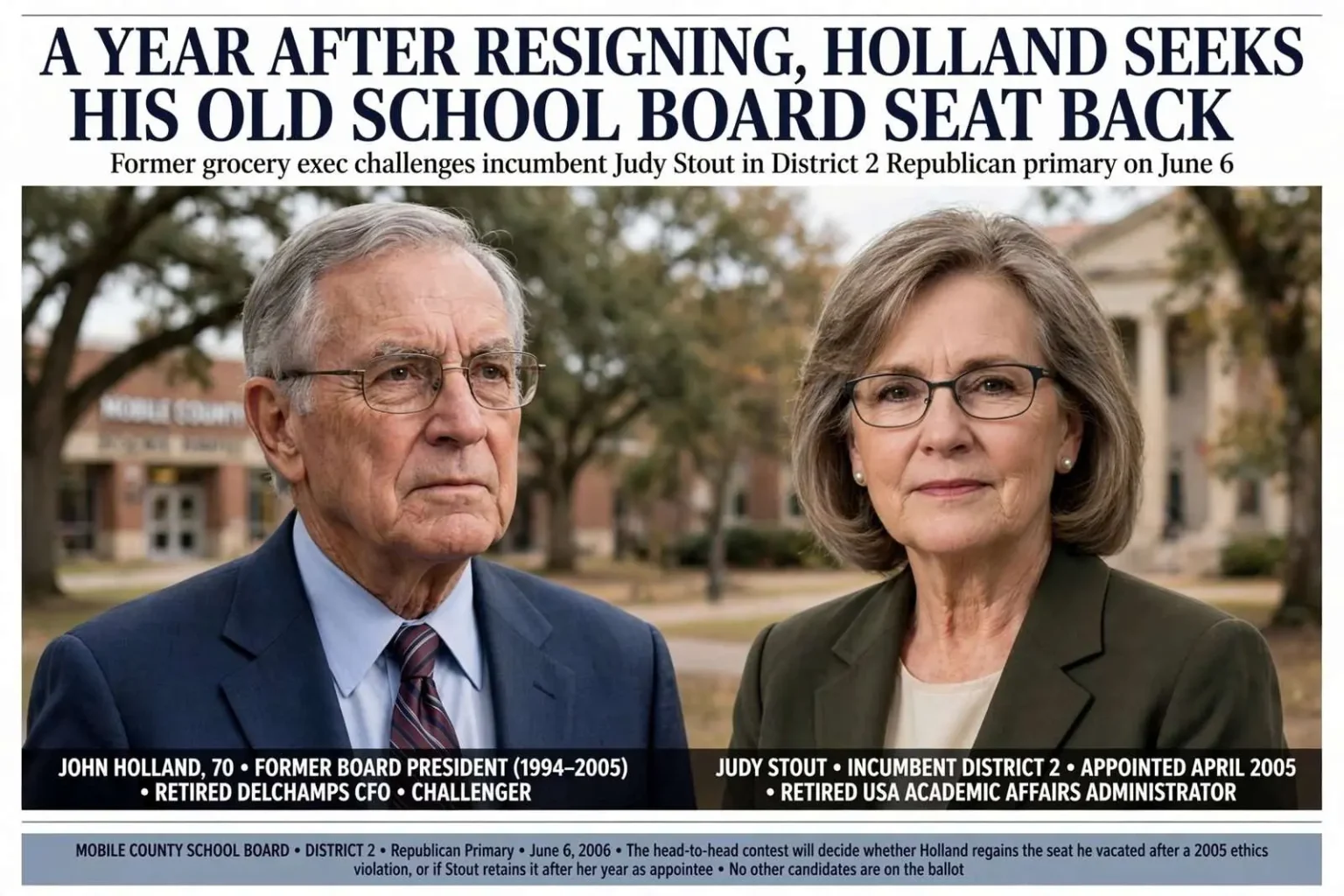
Retired grocery chain executive John Holland announced he would seek to reclaim the Mobile County school board seat he surrendered a year earlier under the shadow of an ethics complaint — and to do it, he would have to defeat the woman appointed to replace him. Holland filed to challenge incumbent District 2 School Board Member Judy Stout in the Republican primary set for June 6, 2006. Stout had been picked by the remaining board members to fill the seat after Holland’s resignation on April 7, 2005. She had announced her intention to run for the post in her own right. No other candidates, Republican or Democrat, had announced for District 2.
The matchup gave the west Mobile district a rarity in county school politics: a head-to-head contest between a board’s past and its present, with no one else on the ballot. Every voter who pulled a Republican primary ballot in June 2006 would be asked a question no nominating contest usually poses — whether the man who resigned over an ethics penalty deserved his old job back, or whether the appointee who had kept the seat warm had earned it outright.
“An expensive speeding ticket”
The Alabama Ethics Commission found on June 1, 2005, that Holland had “committed two minor violations of the Alabama Ethics Law” and assessed an administrative penalty of $1,000. The violations concerned two votes he cast in favor of contracts involving Volkert and Associates, the engineering firm where his son-in-law was employed. Between 1996 and 2003, Volkert had supervised school construction projects totaling roughly $250 million — which is precisely why the appearance of a conflict mattered, however technical the violation.
Holland did not dispute the finding, but he did contest its weight. “One of the key things I understand about that: It was certainly a mistake to vote,” he said. “I know that now. But both times my vote didn’t make a hill of beans.” The outcome, he noted, would have been identical had he abstained. He said he did not even know the Volkert employee who hired his son-in-law; the firm had about 600 employees across a number of divisions.
He characterized the episode as “an expensive speeding ticket that didn’t get expunged,” and said he now wished he had let the matter run its legal course rather than resigning, believing the issue would have expired and left his record unmarked. The regret was the heart of his campaign’s argument: that a $1,000 administrative penalty, on votes that changed nothing, had cost a school system a decade of financial oversight — and that the remedy he chose, walking away, had been disproportionate to the offense.
The ethics episode also gave voters a lens on board governance itself. In a system that would spend hundreds of millions on construction over a decade, the school board’s votes selected and supervised the firms that managed the money. A member whose family drew a paycheck from one of those firms sat, by definition, on the wrong side of the ledger — even if, as Holland insisted, he never knowingly benefited and never swung a decision. The Ethics Commission’s ruling said the violations were real but minor; the question in the primary was whether minor covered it.
The case he was making
Holland held the District 2 seat from 1994 to 2005, serving as board president and vice president and chairing committees on finance, personnel, facilities and land, and community affairs. His pitch rested on his ledger. He retired from Delchamps Inc. as the grocery chain’s chief financial officer, having joined the company as a bag boy — a biography that plays well in Mobile and that he did not hesitate to mention.
Holland, then 70, argued that financial experience was an invaluable asset to a school system with more than $600 million in annual expenditures. During his prior service, he said, he helped the system secure construction bonds that produced more than $350 million in new construction, additions and capital repairs over ten years. Running again, he said he would stress public accountability in all areas, including annual financial reports detailing the system’s complete financial condition. His goals included reducing waste and overhead in programs while improving working conditions for classroom teachers.
He and his wife of more than 40 years, the former Carol Rodgers, had three grown children, all graduates of Mobile County public schools, and three grandchildren. The family’s ties to the system were the quiet backdrop of the campaign: a candidate whose children and grandchildren had all passed through the same classrooms the board governed, in a state where school board races are usually decided by whoever shows up with a yard sign.
The incumbent
Stout retired the previous summer from the University of South Alabama, where she had served as associate vice president for academic affairs, interim dean of the graduate school, director of the honors program and a professor. She made no elaborate case for herself. “I definitely want to continue doing it,” she said of the board seat. “It is difficult but important work. I really and truly enjoy it.”
Her candidacy rested on continuity. Appointed by her fellow board members — a vote of confidence from the very people Holland had served alongside — she had spent the year learning the system from the inside and running it without the taint that the ethics episode attached to her predecessor. Her academic career, built on managing programs and people at a university across town, gave her a professional credential that answered Holland’s balance sheets with a different kind of record: administration, faculty politics and students.
The district
District 2 includes parts of the city of Mobile west of Interstate 65, south of Old Shell Road and east of Sollie and Cody roads, along with areas of Mobile County south of the city limits — among them Tillmans Corner, Belle Fountaine and other Fowl River communities. The territory mixes established west Mobile neighborhoods with the fast-growing unincorporated communities along the road to the bay, and its schools run the same range: older campuses with settled enrollments and new ones built to catch the county’s southward expansion.
Mobile County school board members serve six-year terms, are paid $12,000 annually and are elected on a rotating basis. The board oversees the largest public school system in Alabama. The June 2006 Republican primary would decide the seat, with no Democrat announced — making it, in practical terms, a referendum among Republican voters on whether an ethics penalty and a resignation should end a decade-long tenure, or whether a chief financial officer’s eye was worth more to a $600 million system than a clean record.
What was at stake for the school system
The seat mattered far beyond its $12,000 salary because of what the Mobile County board actually controls. The system it governs is the largest in Alabama, with more than 60,000 students spread across the city and the county’s unincorporated reaches, an annual budget above $600 million, and a construction program that had rebuilt whole campuses over the previous decade. Board members hire and review the superintendent, approve the budget, award construction contracts and set the policies that reach every classroom in the county. A single District 2 seat does not dominate those votes, but it helps decide who holds the gavel and which priorities get heard.
For west Mobile and the southern county, the race also carried a local dimension. District 2’s schools had absorbed much of the system’s growth, and the board’s construction decisions — where the next school was built, which campus was renovated, how the bond money was sequenced — landed directly on the neighborhoods Holland and Stout hoped to represent. Holland’s bond record was, in that sense, not an abstraction: the additions and repairs he helped finance stood in the district’s own schoolyards.
The contest offered voters two theories of what the board needed. Holland’s was arithmetic — a system spending $600 million a year needed someone who had spent a career reading financial statements, spotting waste and structuring debt. Stout’s was stewardship — a system already recovering from scandal needed steady, capable administration from someone with nothing to explain. Both theories were honest, and that made the primary a genuine choice rather than a referendum on personality alone.
The shadow of the resignation
Holland’s resignation in April 2005 had been accepted by colleagues who respected him, and its aftermath shaped the race in ways neither candidate could fully control. Board members who appointed Stout did so without controversy, which meant her incumbency carried the implicit endorsement of the establishment Holland had been part of — and implicitly, a judgment on the circumstances under which he had left it. Every voter who remembered the headlines about the ethics finding would have to decide what it meant that the man now asking for his seat back was the one who had vacated it.
Holland’s answer was to own the mistake and attack his own judgment in leaving. “An expensive speeding ticket” became his shorthand — an offense real, paid and forgettable, except that he had made it unforgettable by resigning. The argument was unusual in its candor: he was not asking voters to believe he had done nothing wrong, only that what he did wrong was small, and that his departure had punished the school system more than it punished him.
Stout, for her part, had no need to relitigate the episode. She could run on her year in the seat, her university career and her plain-spoken enjoyment of the work, and let voters weigh the value of continuity against the value of a comeback. With no other names on the ballot, the District 2 race distilled the 2006 primary season in Mobile County to its simplest form: two candidates, one question, and a June date that would settle it.