A Crowded Field Shapes Up Against Mobile County Commissioner Mike Dean
Mobile County Commissioner Mike Dean looked at a Republican primary fight and a likely Democratic opponent in his 2008 re-election bid, with names from Dauphin Island to Bayou La Batre in circulation.
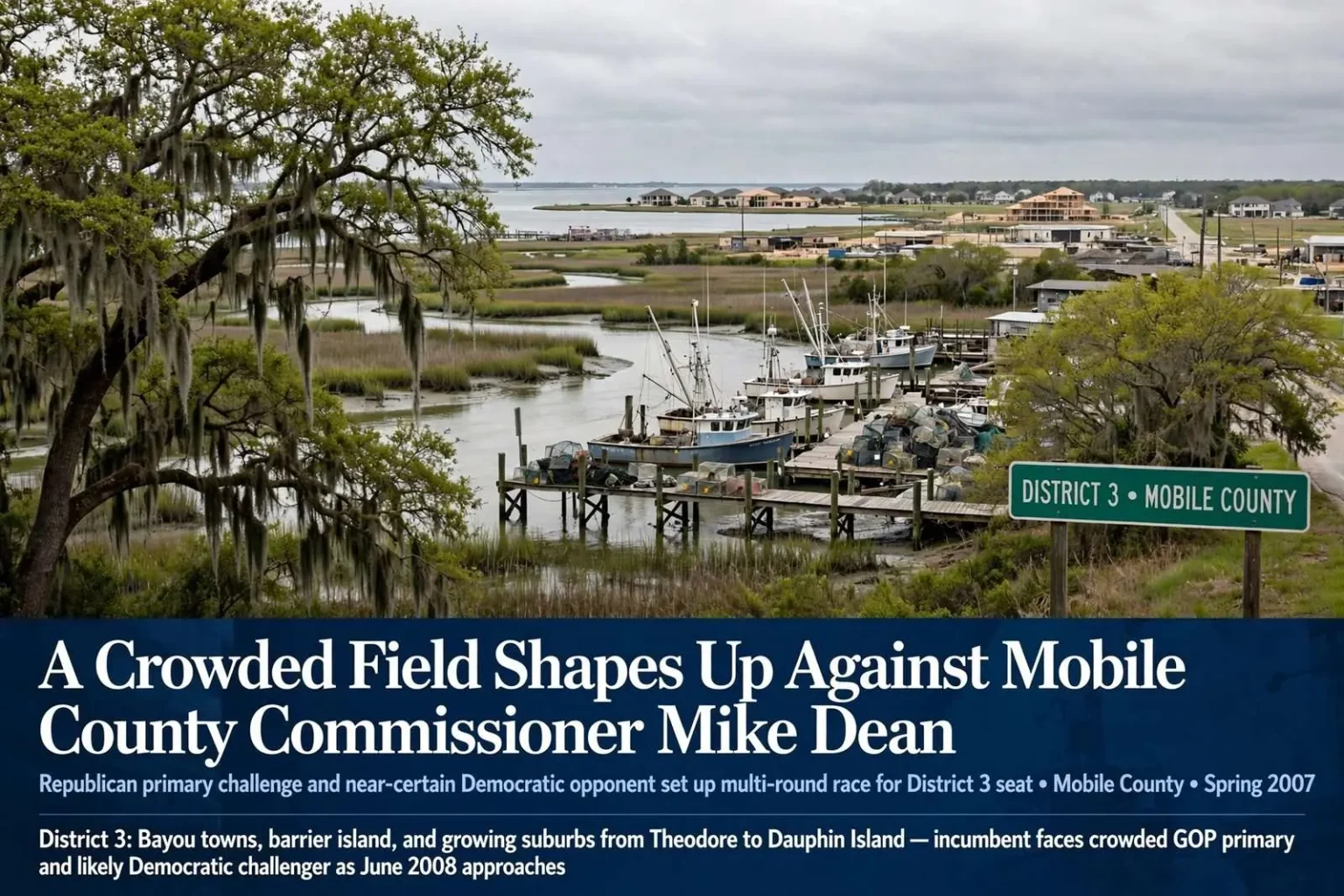
Mobile County Commissioner Mike Dean appeared likely to go two or more rounds to keep his seat, with a Republican primary challenge shaping up for the following June and a Democratic opponent all but certain to await the winner in the general election.
Dean, who represented District 3 — the sprawling southern end of Mobile County, running from the western suburbs down through the bayou communities to the coast — could anticipate opposition from within his own party in the primary, and perhaps again in a runoff to settle the Republican nomination.
The geometry of that prospect told much of the story. District 3 is among the largest and most varied commission districts in Alabama, and any race for it would be fought across communities that barely resemble one another — an oystering town, a barrier island, a pair of fast-growing suburbs and stretches of rural land in between.
The Names in Circulation
Among those mentioned as prospective Republican challengers were Dauphin Island Mayor Jeff Collier; utility company executive Bud Robertson; Bayou La Batre City Councilman Henry Barnes; businessman and former law enforcement officer John Graham; firefighter Terry Lilley; and former interim Mobile County Sheriff David Evans.
The list was a portrait of the district itself. Collier brought an island base and firsthand standing on the storm-recovery and tourism questions that dominate Dauphin Island politics. Barnes spoke for the seafood towns of the bayou country, where the working waterfront’s fortunes rise and fall with the health of the water and the price of fuel. Graham and Lilley represented the kinds of civic credibility — business and first-responder backgrounds — that play well in the district’s suburbs and unincorporated communities.
Evans carried a different kind of name recognition. An interim sheriff by definition holds office briefly, but the title follows a candidate, and law enforcement credentials have long been among the most portable assets in South Alabama politics.
The geography of that list is worth pausing over. District 3 gathers up communities with very different economies and very different priorities — the seafood and shipbuilding economy of Bayou La Batre and Coden, the tourism and storm-exposure concerns of Dauphin Island, the suburban growth pressures of Theodore and Tillmans Corner. A commissioner has to hold all of it together, and any challenger typically starts with a base in one corner of it.
That structure — one challenger, one base — is precisely why a crowded field is dangerous for an incumbent. If several of the names in circulation actually qualified, the primary vote could scatter across hometown lines, and an incumbent with district-wide name recognition could be pushed into a runoff even against a modest combined opposition. In Alabama primaries, low turnouts amplify any organized base, and a runoff changes everything about how a campaign must be funded and fought.
The Democratic Side
On the Democratic side, a general-election opponent looked to be a near certainty, even in a county where Republicans had been winning most countywide offices. Former county commissioner and ex-state Sen. Gary Tanner was floated as a possible standard-bearer, and his name carried both experience and familiarity from years in office.
Mobile County Democratic Chairman Brad Warren was also mentioned as a potential first-time candidate for elective office — a step party chairs take rarely, and usually when they conclude no one else will. The mention of the party’s own chairman in connection with the race said as much about the Democratic bench in the county as about any individual’s ambition.
For whatever Democrat emerged, the general-election arithmetic would be difficult but not hopeless. Countywide races in Mobile were trending Republican by the late 2000s, but the southern district’s scattered communities vote on local loyalties as much as on party, and a well-funded challenger with roots in the right corner of the district could make the fall competitive.
Why the Seat Mattered
The Mobile County Commission is a three-member body with unusually broad authority. Its members control county road money, budget decisions and appointments across a jurisdiction of more than 400,000 people, and each commissioner exercises considerable influence over spending within their own district.
In a county where the commission has often been closely divided, a single seat can determine which projects move and which wait. Road paving, drainage, bridge work and industrial incentives all pass through commission votes, and the politics of “which district gets it first” is a standing feature of Mobile County government. Developers, volunteer fire departments and municipal governments all track the third district’s seat accordingly.
The politics of the moment added to the stakes. The commission had been operating with only two members for a stretch after Sam Jones left District 1 to become mayor of Mobile, and the fight over how to fill that vacancy had already produced one appointment that federal authorities later declared invalid. A special election to restore the commission to full strength was scheduled for that fall.
A commission operating shorthanded concentrates power in fewer hands, and every district’s commissioner carries more weight in the interim. That reality raised the value of each seat — including Dean’s — because a two-member board must agree on nearly everything, and any commissioner who can swing the second vote controls the agenda until the vacancy is filled.
Against that backdrop, the 2008 cycle promised a genuine contest for control of the body. Whoever held District 3 would help decide the next chairman, the next budget priorities and the disposition of a road program that had grown along with the county’s population.
The Long Road to June
Alabama’s primary calendar meant candidates had more than a year of groundwork ahead. Qualifying would not close until the spring of 2008, and the primary itself was set for June. In a district with as many distinct constituencies as District 3, that is a long time to raise money, court the volunteer firefighters and civic clubs, and work the coastal communities that turn out reliably in local races.
Those twelve months favor incumbents in ways that rarely show up in polls. Sitting commissioners can attend the fish fries, the fire department suppers and the civic club meetings that anchor social life in the bayou communities and the suburbs, and they arrive with county government’s resources already at their command — road crews to call, drainage projects to point to, appointments to trade.
For Dean, the situation carried a familiar risk for incumbents in one-party areas: the real contest was likely to come from within his own party, where a crowded field could push him into a runoff and force him to spend heavily before facing any Democrat at all. Money spent in June is money unavailable in November, and a bruised primary winner is easier to beat in the fall — a calculation any Democratic nominee would be counting on.
The names being dropped in the spring of 2007 were, of course, only names. Several never filed. But the exercise itself — the quiet canvass of who might run, conducted a full year before qualifying — is how county politics in South Alabama has always begun, at coffee counters and volunteer fire department suppers long before anyone pays a qualifying fee.
By the time qualifying actually closed, the field would look nothing like the early list, and both parties knew it. What the early maneuvering established instead was the terrain: an incumbent with district-wide standing, a challenger bench full of hometown credibility but no single dominant alternative, and a general-election contest that would test whether the southern district’s loyalties ran first to party or to the commissioner who had been answering its road and drainage calls.
What a Commissioner Actually Delivers
Campaign rhetoric in commission races tends to compress into one currency: roads. County commissioners in Alabama control pavement and drainage in a way no other officeholder does, and residents of District 3 judge their commissioner by the strip of asphalt in front of their house and the ditch that either carries or does not carry the next heavy rain.
The district’s geography makes that charge heavier than usual. Coastal flooding in the bayou communities, washouts on rural roads west of Theodore, traffic pressure from subdivision growth in Tillmans Corner — each problem lands on the commission’s road program, and each has a constituency that remembers who answered. Storm recovery adds another layer: after hurricanes, debris removal, drainage repairs and rebuilding grants all route through county government, and a commissioner’s standing in the coastal communities is often set by how those weeks are handled.
Appointments are the quieter currency. The commission’s seats on water and sewer boards, industrial development bodies and regional planning organizations shape decisions that never appear on a ballot but determine where growth goes. Whoever held District 3 would carry that portfolio into every negotiation, which is why the early list of challengers included sitting mayors and councilmen who already understood the machinery.
For the voters of the district, the spring’s maneuvering offered a preview of the choice to come: a commissioner whose record consisted of the roads, drainage and appointments of the previous years, against a field of challengers each promising to bring their own community’s priorities to the center of the table. The campaign year ahead would test which promise the district believed.