Bayou La Batre Mayor Backs Challenger, Touching Off Feud Over Block Grant Money
Bayou La Batre Mayor Stan Wright endorsed challenger Mike Burdine over incumbent Mobile County Commissioner Mike Dean in 2004, alleging the fishing village had been shortchanged on block grant funds. Dean called the claim false.
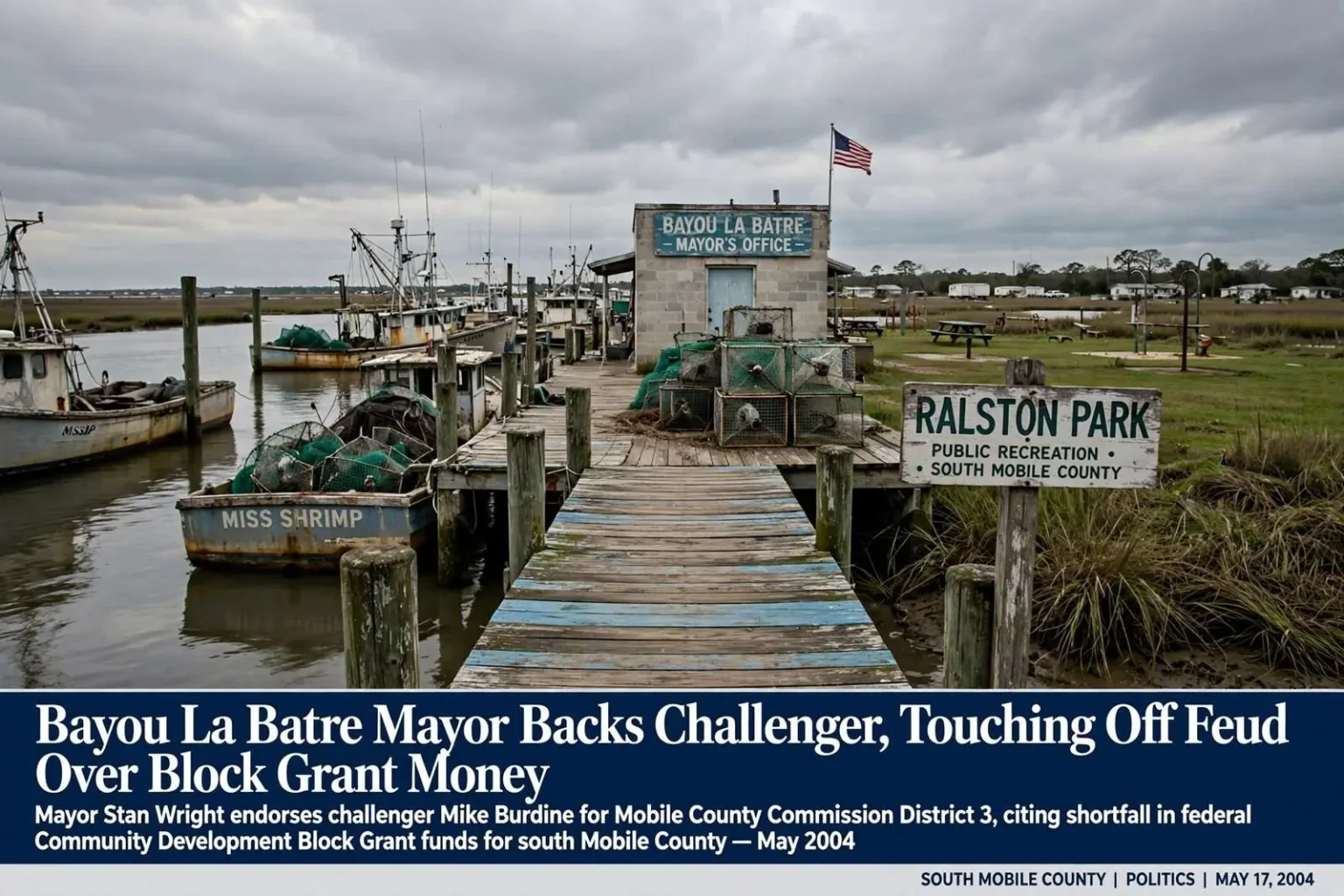
The 2004 Republican primary for Mobile County Commission District 3 took a sharp turn in mid-May when Bayou La Batre Mayor Stan Wright threw his support behind challenger Mike Burdine, a veteran Mobile police officer trying to unseat incumbent Commissioner Mike Dean. An endorsement from a sitting mayor is routine currency in county politics, but Wright did not endorse quietly. He grounded his backing in a specific grievance: the way Mobile County had divided its Community Development Block Grant money, the federal funding stream that flows through local governments to pay for infrastructure and public facilities in low- and moderate-income areas.
The choice of grievance said as much as the endorsement itself. Wright was not accusing the commissioner of ignoring the bayou’s shrimp fleets or its hurricane-prone shoreline; he was making an accounting argument, item by item, about federal dollars the county received and how they were passed along. It was the kind of case a small-town mayor can document in a folder, and he brought it to the campaign.
The mayor’s case
By Wright’s account, roughly two-thirds of Bayou La Batre’s residents met the low- and moderate-income thresholds that drive block grant allocations — a proportion he argued should have entitled the south Mobile County fishing village to a larger share of the county’s appropriation than it actually received. Community Development Block Grants are allocated largely on that data: the more households in a community that fall under federal income thresholds, the stronger its claim when a grantee government divides its annual allotment among competing needs.
Over the previous three years, he said, Bayou La Batre was owed as much as $400,000 more than it got. The practical consequence, the mayor said, was that plans to remake Ralston Park into a recreational showplace for south Mobile County had been set back. The park was one of the few public spaces in a town whose built environment was almost entirely working: docks, processing houses, boat yards and the plain housing of a fleet-dependent community. A showpiece park was not an ornament in Wright’s view; it was the kind of civic amenity the town could never fund out of its own modest tax base.
Wright also broadened the complaint into a general indictment. “The bottom line is that Dean has never represented south Mobile County,” he said. “We need a county commissioner to represent all the people.” The line was aimed at a long-standing perception rather than a single dispute: that the commission’s attention and money flowed toward Mobile and the fast-growing western suburbs, while the county’s southern reaches — Coden, Grand Bay, St. Elmo, Irvington, Bayou La Batre — received what was left over.
The commissioner’s answer
Dean, plainly irritated, disputed every part of it. Any claim that Bayou La Batre had been shortchanged on its block grant allotment was, he said, false. Far from cutting the town out, Dean said, he had fought to secure an additional $300,000 for it. The figures the two men traded were not reconcilable, and neither side offered the county’s grant accounting for public inspection; voters were left to choose between a mayor’s ledger and a commissioner’s memory.
The commissioner suggested the mayor’s real motive lay elsewhere. Wright’s opposition, Dean argued, sprang less from block grant dollars than from the mayor’s disappointment that the commissioner had declined to appoint Wright’s preferred candidate to a county board. He described the mayor as “bitter” and “very confused.” The accusation reframed the endorsement as personal score-settling — an officeholder punishing a colleague over a patronage disappointment — and it gave Dean a story to tell primary voters that did not involve a $400,000 grievance.
Dean also offered a broader explanation for tighter county purse strings. A lackluster economy, he said, had trimmed county revenues and limited what the commission could do to help municipalities compared with the years before the downturn. County commissions draw their money largely from property taxes and fees, and a slow economy constricts both, leaving less discretionary cash for exactly the kind of municipal projects the block grant dispute was about.
“If we haven’t always been able to do as much as we did the year before, well, it’s a ‘what-have-you-done-for-me-lately’ deal with him,” Dean said of Wright. The remark captured the commissioner’s view of the endorsement: a mayor judging a decade of service by the last few years’ allotments, in a budget climate nobody on the commission had chosen.
How much is an endorsement worth in the bayou?
Wright himself conceded that south Mobile County voters were independent thinkers who did not take instruction easily — a candid admission from a man who had just handed out an endorsement. “If their ditches are clogged up, if their roads are caved in, if their trucks are slipping and sliding all over the place, that’s what they care about,” he said. “They don’t give a damn about no endorsement. They go by performance.”
The candor was disarming, and it reflected the political culture of the county’s rural south. Voters there have historically judged officeholders by culverts, roads and drainage — the unglamorous infrastructure that county commissions actually control — and a newspaper endorsement or a mayor’s blessing carries less weight than a commissioner’s record on a specific washed-out road.
Burdine, for his part, was happy to have it. “I’m proud to have his support and I want everybody’s support,” he said. “That’s the way you win elections.” For a police officer running against a long-tenured incumbent, the mayor’s endorsement supplied something more valuable than applause: a standing in the southern end of the district that his own career in the city of Mobile could not supply by itself.
A third Republican was also in the field: Sheriff’s Deputy Howard Waters, who had recently picked up an endorsement from a Republican assembly in south Mobile County. The primary field of three gave the June 1 contest the texture of a genuine competition rather than a coronation, with the incumbent defending his record, a challenger carrying the southern towns’ grievance, and a third candidate courting the grassroots right.
Why the block grant fight mattered
Community Development Block Grants were, and remain, one of the few flexible federal funding sources available to small coastal towns with limited tax bases. Unlike grants tied to a single purpose, block grant money can go to streets, drainage, water systems, community buildings and parks — the unglamorous capital projects that determine whether a small town can function. For a working seafood community such as Bayou La Batre — where shrimping and boat building anchored the economy and where a substantial share of households lived on modest incomes — a difference of a few hundred thousand dollars in county allocations was not an abstraction. It was the difference between a park getting built and a park staying on paper.
The dispute also illustrated a persistent tension in Mobile County politics: the sense among residents of the county’s southern reaches that money, attention and infrastructure tended to flow toward Mobile and the growing western suburbs, leaving the fishing villages along the Mississippi Sound to argue for scraps. The geography is unforgiving — the district stretches from the industrial edge of south Mobile to the open farmland and marsh of the state’s southwest corner — and commissioners who campaign on suburban growth find an audience there that rural voters cannot match at the ballot box.
For Bayou La Batre specifically, the grievance would prove durable in ways the 2004 campaign could not have foreseen. Within a year, Hurricane Katrina would push a storm surge through the town’s low-lying streets and destroy much of its seafood infrastructure, and the question of how federal recovery money reached the town — and how fast — would become the defining issue of its decade. Mayors who learned to document shortfalls in block grant allotments were, in effect, rehearsing for the recovery accounting that followed the storm.
Wright’s own trajectory underscored the town’s growing political voice. The mayor who delivered the 2004 endorsement would go on to leave City Hall for the Legislature, representing the district that includes the bayou in Montgomery, where the same accounting instinct — every dollar traced to its intended recipient — remained his signature style.
Whatever the merits of the accounting, the 2004 exchange between a small-town mayor and a sitting county commissioner put that tension on the record in unusually blunt language. A $400,000 claim against a $300,000 counter-claim, a patronage appointment disputed as the real grievance, and a mayor conceding that his own voters ignore endorsements — the whole quarrel was a compact course in how south Mobile County politics actually works. The June 1 primary would tell the voters’ side of it.