
Ben Brooks Weighed a Run for the State Senate or a Circuit Judgeship in 2006
Mobile City Councilman Ben Brooks said in October 2005 he was strongly considering a run for state Senate District 35 or for the circuit judgeship being vacated by Ferrill McRae, but would consult his district first.
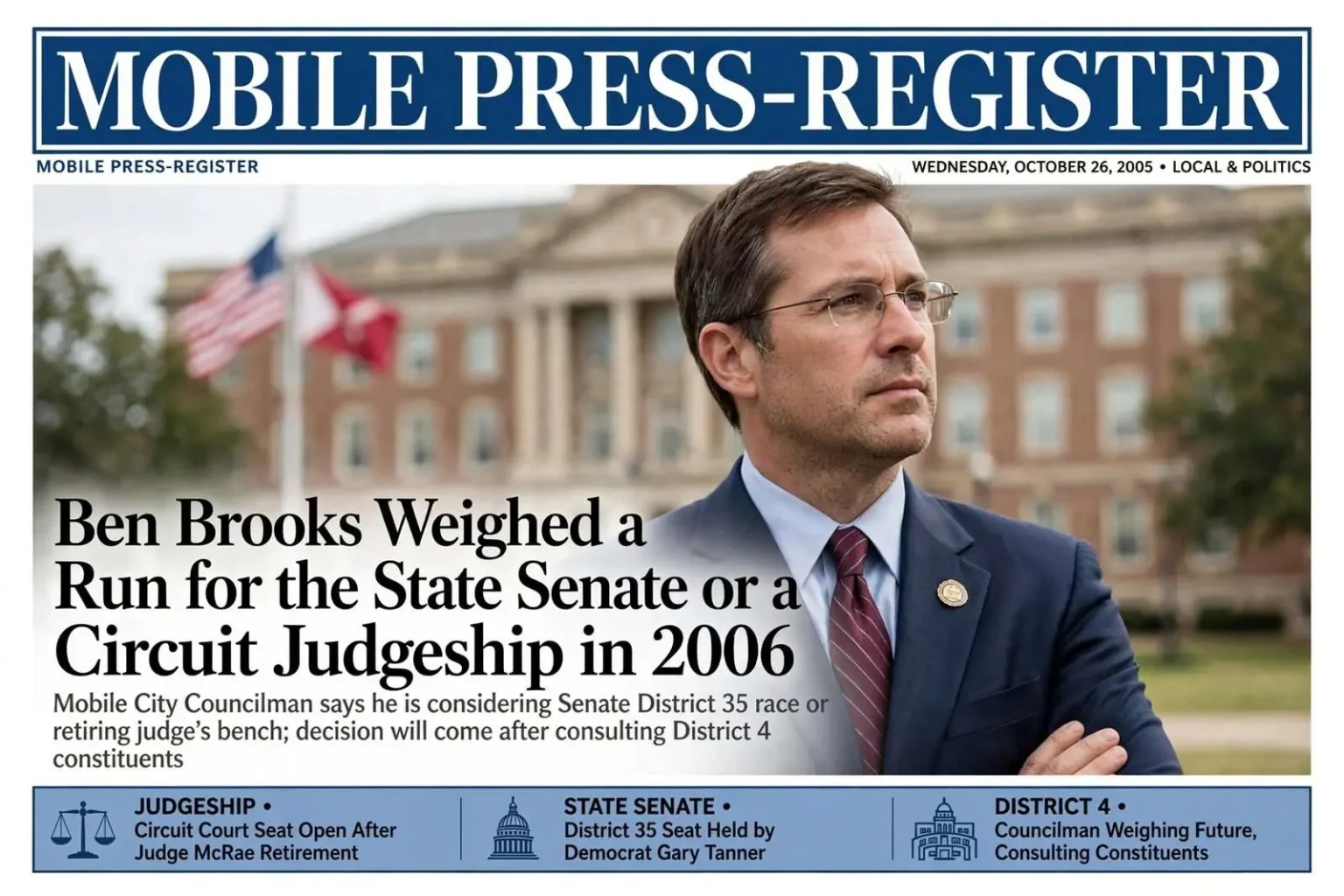
Mobile City Councilman Ben Brooks, unopposed only two months earlier in his bid for a second term, said in October 2005 that he was likely to seek another office in the following year’s elections, and that he was weighing two very different paths.
Brooks, then a 47-year-old Mobile attorney, confirmed he was strongly considering a race for either state Senate District 35, held by south Mobile County Democrat Gary Tanner, or the Mobile County Circuit judgeship set to be vacated by the retirement of longtime Circuit Judge Ferrill D. McRae.
The timing gave the announcement its texture. Brooks had just coasted back onto the council without opposition — the clearest possible sign of a secure political base — and within weeks was telling constituents he might leave it. The two openings he named were not speculative; both had real dates attached, and both would appear on the same 2006 ballot.
A Decision He Said He Would Not Make Alone
Brooks emphasized that he would consult his District 4 constituents before committing to either race.
“It’s been weighing pretty heavy,” Brooks said. “The situation is amorphous. I’ve met with a lot of people who are really urging me to do that (run for state Senate). I’ve also been urged to run for the judgeship. They are both positions of great honor. I’m blessed and lucky to have an opportunity to consider them. I will think and pray over it with my family.”
He was direct about the obligation he felt to the district that had elected him.
“I’m not abandoning anybody,” he said. “Before I make or announce a decision, I will be consulting with the residents of my district, my constituents. If these people told me ‘we cannot lose you,’ I’d have to rethink it.”
Asked whether he wanted one of the two offices, Brooks did not pretend otherwise.
“Do I desire to be a part of one of those scenarios next year?” he asked. “There’s no question that’s of high interest to me. Again though, I will protect the interests of District 4 first.”
The answers drew the outline of a politician trying to move without appearing to move. Every quote paired ambition with obligation — interest in the new office with fidelity to the old one — and set the district itself up as the deciding voice. It was a careful posture for a councilman whose seat had just gone uncontested, and it left him room to run while telling the voters he had asked permission.
He said he expected to make a final decision within a month to a month and a half.
That timetable kept the question alive through the fall, with both potential races building behind it: the qualifying deadlines for 2006 elections, the retirement paperwork at the courthouse, and the field of would-be successors already circling his council seat.
The Mechanics of a Move
The rules gave Brooks room to look before leaping. He would not have to relinquish his city council post in order to run for either the judgeship or the Senate seat. Only if he won would he be required to resign the city office before taking the oath for the new one.
Alabama’s resignation-to-run rules bite only at victory, so a sitting councilman could campaign for a judgeship or a Senate seat with his current office intact — and return to it, unscathed, if he lost. The asymmetry made 2006 an unusually low-risk year to try: the upside was a new office, the downside was the seat he already held.
That departure would carry consequences for District 4. Brooks had nearly three years remaining on his council term, and his exit would require a special election; the next regularly scheduled municipal elections were not set until August 2009.
Three years of vacancy, filled only by a special election, was the real cost of a win — and the reason Brooks kept returning to his constituents in the quotes above. A district that had not bothered to oppose him would be asked to run an extra election, and hold a new representative, if he advanced.
Brooks said he was aware of three or four potential successors, all of whom he considered well qualified and interested in running. He declined to name them.
His refusal to name the field said something about his position: he was aware of the bench behind him, had judged it adequate, and intended to keep the choice — his own and the district’s — from hardening in public before his decision did.
A Republican in a Nonpartisan Office
Mobile city council elections are nonpartisan, but Brooks had long been a Republican and said he would seek either office under consideration as a Republican.
The distinction mattered because the council had masked his party for years. Voters in District 4 had elected him on name, work and message, without a party label — but the offices he was weighing were partisan, and his politics would be measured openly for the first time.
He first won office in 2001, defeating incumbent Councilman Mabin Hicks, who later became a Brooks supporter.
The Hicks detail became one of the more quietly useful facts in Brooks’ file: the man he had unseated had come around to him, which told Republican primary voters that even the incumbent he beat considered him a worthy successor.
During more than four years in office, Brooks had built a reputation as a fiscal conservative who argued that the city’s tax and regulatory policies had hindered economic growth inside the corporate limits, a message with obvious appeal in a Republican primary.
That record was the bridge between his council service and the races he was weighing. On the nonpartisan council, Brooks had argued Mobile’s own government made business harder than it needed to be — a line of critique that translated directly into the partisan vocabulary of lower taxes and lighter regulation.
The Two Openings
Each opportunity carried its own logic. District 35, covering south Mobile County, was held by Tanner, a Democrat, and represented a genuine partisan target in a region trending Republican.
South Mobile County — from the suburbs south toward the Baldwin line — had been shifting toward the Republican column for years, and Tanner’s hold on the seat represented the kind of Democratic incumbency that southern Alabama’s changing electorate was steadily eroding. A well-funded, well-known Mobile attorney with a council record of fiscal conservatism was, on paper, the party’s natural recruit for exactly that race.
The circuit judgeship, by contrast, was opening because of the retirement of McRae, one of the most durable figures on the Mobile County bench, whose departure would create the kind of open seat that rarely comes along.
Judicial openings in Mobile County were rare because judicial tenure was long. A circuit judge’s six-year terms, renewed by voters who rarely had a reason to object, meant that a seat opened principally through death or retirement — and McRae’s retirement was precisely that event. For an attorney who had practiced in Mobile’s courts for two decades, an open circuit bench was the kind of opportunity that arrives once in a legal career.
The choice between them was, in effect, a choice between two careers: the legislative one, contentious and public, run on two-year and four-year cycles in Montgomery; and the judicial one, insulated from ordinary politics once won, with a six-year term and a courtroom rather than a caucus.
A legislator campaigns every cycle, negotiates in public, and lives by coalition; a judge decides alone, under rules that discourage campaigning, and answers to an appellate record rather than a district’s next election. Brooks was weighing not two offices but two ways of spending the rest of a working life — service in the arena or authority on the bench.
What Followed
Brooks ultimately chose the Senate. By the spring of 2006 he was running for District 35 and would face former state Sen. George Callahan in the June Republican primary, with the winner set to challenge Tanner in November.
The choice of the legislative race said what his consultation had been measuring: the pull of the argument he had built on the council, and the appeal of carrying it to a bigger stage. A judgeship would have traded politics for tenure; the Senate race promised to extend the fight he was already in — over taxes, regulation and the direction of south Alabama — into Montgomery.
The primary matchup with Callahan gave the race its immediate shape. Callahan, a former state senator from the district, brought name recognition in the southern end of the territory and his own network of supporters; Brooks brought the council record, the Republican credential and the District 4 base. The June primary would settle which of them carried the party’s flag against Tanner in the fall.
Behind the political arithmetic sat the family and the district. Brooks and his wife, Kathy, had three children: Megan, Ben and Elizabeth. He had lived in the Dog River area of Mobile nearly his entire life and was a member of Cypress Shores Baptist Church.
Those biography lines were the substance of his connection to District 4 — a native of the same waterside neighborhoods he represented, rooted in a church and a household that mobile politics had not yet moved. It was the profile of a local politician whose ambitions had grown inside one geography rather than across several.
He said he had long felt a strong calling to public service, and that the possibility of increasing his contribution was difficult to resist.
“You only go around once in life,” Brooks said. “It may be a chance to bring about even more advocacy for the residents of this district.”
The closing line tied the whole deliberation together. Brooks had spent October 2005 insisting he would not leave District 4 behind — and by the spring he was running for a larger version of the same job, on the argument that a bigger office would make him a better advocate for the same people. The consult-first promise, the succession bench, the resignation rules and the two openings all resolved into that single, simple claim: the district would be represented, at the city level or at the state one, by the same man either way.


