State Audit Flags Mobile County Commission Travel Spending
State examiners flagged the Mobile County Commission for paying travel claims that did not fully meet its own reimbursement policy during the 2009-2010 fiscal year, and urged tighter documentation going forward.
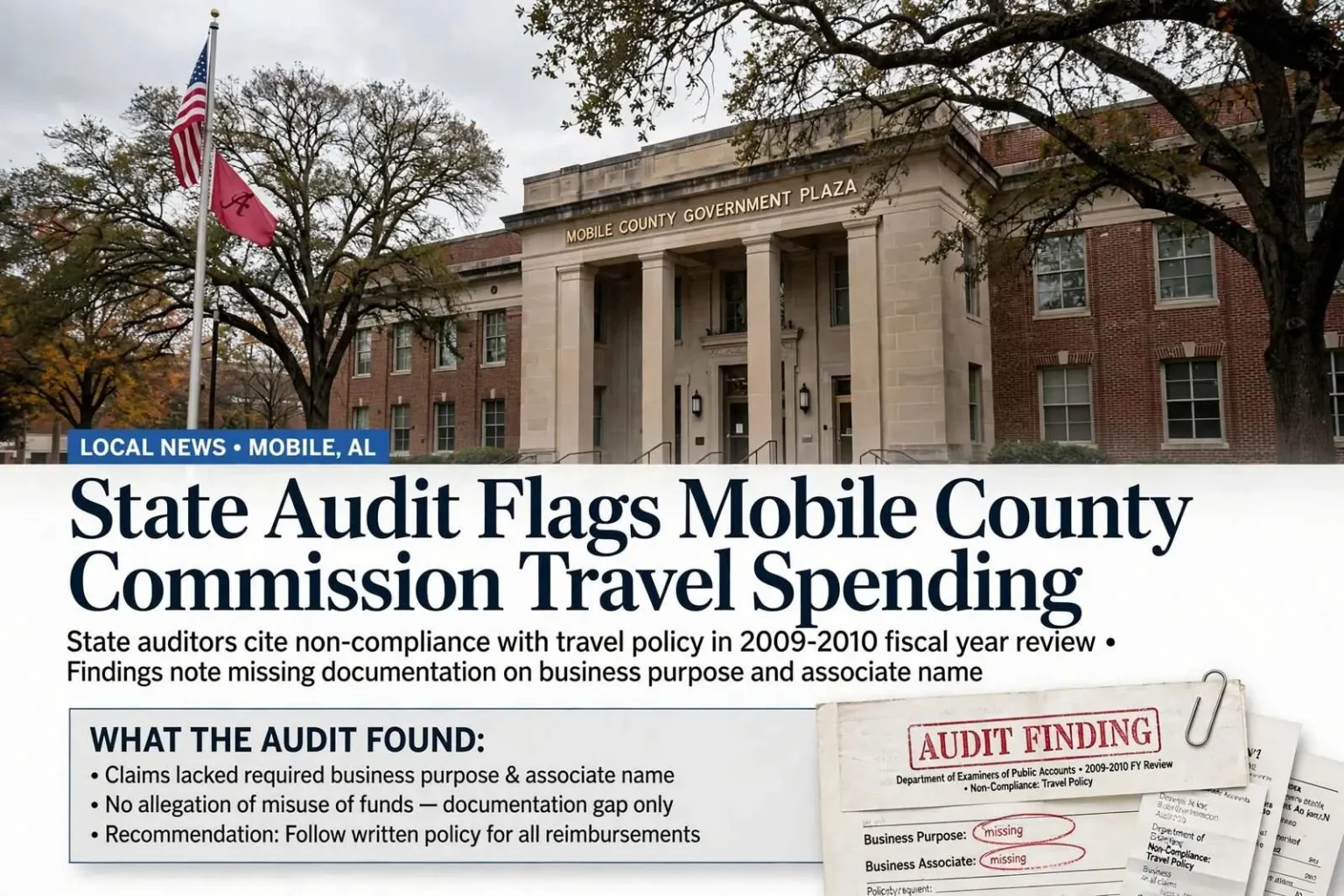
The Mobile County Commission received a formal note of concern from state auditors over how it documented certain travel spending during the 2009-2010 fiscal year, according to a review of the county’s financial activities released this week by the state Department of Examiners of Public Accounts. The finding was narrow — a single area of non-compliance — but it arrived at a moment when confidence in county government was already under strain.
What the Examiners Found
The examiners identified a single area of “non-compliance” centered on the commission’s own written travel policy. That policy required more than a receipt before the county reimbursed an official or employee for money spent on the public’s behalf.
“In addition to an original itemized and dated receipt, all claims for reimbursement of expenses incurred on behalf of business associates must include the name of the associate and the business purpose,” the policy states.
According to the audit, the commission paid travel expenses that were not in compliance with that provision. In other words, some reimbursed claims did not spell out who the business associate was or why the meeting or meal advanced county business.
Missing documentation of that kind does not by itself mean money was misspent. It means the record cannot prove where the money went — a distinction auditors draw carefully, and one that separates a bookkeeping finding from an allegation of fraud. The examiners’ job under Alabama law is to test whether county records conform to written policy and statute, and to flag the gaps publicly when they do not.
The recommendation that followed was correspondingly plain. The examiners did not allege wrongdoing or the misuse of funds. Instead, they issued a straightforward recommendation: “Travel claims submitted for payment by the Commission should be in compliance with the Commission’s Travel Policy.”
Findings of this kind are a routine feature of the state’s annual look at county books. The Department of Examiners of Public Accounts reviews the financial records of Alabama’s 67 counties, along with state agencies, municipalities and public boards, and reports discrepancies between written policy and actual practice, giving officials a chance to correct their bookkeeping before the next cycle. Its reports are public documents, and county commissions across the state routinely receive them with a handful of findings, most of them procedural.
For Mobile County, the 2009-2010 review landed in an environment where even a routine finding drew attention. The commission governs Alabama’s second-most-populous county, administering a budget that funds the sheriff’s office, road projects, health services and the county’s sprawling court system, and its spending practices are watched closely by taxpayers and by the press.
Why Documentation Matters
Travel and entertainment reimbursements are among the most closely watched lines in any local government budget precisely because they involve public officials spending public money outside the office, often over meals or on the road. Requiring the name of the person met and the business purpose of the expense is a common safeguard. It creates a paper trail that lets auditors, and ultimately taxpayers, confirm that a reimbursed dinner or trip served a legitimate governmental function rather than a personal one.
The standard Mobile County had adopted was stricter than the bare minimum. A receipt proves that money changed hands and what was purchased; it says nothing about the company kept or the purpose of the meeting. By requiring both the associate’s name and the business purpose, the commission’s policy was designed to make every reimbursement self-explaining — a file anyone could audit without a follow-up interview.
The commission’s policy already embraced that standard on paper. The audit finding turned on execution: claims were paid without the supporting detail the policy demanded.
Gaps like that typically trace back to process rather than intent. A reimbursement form gets signed, a receipt is stapled to it, and the paperwork moves through accounts payable without anyone noticing that the “business purpose” line was left blank. Auditors test claims months or years later, sample them against the written policy, and count how many fall short. When the shortfall is a pattern rather than a one-off, it appears in the report as a finding, along with a recommendation the governing body is expected to adopt.
Once a finding is issued, the practical burden falls on the county’s finance staff and the commission itself. The fix, in cases like this one, is procedural: reject incomplete claims at intake, require the associate’s name and purpose before payment, and return any deficient form to the traveler for correction. Many Alabama counties responded to similar findings over the years by standardizing reimbursement forms, adding a supervisor’s sign-off, or adopting per-diem schedules that reduce the judgment calls involved in meal expenses on the road.
The state’s examiners follow up on prior findings in subsequent audits, so a commission that corrects its practice will generally see the item drop from the next year’s report. One that does not can expect the same language to reappear, year after year, until the underlying habit changes.
A Watchful Year for County Finances
The finding landed during a period of unusually intense scrutiny of Mobile County government. The commission had been operating a member short following the resignation of District 2 Commissioner Steve Nodine, and a crowded field of candidates was already campaigning to fill the vacant seat in a special election. Questions about accountability and the stewardship of public dollars were very much part of the local conversation.
That context mattered. A travel documentation finding that might have drawn little notice in a quiet year became part of a running discussion about how county government conducts itself, with candidates for the open seat citing transparency and tighter controls as themes of their campaigns. County residents, meanwhile, had ready access to the audit itself, which the examiners publish, and local news coverage amplified the specifics.
The Department of Examiners of Public Accounts occupies a distinctive role in Alabama government. It is the state’s audit agency for public money, tracing its lineage to the old state Examiner of Accounts, and its staff examine everything from a county probate judge’s fee accounts to the books of two-year colleges and municipal utilities. Its findings do not carry fines or penalties on their own; the agency’s leverage is publicity and referral. Serious matters can be forwarded to the attorney general or district attorneys, but the overwhelming majority of findings — like Mobile County’s travel documentation note — end with a recommendation and an expectation of correction.
For county employees and officials, the practical lesson of a finding like this one is that the reimbursement policy is not advisory. The commission had written a good rule; the audit measured whether the rule was followed, not whether it was a good rule. The distance between the two is where most local government audit findings live.
For the commission, the remedy was uncomplicated. Bringing travel claims into line with the existing policy required no new ordinance or expense, only a stricter habit of attaching the associate’s name and the business purpose to every reimbursement request. County officials pointed to the recommendation as guidance they intended to follow in the fiscal year ahead.
The Department of Examiners of Public Accounts posts its county audits publicly, and residents interested in the full accounting of the commission’s finances could review the report through the department’s office. The reports are written in plain, formulaic language — a section of findings, a section of recommendations and, where required, a response from the governing body — making them one of the more accessible windows into how public money is actually handled at the county level.
For residents trying to read such a report, the vocabulary matters. A “finding” is a documented difference between what policy or law requires and what the records show. “Non-compliance” is the examiners’ term for a policy the auditee wrote for itself and then did not follow. Neither term implies criminal conduct, and examiners are careful to route any suspicion of actual misuse of funds down a separate track. Most findings, like Mobile County’s, are the governmental equivalent of a failed inspection for paperwork rather than conduct.
Travel spending remains one of the perennial trouble spots in local government auditing across Alabama, alongside inventory controls, segregation of duties in small offices and timeliness of deposits. The reason is structural: travel expenses are small individually, frequent in aggregate and incurred by people operating outside the normal review environment of the office. A commission member at a conference in Montgomery or a negotiation out of state generates receipts that pass through fewer hands before payment than a utility bill does.
That is precisely why the documentation requirement exists. When a claim must name the business associate and state the purpose, the file itself answers the auditor’s first questions. When it does not, the county is left reconstructing events years later from memory — an exercise that rarely satisfies anyone and leaves even entirely legitimate expenses looking questionable on paper.
County commissions in Alabama operate under a framework in which the commission is both the policy maker and the beneficiary of its own travel rules, a combination that makes independent documentation requirements especially important. The state’s auditor reports function as the outside check, applied uniformly whether a county is large or small, and the annual cycle keeps pressure on governing bodies to keep their own written policies current.
Mobile County’s experience in the 2009-2010 review followed the familiar arc of such findings: a narrowly drawn observation, a recommendation that simply restated the county’s own policy, and a fix that cost nothing to implement. The commission’s response — treating the recommendation as guidance for the fiscal year ahead — was the standard resolution the process is designed to produce.
As with most such reviews, the value lay less in any single line item than in the reminder that even routine spending by local officials is checked, recorded and open to inspection. A resident who reads the annual audit of their county government sees not only the exceptions that were flagged, but also the enormous volume of transactions that were sampled and passed — a quiet accounting of the everyday correctness that audits exist to confirm.
For the commission, the episode was a modest one in the long record of Mobile County finances, but it illustrated the mechanics of accountability in Alabama local government: a written rule, an independent examiner, a public report and a correction. The system worked as intended, precisely because the shortfall was documented, published and addressed before the next audit cycle began.