How a Nickname Called ‘Porky’ Landed a Senate Candidate His Venue
A Senate District 34 fundraiser in Spring Hill came together only after a Mobile attorney signed a last-ditch e-mail with his high school nickname, and the campaign has since topped $150,000.
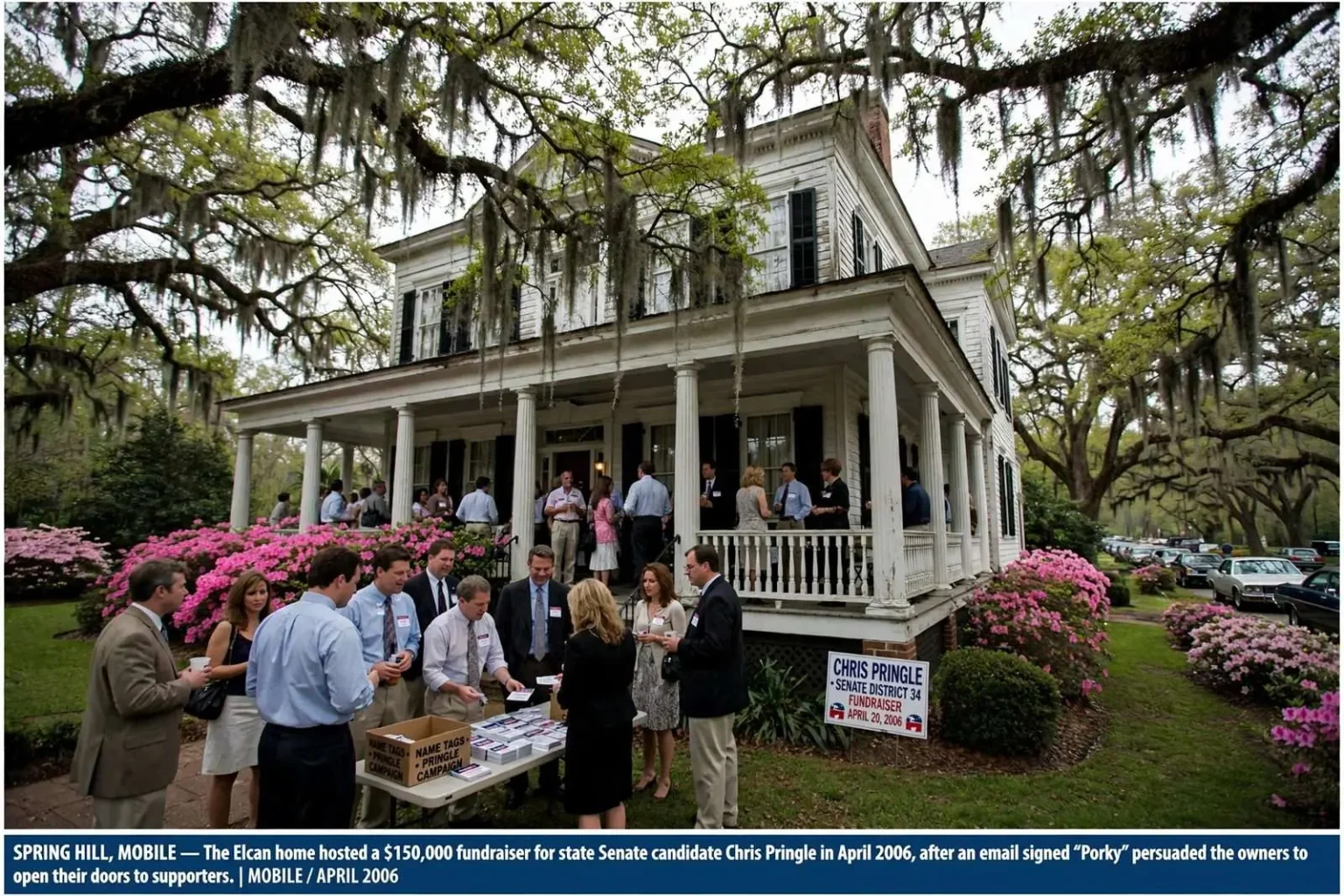
MOBILE — In scheduling a fundraiser, a candidate and his advisers weigh the angles that maximize turnout. The venue matters. The house should have some quality that draws a bigger crowd than the candidate alone could summon — and in Mobile in the spring of 2006, one house in Spring Hill had exactly that quality.
The trouble was persuading its owners to open it.
Spring Hill has long been the part of Mobile where political money and social history overlap. The neighborhood’s homes — some of them among the largest private residences in the county — sit along winding streets lined with oak and azalea, and a fundraiser hosted in the right living room there signals something a rented hall cannot. Candidates in countywide and legislative races have chased Spring Hill invitations for generations, and the hosts, who are courted relentlessly every election season, have learned to say no with practiced ease.
The campaign that would not take no
The campaign of state Senate District 34 Republican hopeful Chris Pringle concluded that the exceptionally spacious Spring Hill home of Mr. and Mrs. Dan Elcan would comfortably accommodate supporters — and would also attract a certain number of people who simply wanted to see the inside of the house.
Pringle backer Scotty Waters made the ask. He was turned down. He asked again. He was turned down again. Repeated attempts produced the same result.
So the campaign called in Mobile attorney Richard Wilkins to try.
Wilkins made a last-gasp e-mail appeal to Mrs. Elcan. He signed it “Porky” — the nickname he had carried in his and Jamie Elcan’s high school days, assigned on account of what was said to be a striking resemblance to the cartoon character Porky Pig.
The recollection of that bygone era apparently melted a resolve that repeated conventional appeals had not touched. Mrs. Elcan relented.
There is a reason the gambit worked when the formal requests did not. In a city like Mobile, where the same families have attended the same schools and churches for generations, a nickname is a credential — proof that the asker knew the target when they were both unknown. A letter from an attorney can be declined politely; a letter from “Porky” required an answer to an old friend, and the old friend knew it.
The result
The Pringle fundraiser drew a crowd large enough to exhaust the supply of name tags. The campaign reported it had topped $150,000, against a stated fundraising goal of $250,000.
The episode is a small comic gem, but it is also a reasonably precise illustration of how money is actually raised in a competitive Alabama legislative primary. Not through mass mail or television, at that stage, but through a series of living rooms — and through the accumulated social capital of people who went to school together forty years ago.
A six-figure haul from a single house party is unremarkable by congressional standards but substantial for a state Senate seat, where total campaign spending rarely reaches the levels seen in federal races. In practice, a legislative challenger who can bank $150,000 by spring has covered most of what a serious primary requires: signs, mail pieces, radio spots and the voter walk books that decide low-turnout elections. The remaining gap to the $250,000 goal would have been filled by smaller house parties and the direct mail calendar that follows Labor Day.
A crowded Republican field
District 34 had attracted an unusually strong Republican field, reflecting the seat’s importance in a rapidly realigning suburban Mobile County. Alongside Pringle, the announced GOP candidates included Connie Hudson, the Mobile City Councilwoman; Rusty Glover, the state representative from House District 102; Todd Burkhalter, a music industry executive; and Keith Graham, a local certified public accountant.
The list is notable for its quality. A sitting city councilwoman, a sitting state representative and a former state representative were all competing for the same seat — a sign that in Mobile County by 2006, the Republican primary in a suburban district was widely understood to be the decisive contest, with the general election a formality.
That assumption reflected the era. Mobile County, once a Democratic stronghold in statewide politics, had been turning reliably Republican in federal and legislative contests through the 1990s and early 2000s, and a district drawn across the suburban swaths of west Mobile and the Eastern Shore fringe was by then far more likely to be decided among Republicans in June than against a Democrat in November. The crowded primary was less an accident than a rational response to that arithmetic: the office would be won once, in the primary, and whoever emerged would likely hold the seat as long as he or she wanted it.
The turnaround
Pringle’s candidacy was itself a reversal. He had left the Alabama House to run for Congress and lost. Roughly a year earlier, he had publicly ruled out a District 34 Senate bid with a memorably direct explanation: “I’m not going to get in a race I can’t win.” At the time, he said he intended instead to help the incumbent raise money.
Circumstances changed, and so did his assessment. By April 2006 he was in the race with a six-figure war chest and a crowd of supporters in a Spring Hill living room.
The reversal illustrates a truth of legislative politics that operatives acknowledge privately and candidates rarely say aloud: the decision to run is rarely about ideology and usually about arithmetic. Pringle’s blunt formulation — no races he could not win — is the standard every serious campaign applies, even when the public explanation is phrased more diplomatically. When the incumbent’s situation changed, the calculus changed with it, and a man who had publicly ruled the race out entered it with a fundraiser at one of the city’s grandest addresses.
What happened next
Rusty Glover ultimately won the District 34 seat and served in the Alabama Senate for multiple terms. Pringle later returned to the Alabama House and rose to Speaker Pro Tempore, and Connie Hudson went on to a long tenure on the Mobile County Commission — a reminder that in local politics, a lost primary is rarely the end of a career.
Glover’s victory in a field that crowded was itself notable: the House District 102 representative outlasted a councilwoman with citywide name recognition and a candidate whose fundraising spring had made headlines. He would go on to serve as a Senate committee chairman before an unsuccessful statewide bid for lieutenant governor in 2014, and the seat he took in 2006 became one of the anchor chairs of Mobile’s legislative delegation.
Hudson’s later countywide career validated the judgment of everyone who had expected the 2006 primary to be decisive for the region’s rising Republicans. Denied the Senate seat, she built a base on the County Commission that made her a fixture of Mobile County government for years — proof that in Mobile politics, name recognition compounds like interest across cycles.
What endures from that spring is the smaller lesson: three formal requests failed, and a schoolyard nickname succeeded. Every consultant in the state can buy television time, and every campaign can print mailers, but no amount of paid media can substitute for the moment when an old classmate signs an e-mail the way only an old classmate can. In Alabama politics, the tools change with every cycle. The social capital does not.
The mechanics of the Elcan fundraiser deserve a closer look, because they show how the money in a legislative primary is actually assembled. No single check carried the campaign to $150,000; the total was the sum of dozens of mid-size contributions from the professional class of west Mobile — attorneys, contractors, bankers, physicians and the commercial developers whose projects rise or fall on the decisions of county and state government. A host home supplies the setting, the candidate supplies the reason, and the crowd supplies the aggregate. What the venue adds is density: enough simultaneous draw to fill a room with the exact people whose checks, combined, fund a primary.
That is also why the fight over the house was worth having. Waters’ repeated asks and Wilkins’ e-mail were not social calls; they were the campaign’s effort to secure the single most productive evening on its spring calendar. Had the Elcans declined for good, the Pringle campaign would have spent the season assembling the same total in increments, at a higher cost in labor and at lower yields per event. The nickname did not just win a laugh — it consolidated an entire fundraising quarter into one Thursday night in Spring Hill.
The story has since taken on a second life as a parable told at campaign schools and civic club lunches across south Alabama: when the front door will not open, stop knocking like a stranger. Political operatives retell it as proof that Alabama campaigns still run on the relationships formed decades before the first yard sign goes up, and host families retell it as a warning that no refusal is permanently safe from the right old friend.
For the candidates still chasing seats in the decades since, the practical advice embedded in the episode has not changed. Ask in person. Ask with a story. And when the formal channels close, check whether anyone on the campaign staff shares a homeroom — or a nickname — with the person holding the keys.