Teenagers Take Up Sponges for a Mobile Mayoral Campaign
A group of Mobile high school students calling themselves the Bess Empowerment Team organized a car wash on Cottage Hill Road to raise money for Bess Rich's 2005 campaign for mayor.
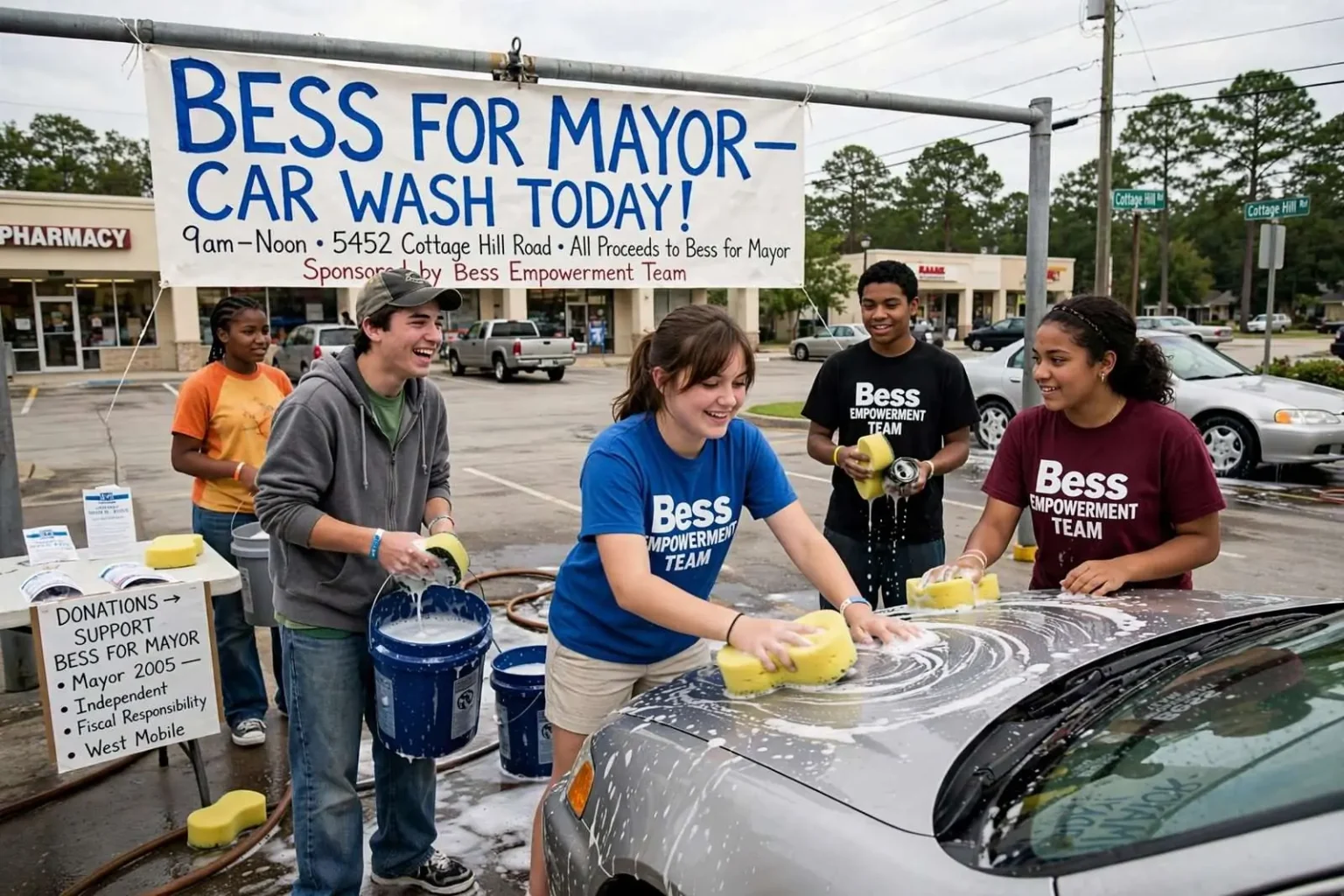
MOBILE — The 2005 race for mayor of Mobile was fought with television buys, direct mail and six-figure fundraising goals. It was also, for one Saturday morning in May, fought with buckets and sponges.
A group of local high school students announced plans to sponsor a car wash on Saturday, May 14, 2005, from 9 a.m. until noon at 5452 Cottage Hill Road, with all proceeds going to the “Bess for Mayor” campaign. The students called themselves the Bess Empowerment Team.
“I’m thrilled this group is showing their support for me by sponsoring this car wash,” said candidate Bess Rich. “It’s nice to see young adults get involved in politics at the local level. I really appreciate their efforts.”
The event joined the long list of small-dollar campaign traditions — bake sales, yard signs, fish fries — that Mobile municipal campaigns have always run alongside their television schedules. What made it worth noticing was who was holding the sponges. In a city election where turnout is chronically thin and the electorate skews gray, a self-organized team of teenagers was, all by itself, a small political event.
A small event with a point to make
The sums involved in a high school car wash are, by the standards of a citywide campaign, negligible. But the event was not really about the money.
Municipal elections in Mobile have historically drawn a fraction of the turnout of presidential contests, and the voters who do show up skew older. Every candidate in a city race faces the same structural problem: the people most affected by decisions about parks, schools, drainage and downtown development over the next twenty years are frequently the people least likely to be at the polls — because many of them are not yet old enough to vote at all.
A group of teenagers volunteering their Saturday to wash cars for a mayoral candidate does not fix that. It does, however, put a marker down. The students were not old enough to cast a ballot in August, but they were old enough to organize, to pick a candidate, to name themselves, and to spend a morning in a parking lot on Cottage Hill Road doing something about it.
Information about the event was directed to Patricia Mark of the campaign.
The Cottage Hill Road location put the car wash in the heart of west Mobile — the suburban stretch of the city where neighborhoods of ranch houses and new subdivisions spread for miles, and where Bess Rich’s own political career had been built. West Mobile’s voters had long formed the backbone of the city’s electorate, and its commercial corridors — Cottage Hill, Schillinger, Hillcrest — were the fastest-growing parts of town.
The candidate
Bess Rich was one of four principal candidates in the Aug. 23, 2005, election for mayor of Mobile. She had served two terms on the Mobile City Council representing District 6, from 1993 to 2001, and had left the council with a reputation as one of its most independent voices — a west Mobile representative who asked hard questions about the city budget and answered her constituents’ mail.
The 2005 race was an open-seat contest, a rarity in Mobile. The incumbent mayor was stepping aside after multiple terms, and the field that formed to replace him included figures from every corner of the city’s politics: a veteran Mobile County commissioner with long service in county government, a city councilman from the city’s core, and Rich, the former councilwoman running on her record of fiscal scrutiny and district service.
Open-seat races change the chemistry of a city election. Without an incumbent to run against or defend, candidates compete for the title of successor — each arguing continuity or change on their own terms — and the campaigns tend to reach deep into the city’s neighborhoods for volunteers, endorsements and the ground organization that decides low-turnout elections.
That is the context in which the Bess Empowerment Team mattered. Campaigns in Mobile are won at the margins: a few hundred votes in a handful of precincts can decide a race that draws forty percent of the city’s registered voters. Volunteers who show up reliably — stuffing envelopes, waving signs at intersections, washing cars — are the raw material of those margins.
How Mobile elects its mayors
Understanding the stakes requires a word on how the city runs. Mobile operates under a mayor-council form of government: a mayor who serves as the city’s chief executive, and a seven-member council — one member from each district — that writes the budget and passes the city’s laws. The mayor controls the administration, the departments and the day-to-day direction of city government, which is why mayoral races in Mobile draw the money and attention that council races rarely do.
Municipal elections in Alabama are nonpartisan, so the August election stands on its own without a party label to guide voters. If no candidate wins a majority, the top two finishers advance to a runoff weeks later. The system rewards candidates with deep personal organizations, because in a low-turnout nonpartisan race, name recognition and reliability of supporters count for more than party loyalty ever can.
The city the 2005 candidates were competing to lead was changing in familiar ways. West Mobile kept growing, filling in with subdivisions and retail along Airport Boulevard and Cottage Hill Road. Downtown, the city had spent a decade and more of public investment trying to rebuild a core that had emptied out — a convention center, a baseball park, renovated blocks along Dauphin Street. The port, the shipyard and the defense and aerospace work around the region kept the economy moving, and the city’s population had held steady near two hundred thousand even as the suburbs beyond the city limits grew faster.
Every major issue of the campaign — crime, drainage, downtown revitalization, the city’s finances — landed differently in different neighborhoods. A teenager washing cars on Cottage Hill Road was, in a small way, taking a position on all of it: a bet that the candidate on whose behalf the buckets were out would run the city they were about to inherit.
Young people and the local ballot
The car wash also pointed at a durable truth about municipal politics: the gap between who local government affects and who local government hears. The students who organized the Bess Empowerment Team could not vote for mayor, but they rode the school buses whose routes the city helps fund, played on the parks whose fields the city maintains, and watched the downtown whose redevelopment the city financed. Their parents’ property taxes and the sales taxes they paid on every purchase carried the city budget.
Civic organizations and the schools have long worked to close that gap — student government days, mock elections, trips to Government Street for council meetings — but the surest lesson in local politics remains doing the work. A campaign car wash is, whatever its proceeds, a course in organizing: picking a date, securing a location, publicizing the event, showing up early and staying until the last car is dry.
For the candidate, the value ran both ways. Volunteers under eighteen carry yard signs, answer phones and bring an energy that professional staff cannot manufacture, and a candidate seen welcoming young supporters signals something to their parents — the very voters who will decide the election. The message a car wash sends is not “this will fund the media buy.” It is “look who this campaign attracts.”
The long game of grassroots campaigns
Mobile’s mayoral campaigns have always been built on both ends of the fundraising spectrum — the six-figure media budgets that introduce candidates to the whole city, and the nickel-and-dime machinery that actually turns voters out. The car wash belongs to the second category, along with the campaign headquarters openings, the neighborhood coffees and the parade appearances that fill a Mobile campaign calendar from spring through summer.
The rhythm is familiar to anyone who has worked a local race. Months before the election, campaigns open storefront headquarters and recruit precinct captains. Through the summer, they appear at every festival, church anniversary and civic club that will have them. In the final weeks, the ground game takes over — phones, doors and rides to the polls — and all of it depends on volunteers, the younger and more energetic the better.
For the students of the Bess Empowerment Team, the morning on Cottage Hill Road offered something a civics class cannot: ownership of a piece of an actual campaign. Political scientists who study youth engagement have found the same pattern for decades — the most reliable predictor of adult political participation is early participation, the hands-on kind, before the age when most people ever think about city hall. The students were not merely helping a candidate; they were forming the habit that makes citizens.
August and after
When the August election arrived, Mobile’s voters would sort a field of candidates with real distinctions between them — a county commissioner’s long résumé of regional government, a councilman’s record in the city’s core, a former councilwoman’s two terms of budget scrutiny and district service. The Aug. 23 balloting sent the race to a September runoff, where the campaign that had built the stronger organization across the city’s neighborhoods would have the advantage.
Whatever the outcome, the episode on Cottage Hill Road captured what local campaigns are underneath the advertising: neighbors organizing neighbors, one event and one parking lot at a time. The television buys would end on election day; the connections formed over buckets and sponges tend to last longer.
And there was something fitting in the location. Cottage Hill Road runs through the residential heart of west Mobile, the part of the city that had grown up with the city itself since the city limits pushed west decades earlier — new schools, new parks, new traffic, all the growing pains that make municipal government personal. If the city’s future was being decided anywhere, it was being decided there, in the subdivisions and shopping strips the next mayor would govern.
The Bess Empowerment Team’s car wash ended at noon, as car washes do. The campaign it supported ran through the summer, and the students who spent their Saturday washing cars for a mayoral candidate got the lesson every civic organization in Alabama tries to teach: that local politics is not something that happens to you, but something you can pick up, name after your candidate and do — with your own hands, on a Saturday morning, before you are old enough to vote.