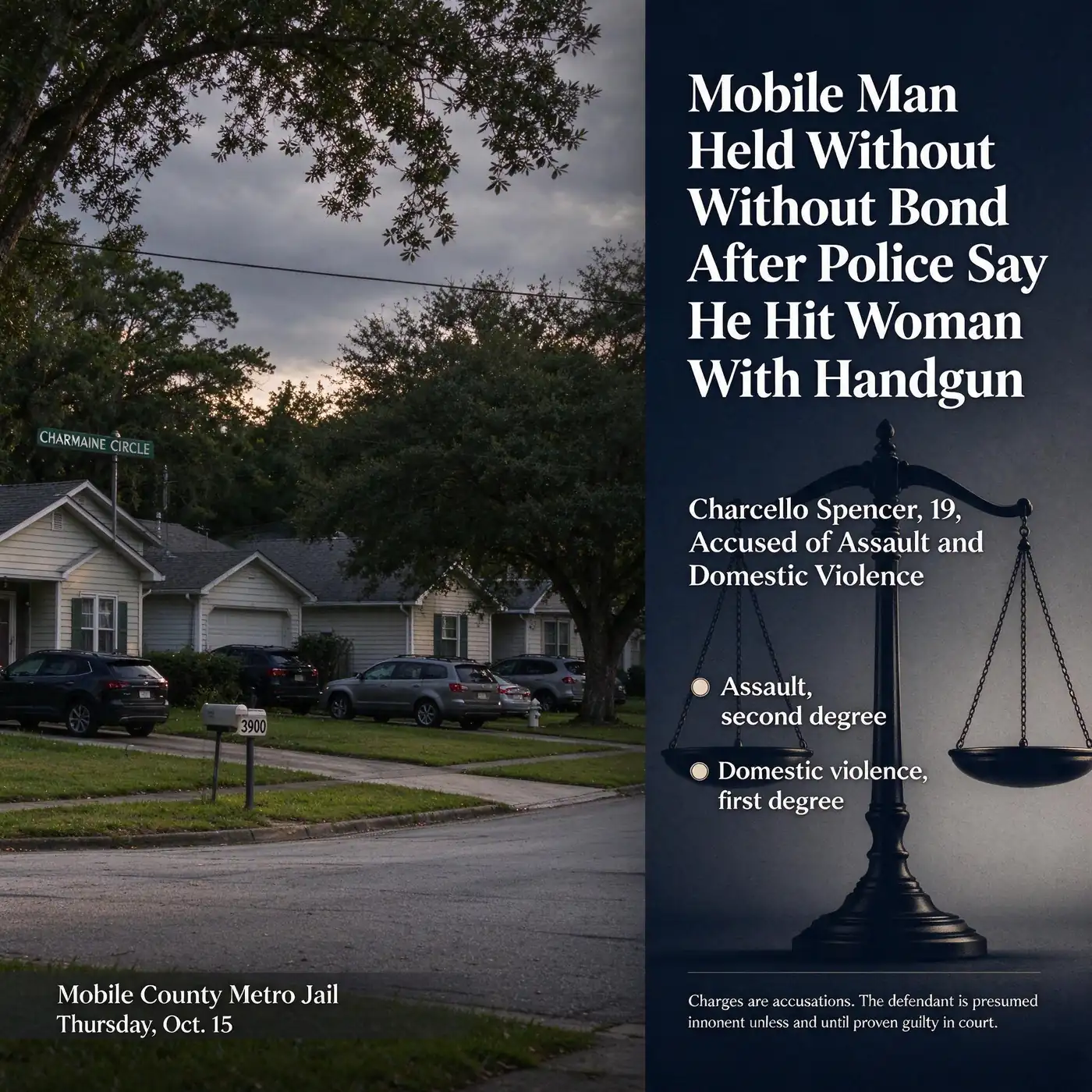
MOBILE, Ala. — A Mobile man held without bond on charges of second-degree assault and first-degree domestic violence is accused of striking a woman with a handgun Saturday afternoon on Charmaine Circle, police said. Charcello Spencer is 19.
Spencer was arrested and booked into the Mobile County Metro Jail, according to Mobile police. Jail records show his next court date is set for Thursday, Oct. 15.
The charges are accusations. Spencer is presumed innocent unless and until he is proven guilty in court.
What police say happened
Officers were called to the 3900 block of Charmaine Circle around 5 p.m. Saturday, Oct. 10, in reference to an assault, police said. When they arrived, they found a woman with minor injuries. She was taken to a local hospital for treatment.
Investigators said Spencer hit the woman with a handgun, causing her injuries. Police did not say whether a shot was fired, what led to the confrontation or how Spencer and the woman know each other. The domestic violence charge indicates authorities believe the two have a family, household or dating relationship covered by Alabama’s domestic violence law, but police did not describe the relationship.
Police have not released the woman’s name. News organizations generally do not identify victims of alleged domestic violence.
The charges
Spencer faces two charges, according to police and jail records:
- Assault, second degree
- Domestic violence, first degree
Second-degree assault
Under Alabama law, second-degree assault covers several situations. One of the most common is causing physical injury to another person with a deadly weapon or a dangerous instrument, with the intent to cause injury. A firearm used to strike someone can fall into that category. Second-degree assault is a Class C felony in Alabama, which carries a possible sentence of one year and one day to 10 years in prison.
First-degree domestic violence
Alabama’s domestic violence statutes apply when certain crimes, such as assault, stalking or burglary, are committed against a current or former spouse, a parent, a child, a person with whom the defendant has a child, a present or former household member, or someone with whom the defendant has or had a dating relationship. The law is divided into three degrees, with first degree the most serious. Domestic violence in the first degree is a Class A felony, the highest classification in Alabama’s criminal code, punishable by 10 to 99 years or life in prison.
The law also includes enhancements. A person convicted of first-degree domestic violence a second or subsequent time must serve at least a year without parole, and that minimum doubles if the offense violated a protection order or happened in front of a child under 14. Police have not indicated that any of those factors apply in this case.
Prosecutors decide what charges ultimately move forward. Felony charges in Alabama are typically presented to a grand jury, which decides whether to issue an indictment. Charges can be changed, reduced or dismissed along the way.
Held without bond
Spencer remained in the Mobile County Metro Jail without bond as of Monday, according to jail records. Authorities did not say why bond was not set.
Most people charged with crimes in Alabama are entitled to bail. But in 2022, Alabama voters approved a constitutional amendment known as Aniah’s Law, which allows judges to deny bail to people charged with certain violent felonies, including first-degree domestic violence, after a hearing requested by prosecutors. The law is named for Aniah Blanchard, a 19-year-old college student who was kidnapped and killed in 2019 by a man who was out on bond for other violent charges. It is not known whether prosecutors have sought to hold Spencer under that law.
A defendant’s first court appearances usually deal with bond, appointment of an attorney and scheduling, rather than the evidence in the case.
How the case moves forward
Felony cases in Mobile County generally begin in district court. A defendant may request a preliminary hearing, where a judge decides whether there is probable cause to send the case to a grand jury. If a grand jury returns an indictment, the case moves to Mobile County Circuit Court for arraignment, where the defendant enters a plea, and eventually to a plea agreement or trial.
At every stage the burden is on the state to prove the charges beyond a reasonable doubt. A defendant is not required to prove innocence.
Where to find help
Anyone experiencing domestic violence in the Mobile area can get confidential help, 24 hours a day:
- Penelope House, Mobile’s domestic violence shelter and service provider, operates a 24-hour crisis line at 251-342-8994. The organization, established in 1979, serves Mobile, Washington, Clarke and Choctaw counties and offers emergency shelter, safety planning, help with protection orders, counseling and services for children.
- The National Domestic Violence Hotline is available at 1-800-799-7233, or by texting START to 88788.
- In an emergency, call 911.
Advocates note that abusers may monitor phones and computers. Anyone concerned about that can use a safer device or call a hotline directly.
Anyone with information about Saturday’s incident can contact the Mobile Police Department.