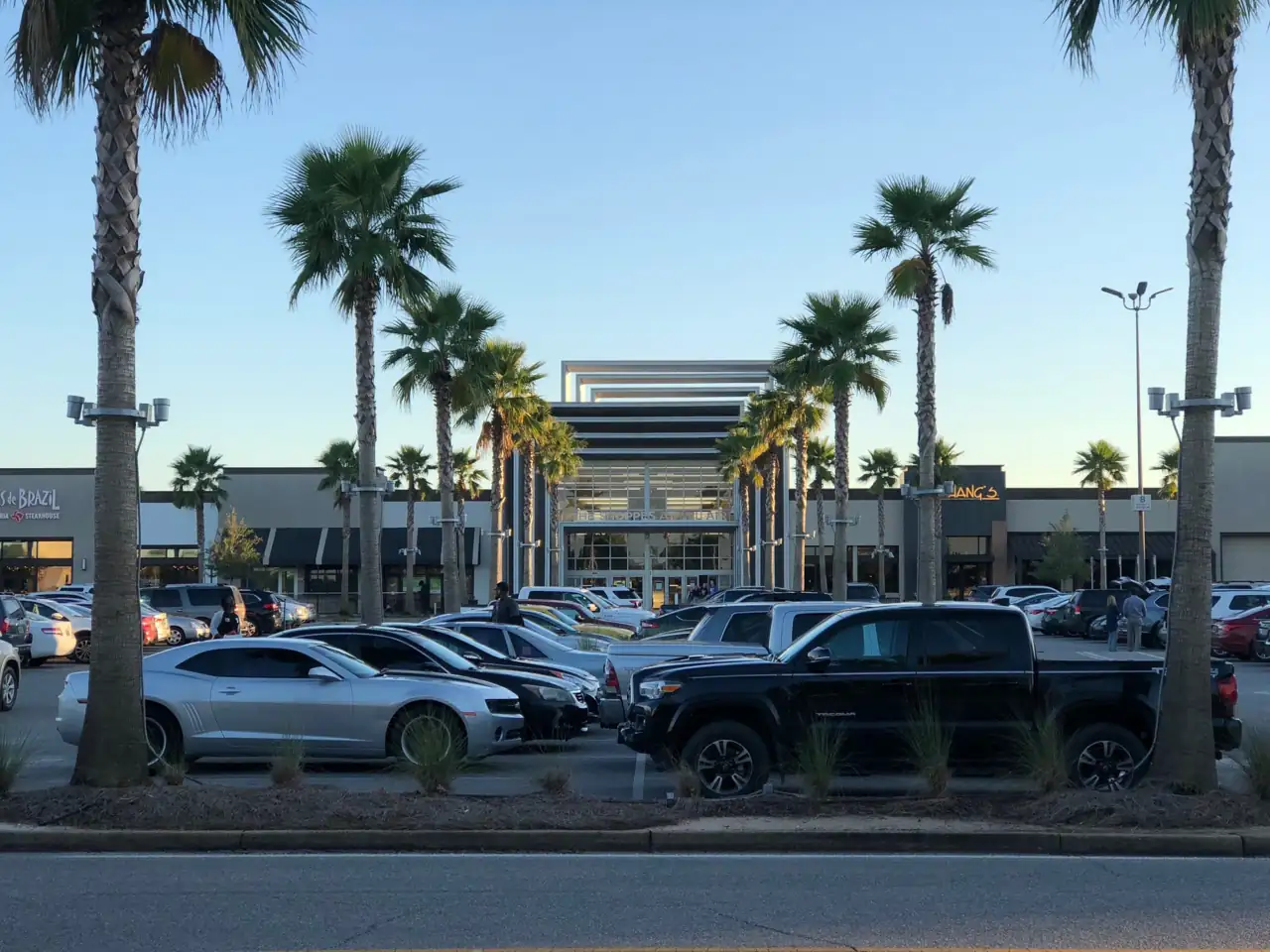
MOBILE, Ala. — The gunfire erupted just after 5:30 p.m. on a Thursday evening in January 2024, sending shoppers scrambling for cover inside the east wing of the Shoppes at Bel Air. Two groups of individuals known to each other had opened fire in the center interior of Mobile’s oldest continuously operating enclosed mall, bullets tearing through storefronts and striking walls just outside entrances. Miraculously, no one was hit. But the chaos that followed—panicked families fleeing, employees barricading themselves inside stockrooms, the piercing wail of police sirens—was a scene that has become disturbingly familiar at this Airport Boulevard retail hub.
What happened next is where the story takes a darker turn. When news crews arrived to document the aftermath, they were not allowed to bring their cameras inside. “We are not allowed to bring our cameras inside,” one local reporter noted on air, “but I can tell you I saw numerous spots on the mall’s interior walls where bullets struck just outside store entrances”. The message was clear: what happens inside the Shoppes at Bel Air stays inside the Shoppes at Bel Air—at least as far as the public is concerned.
This is not an isolated incident. It is part of a decades-long pattern of violence, a pattern that mall management and its security contractors have worked aggressively to keep out of the public eye. Through a combination of off-duty police officers, aggressive security guards, and a de facto ban on news cameras, the Shoppes at Bel Air has constructed a wall of silence around its escalating crime problem. And the people of Mobile are paying the price.
A Pattern of Bloodshed
The Shoppes at Bel Air—still commonly called Bel Air Mall by longtime residents—has been the site of at least a dozen violent incidents since 2016, according to a review of police reports and local news coverage. The violence spans the spectrum: shootings, stabbings, armed robberies, and brutal assaults, both inside the mall and in its sprawling parking lots.
In September 2021, 21-year-old Bryan Maynard Jr. was shot and killed in the mall’s parking lot in front of the DXL store. Maynard, who had traveled from North Carolina with a friend to sell a Cartier watch to a man he met on social media, was ambushed at gunpoint during a robbery that turned deadly. The plan, prosecutors later revealed, was for the robbers to keep the money and resell the watch. Patrick Vashun Lewis, 26, was convicted of murder and first-degree robbery and sentenced to life in prison plus thirty years. The killing was a cold, calculated ambush in a parking lot that thousands of shoppers use every week.
But the violence is not confined to the parking lot. In July 2018, two men got into an argument inside the mall near Victoria’s Secret, and one pulled a gun and fired multiple shots. Bullets struck a kiosk and a wall. Shoppers hid in clothing racks and dressing rooms. “We found people hiding in clothes racks, found people hiding in dressing rooms,” said Krista Taylor, a Victoria’s Secret employee. “It was crazy”. Police released a composite sketch of the shooter, but the trauma inflicted on that day—the sheer terror of a shooter firing indiscriminately in a crowded retail space—left an indelible mark on the community.
In January 2024, the scene repeated itself. A shootout inside the mall sent shoppers fleeing and employees hiding. Two suspects, including 18-year-old Jaquentin Brantley, were arrested and charged with shooting into an occupied building. Brantley’s attorney claimed self-defense, but the fact remained: a gunfight had erupted in a mall food court area, and the public was only learning about it through police press releases and surveillance images, not through on-scene reporting.
Then there was December 2019, when a shoplifting pursuit inside a Dillard’s department store ended with a gun falling to the floor and discharging a single shot. The suspect, Jermiah Cecil Johnson, fled the scene. No one was injured, but the incident highlighted a terrifying reality: even a routine retail theft can turn into a shooting inside this mall.
And the list goes on. In June 2016, a group of six teenage boys attempted a broad-daylight robbery in the mall’s parking lot. In November 2017, shots rang out in the parking lot on Thanksgiving night, striking two vehicles, including one van that was hit six times. In May 2020, a man was shot multiple times in the north parking lot. In December 2024, an armed robbery occurred inside the mall, with a suspect robbing an individual of his jewelry at gunpoint.
“I never had a fear of being shot or robbed,” said one local news anchor, reflecting on the changing reality of Mobile. “But now we’ve had shootings at Bel-Air Mall”.
The Camera Ban: A Tool of Concealment
The violence at the Shoppes at Bel Air is not a secret to anyone who lives in Mobile. What is far less visible is the full scope of that violence—and that is by design.
When news crews respond to shootings, stabbings, and other violent incidents at the mall, they are routinely denied access to the property. Security guards and off-duty police officers employed by the mall are instructed to kick out and trespass any news cameras that attempt to enter the premises. The result is that journalists are forced to film from across Airport Boulevard, capturing distant, grainy footage of emergency vehicles and cordoned-off parking lots rather than the on-the-ground reality of what has occurred.
This policy is not written into any public document. It is enforced informally but aggressively. The reporter who covered the January 2024 shooting for a local NBC affiliate was blunt about it: “We are not allowed to bring our cameras inside”. The statement was made matter-of-factly, as if this were simply the way things work—as if the public’s right to know were secondary to the mall’s desire to control its image.
The implications are profound. Without cameras inside the mall, the public cannot see the bullet holes in the walls. They cannot see the shattered glass, the bloodstains, the terrified faces of shoppers who narrowly escaped death. They cannot see the true scale of what happened. They must rely on police press releases—which are often sparse on details—and on the mall’s own carefully curated statements.
The mall has a sophisticated surveillance network. As far back as 2015, the Mobile Police Department had access to live security camera feeds from Bel Air Mall as part of a broader public safety initiative that included over 2,000 camera feeds from various sources. The mall knows exactly what happens on its property. It has the footage. But that footage is rarely released to the public, and when it is, it comes in the form of grainy still images distributed by police, not in the form of unedited video that would show the full context of a violent incident.
The camera ban serves a dual purpose. It limits the public’s understanding of the violence, and it protects the mall’s bottom line. A mall known for shootings and stabbings is a mall that struggles to attract shoppers. By controlling the narrative—by preventing the public from seeing the violence firsthand—the mall’s owners can maintain at least the illusion of safety.
The Security Paradox: Aggression and Allegations
The same security apparatus that keeps cameras out is also accused of brutality and racial profiling.
In June 2019, five young African-American males and one adult chaperone were approached by an aggressive security guard outside the mall. According to a $25 million lawsuit filed against the mall, its property owner Brookfield Properties, and security contractor Allied Universal, the guard ordered the group to “get the f— against the wall” and handcuffed them. When 16-year-old Cameron Robinson complained that the group was being racially profiled, the guard—identified in the lawsuit as Justin Kestler—allegedly slammed Robinson’s head to the ground and ordered his Dutch Shepherd K-9 to attack. Robinson was bitten multiple times and hospitalized for two and a half days.
“Dogs were used to control African-Americans during the civil rights protests in Birmingham, Alabama, in 1963,” said Atlanta-based attorney L. Chris Stewart, who represented the group, “and it appears with this incident that we haven’t made much progress”. The lawsuit, which sought $25 million in damages, painted a picture of a mall where security guards operated with impunity, targeting young Black shoppers and using excessive force at the slightest provocation.
That incident followed years of complaints about the mall’s security culture. In 2017, after a viral video of a teen brawl prompted the mall to increase its security presence, the property owner announced that it would add more off-duty police officers during high-volume hours and station security officers at the main entrance on Friday and Saturday evenings. The mall also banned unaccompanied teens from entering after 6 p.m. on Fridays and Saturdays—a policy that critics said disproportionately targeted Black and brown youth.
The result is a mall that is simultaneously armed to the teeth and incapable of preventing violence. Despite the presence of off-duty police officers, security guards, K-9 units, and a vast surveillance network, shootings continue to happen. The security measures are reactive, not preventive. They are designed to control the mall’s image and to manage its clientele, not to address the root causes of the violence.
A Community’s Reckoning
For the people of Mobile, the Shoppes at Bel Air is more than just a mall. It is a gathering place, a shopping destination, a source of local pride. It is also, increasingly, a source of fear.
“Is Shoppes at Bel Air mall safe?” asked a local NBC affiliate in the aftermath of the 2018 shooting. It is a question that has been asked again and again, with each new incident, each new headline. And it is a question that mall management has never answered directly.
Instead, the mall has relied on a strategy of silence and spin. After the 2018 shooting, a mall spokesman claimed that rumors of a man with a gun were false. After the 2019 gun discharge, the mall said nothing. After the 2021 murder, the mall issued a brief statement expressing condolences but offering no details about security changes. And after the 2024 shootout, the mall again said nothing—at least not publicly.
Meanwhile, the violence continues. In December 2024, an armed robbery occurred inside the mall. In January 2024, a teenager was arrested for firing shots inside the mall. In 2023, a woman was robbed of her purse and cash inside the mall. The incidents are stacking up, and the public is left to piece together the truth from fragmented news reports and police press releases.
The camera ban is not just a restriction on journalists. It is a restriction on the public’s right to know. It is a deliberate attempt to control the narrative, to keep the violence out of sight and out of mind. And it is working. Many residents of Mobile have no idea how many violent incidents have occurred at the Shoppes at Bel Air. They have no idea that a man was murdered in the parking lot in front of DXL. They have no idea that a shootout erupted inside the mall’s east wing, sending bullets into storefronts. They have no idea because the cameras were not allowed inside, and the mall has done everything in its power to keep it that way.
The Silence Must End
The Shoppes at Bel Air is not a safe place. The evidence is overwhelming: a murder in the parking lot, multiple shootings inside the mall, armed robberies, a brutal K-9 attack, and a pattern of violence that stretches back nearly a decade. The mall’s response has been to circle the wagons—to employ off-duty police officers to keep cameras out, to limit public access to information, and to present a sanitized version of reality to the community it serves.
This is not acceptable. The people of Mobile have a right to know what is happening at their local mall. They have a right to see the bullet holes, to hear the stories of survivors, to understand the true scale of the violence. The camera ban is an affront to that right. It is a tool of concealment, and it must end.
The Shoppes at Bel Air should open its doors to journalists. It should release its surveillance footage. It should be transparent about the violence that occurs on its property. And it should work with the community to address the root causes of that violence—not just with more security guards and more guns, but with real investment in the people of Mobile.
Until then, the cameras will stay outside. And the violence will continue. The question is: how many more shootings, how many more stabbings, how many more murders will it take before the walls of silence come down?