University of South Alabama Mobile
Shelby Announced More Than $10 Million for Mobile-Area Projects in 2006 Spending Bill
U.S. Sen. Richard Shelby announced in October 2005 that the Senate-passed FY 2006 transportation and housing spending bill carried more than $10 million for Mobile-area projects, including the State Docks and a federal courthouse.
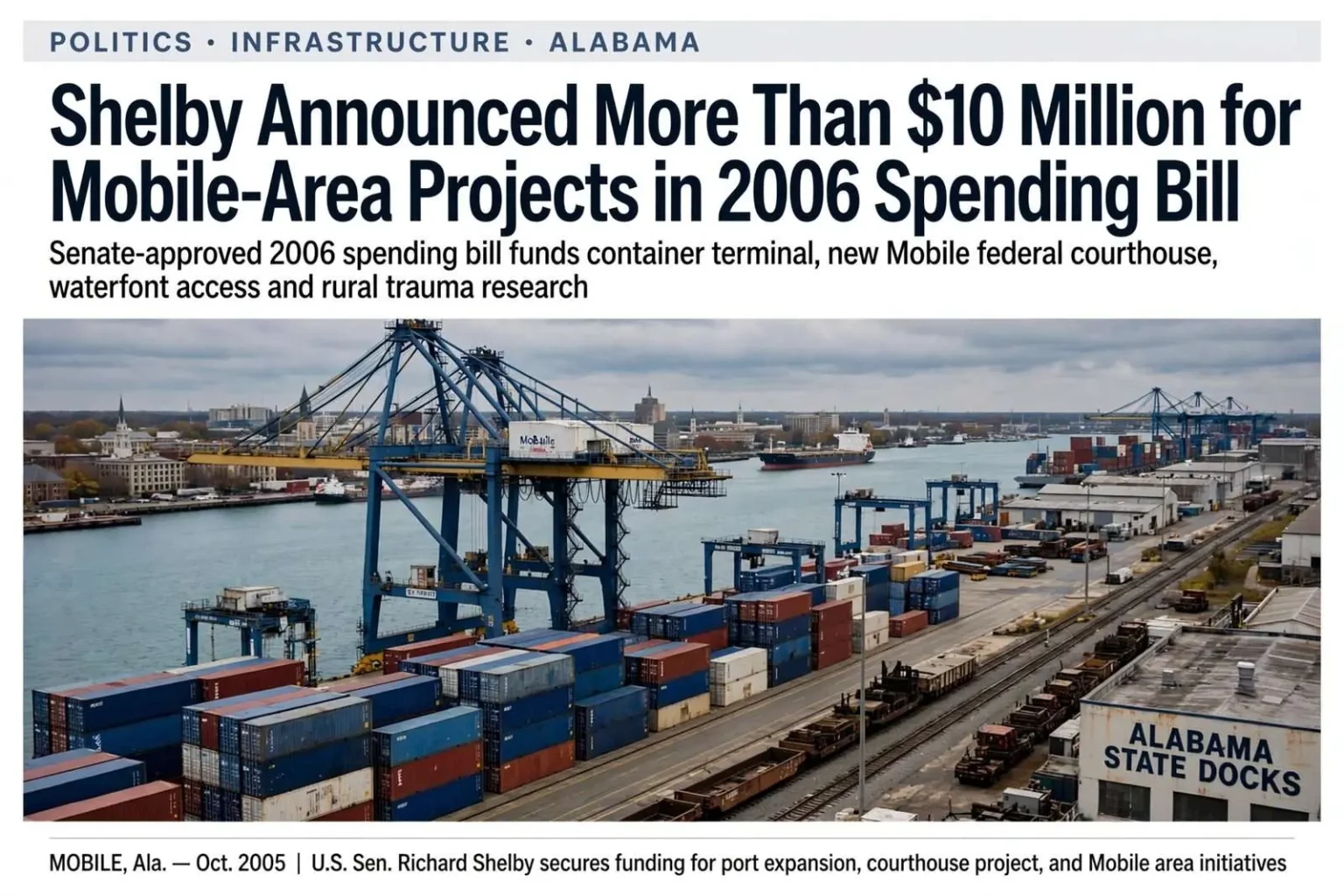
U.S. Sen. Richard Shelby, R-Ala., announced in October 2005 that the Senate had approved a fiscal year 2006 spending bill carrying more than $10 million for projects in the Mobile area and the Wiregrass, including money to modernize the Alabama State Docks and to begin construction of a new federal courthouse in Mobile.
The Transportation, Treasury, Judiciary and Housing and Urban Development appropriations bill passed the Senate by a vote of 93 to 1 and moved to a conference committee with the House of Representatives. Shelby was a senior member of the subcommittee that wrote it.
Appropriations subcommittees are where the federal government’s actual spending decisions take shape. The Transportation, Treasury, Judiciary and HUD subcommittee, often shortened to Transportation-HUD, writes the annual bill that funds the Department of Transportation, the Department of the Treasury, the federal judiciary, the Department of Housing and Urban Development and a long list of related agencies. A senior member of that subcommittee — and Shelby chaired or sat near the top of it during these years — holds unusual leverage over transportation and community development projects across the country, and Alabama’s share of that bill drew heavily on that position.
“I am pleased that the bill provides funding for important projects across the state,” Shelby said. “These funds reflect our commitment to safe and efficient transportation, infrastructure development, and economic growth activities.”
The announcement landed in the middle of a budget season shaped by Hurricane Katrina, which had struck the Gulf Coast two months earlier and strained federal discretionary accounts. For Mobile’s civic leadership, the Senate bill’s provisions for the port and the waterfront were a signal that Washington intended to keep investing in the city’s economic infrastructure even amid the demands of Gulf Coast reconstruction.
What the Bill Carried for South Alabama
Alabama State Docks — $5.4 million. The largest single item, earmarked for the construction of an intermodal containerized freight terminal. Shelby argued that the docks had the potential to become one of the country’s most economically viable ports because of Mobile’s proximity to emerging trade routes on the Gulf of Mexico, and noted that preliminary data indicated Alabama would need to expand its dockside facilities for handling and storing containerized cargo.
The container terminal money went to the heart of what would become Mobile’s defining economic project. The Alabama State Docks, operated by the Alabama State Port Authority on the Mobile River, had been created by state constitutional amendment in 1922 and owned by the people of Alabama ever since. By the mid-2000s, world shipping was consolidating around containerized cargo — standardized steel boxes moved by crane between ship, rail and truck — and ports that could not handle containers efficiently risked losing trade to competitors in New Orleans, Houston and Florida. An intermodal terminal connects those boxes directly to rail lines and interstate highways, letting cargo move inland without being broken down and repacked.
Mobile’s location gave the investment a logic beyond Alabama’s borders. The city sits within a day’s drive of a large share of the population of the southeastern United States, and trade through the Gulf of Mexico with Latin America and, increasingly, with Asia via the Panama Canal was growing. Port officials had spent years assembling land and permits for a container facility at Pinto Island and nearby sites, and federal appropriations like this one paid for the terminal infrastructure, cranes and ground improvements that local bonding could not cover alone.
Mobile Waterfront Infrastructure Development — $1.5 million. To construct an accessway providing a safe pedestrian route to the Maritime Center of the Gulf. The item tied into a longer-running effort to reconnect downtown Mobile to its riverfront, a goal that dated to the city’s Tricentennial planning and its 1990s waterfront development studies. Separating the business district from the water were active rail lines and working port operations, and pedestrian access across that working edge required dedicated crossings and walkways. The Maritime Center of the Gulf, operated on the waterfront, served as a public focal point for the city’s maritime heritage, and a safe route to it was intended to make the riverfront usable for residents and visitors rather than visible only from the car.
Mobile Courthouse Construction — $2 million. Toward construction of a new federal courthouse in Mobile. The federal courthouse serving the Southern District of Alabama stood among the oldest continuing federal court facilities in the region, and the General Services Administration, which builds and manages federal buildings, had been studying a replacement for years. Courthouse construction money in the Transportation-HUD bill funded the early design and site phases of those projects; a full courthouse typically required a sequence of appropriations across several fiscal years before doors opened.
Mitchell College of Business Library — $400,000. For the University of South Alabama to build a library at its business school. The Mitchell College of Business, named for Mobile businessman and university benefactor Charles Mitchell, was one of the university’s largest academic units, preparing students for careers in banking, logistics, health care administration and the port-related industries that anchored the regional economy. A dedicated business library concentrated the specialized materials — trade journals, market data, financial databases — that a general campus library diluted across the shelves, and gave the college a research and study center of its own.
USA Center for the Study of Rural Vehicular Trauma — $350,000. To continue research collecting and analyzing data on rural vehicular trauma victims in order to identify causes of fatalities and to develop a trauma system aimed at reducing death and injury among rural residents. The center’s work addressed a persistent gap in Alabama health care: rural counties across south Alabama, including those in the Wiregrass, lacked the quick ambulance transport and nearby trauma-care facilities that urban residents take for granted, and crash victims in those counties died at higher rates from injuries that were survivable closer to a hospital. Studying who died, where, and from what injuries was the first step toward designing a statewide trauma system that routed patients to the right facility faster.
The Wiregrass — the southeastern corner of Alabama around Dothan, Enterprise and Ozark — shared many of the same federal interests as Mobile even though it sits a two-hour drive from the bay. Its highways carry freight between the Port of Mobile and the Atlanta and Florida markets, and its Fort Rucker army aviation installation tied the region to federal spending decisions. Appropriations like this bill touched both ends of the congressional district’s economy.
What Happened Next
Passage in the Senate was only one stage of the process. The bill still had to survive the conference committee with the House, where the two chambers negotiated a single version of the spending measure, and then a signature from President Bush. House and Senate versions of appropriations bills routinely differed on individual project amounts, and the conference stage was where a senator’s subcommittee seniority mattered most. The Mobile-area items announced in October were the Senate position going into those negotiations — the floor, in practice, for what the region could expect when the final bill emerged later in the year.
Alabama State Docks — $5.4 million. The largest single item, earmarked for the construction of an intermodal containerized freight terminal. Shelby argued that the docks had the potential to become one of the country’s most economically viable ports because of Mobile’s proximity to emerging trade routes on the Gulf of Mexico, and noted that preliminary data indicated Alabama would need to expand its dockside facilities for handling and storing containerized cargo.
Port officials framed the container terminal as the port’s answer to a generation of change in shipping. Cargo volumes through the Port of Mobile had climbed steadily through the 1990s and early 2000s, with the docks handling coal, forest products, iron and steel, chemicals and containerized goods across terminals on both sides of the Mobile River. Every expansion required dredging to maintain the ship channel, land for storage, and rail connections into the CSX and Norfolk Southern networks — the ingredients an intermodal terminal needed to compete. State and federal dollars worked in sequence: the port authority issued bonds for terminals and equipment while federal appropriations covered channel work and infrastructure that served national trade.
The courthouse item, meanwhile, addressed a need that Mobile’s legal community had pressed for publicly for years. The Southern District of Alabama’s growing caseload — civil rights cases, drug prosecutions, admiralty and maritime litigation arising from one of the Gulf’s busiest ports — had outgrown the older courthouse facility, and judges and clerks operated in cramped quarters. The $2 million moved the project forward on the federal building pipeline, where the GSA ranked courthouse replacements nationally and funded them in stages.
For the University of South Alabama, the two federal items in the bill — the business library and the trauma research center — reflected the university’s dual role as Mobile’s largest employer of professionals and the region’s medical and research anchor. Founded in 1963 and grown into one of the major universities on the Gulf Coast, USA drew on federal research money for its medical school and its health systems work, and the rural vehicular trauma center was part of that portfolio. Its researchers collected crash data from county coroners, state troopers and hospital emergency departments across south Alabama, mapping where victims survived and where they did not, with the goal of a coordinated trauma network for counties that had none.