A Courthouse Reshuffle Looms: 40-Year Judge to Retire, Challengers Line Up
The pending retirement of Circuit Judge Ferrill D. McRae after four decades on the bench set off a scramble among Mobile attorneys, while other courthouse offices drew challengers for 2006.
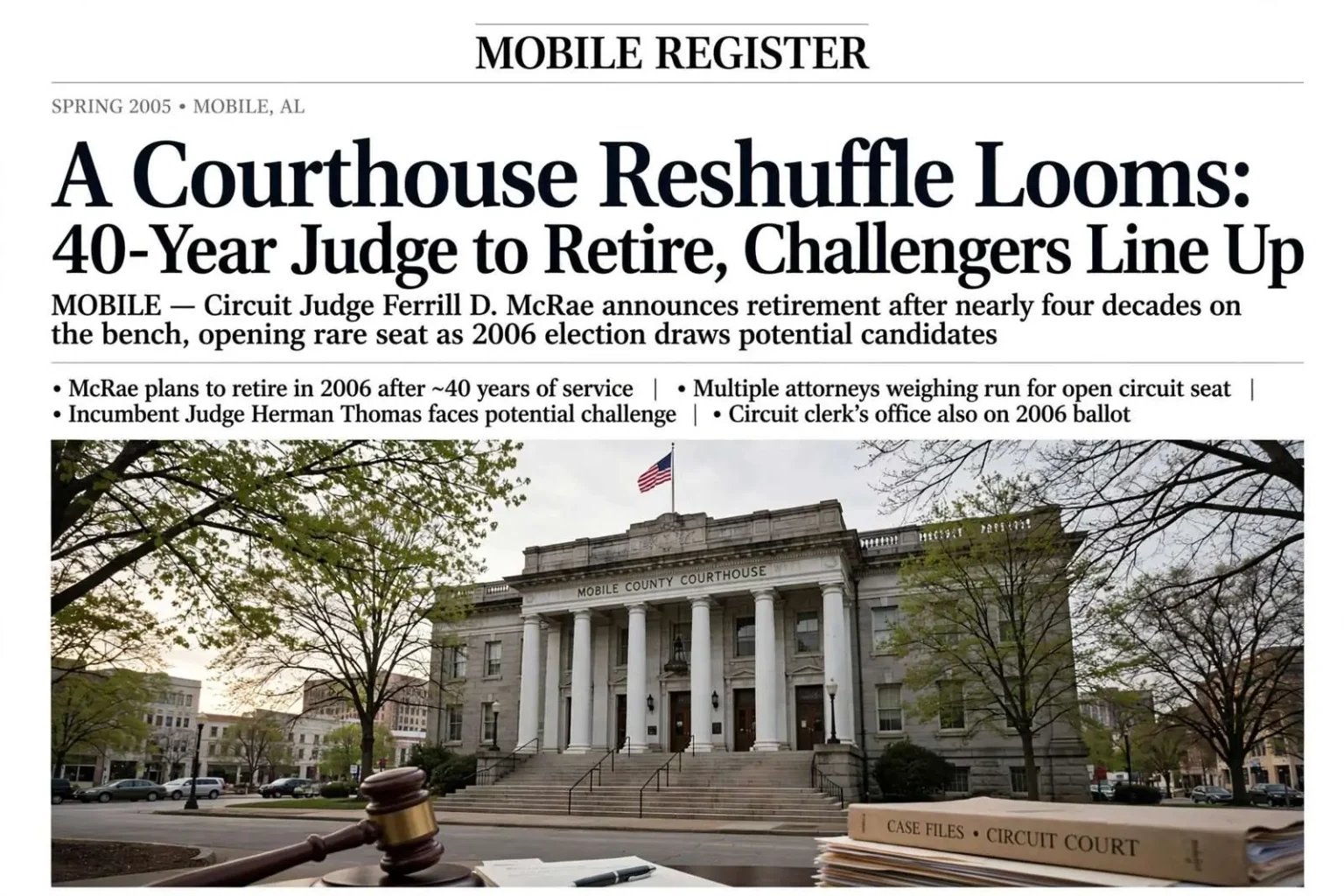
MOBILE — The single most consequential piece of news for the Mobile County courthouse in the spring of 2005 was not a verdict or an indictment. It was a retirement. Circuit Judge Ferrill D. McRae announced he would retire the following year, leaving an open seat on the bench after roughly four decades of service — and setting off the kind of quiet, careful jockeying that precedes any judicial contest in Alabama, where judges run in partisan elections.
An open circuit seat is a rare commodity. Alabama’s circuit judges serve six-year terms, and incumbents who want to keep their robes usually do, so a voluntary retirement is often the only door through which a new generation of lawyers can reach the bench. In Mobile County, home to one of the busiest judicial circuits in the state, the announcement guaranteed that the 2006 election cycle would reshape at least part of the courthouse hierarchy.
The Scramble for the McRae Seat
Attorneys mentioned as prospective candidates to succeed McRae formed a long and varied list. District Judge George Hardesty, a veteran Republican, had worked as both a defense attorney and a prosecutor before joining the district bench, giving him a resume that touched nearly every corner of the local court system. Robert Smith, a Mobile lawyer, had run for the Alabama Supreme Court the previous year and remained visibly interested in public office.
Jim Frost and Duncan Crow, both Mobile attorneys, were also part of the early speculation, as lawyers with established practices and long records in the local bar tend to be whenever a judgeship opens. Ben Brooks, the Mobile City Councilman then campaigning for re-election in District 4, surfaced in the conversation as well, though his immediate focus remained his council seat. Walter Honeycutt, who had run unsuccessfully as the Republican nominee against incumbent Democratic District Attorney John Tyson, rounded out the list of names circulating through courthouse hallways and political gatherings alike.
None of the early names had committed to anything by spring, and everyone involved understood why. In Alabama, judicial candidates must weigh not only a primary contest within their own party but the arithmetic of a countywide general election, where judicial races sit low on a ballot crowded with legislative and statewide contests. Announcing too early invites opposition; announcing too late cedes the groundwork to someone else.
One name was removed from speculation almost as soon as it appeared. Mobile County Probate Judge Don Davis moved to dismiss any suggestion that he would seek a circuit seat, saying he planned instead to run for a second term as judge of probate court. The probate bench, with its jurisdiction over estates, adoptions, property records and other matters that touch nearly every family in the county, offered Davis a stable platform without the uncertainties of a circuit race.
A Challenge to Judge Thomas
Elsewhere in the courthouse, local attorney John Williams was reportedly weighing a challenge to Circuit Judge Herman Thomas, seeking the Republican nomination to face the Democratic incumbent. The possibility of a contested race against a sitting judge underscored how Alabama’s partisan judicial election system keeps even the bench itself answerable to voters every six years.
Williams, then 36 and a native of Citronelle, had built a career that blended prosecution, private practice and part-time judicial service. He had spent four years as a prosecutor in Montgomery before returning to Mobile in 1997 to open the Mobile office of Graddick and Belser, the law firm founded by former Alabama Governor Fob James’ one-time rival and former Mobile County District Attorney Charles Graddick. The return home mattered: Citronelle and the smaller communities of north Mobile County remained a natural constituency for a lawyer who had never left the area for long.
His credentials ran deeper than private practice. Williams had served eight years as municipal judge in Citronelle and was the city prosecutor for Satsuma, two of the municipalities scattered across the county outside Mobile’s city limits. He attended the University of Alabama School of Law, where he was student bar president, a leadership credential that signals early political aptitude in a state where law school classmates become future judges, legislators and clients.
Challenging an incumbent judge is among the hardest races in American politics. Sitting judges carry the advantages of name recognition built through years of presiding over divorces, lawsuits and criminal dockets, and bar associations frown on campaigns that attack judicial records. A challenger must argue for change without appearing to politicize the bench — a line every Alabama judicial candidate walks, and one Williams would have to walk in a primary before ever reaching a general election.
The Circuit Clerk’s Office
The reshuffle extended beyond the judgeships. In the circuit clerk’s office, Court Administrator Jo Jo Schwarzauer was among the figures drawing attention as the 2006 cycle approached, with the clerk’s job one of the countywide offices that would be on the ballot. The circuit clerk sits at the operational center of the courthouse, responsible for court records, filings, juries and the flow of paperwork that keeps a large trial court functioning.
For courthouse observers, the convergence of an open circuit seat, a potential challenge to an incumbent judge and activity around the clerk’s office made 2006 a potentially landmark election year for Mobile County’s legal establishment. Judicial races rarely dominate headlines the way governor or Senate contests do, but in a county where the courthouse touches daily life — from traffic cases to felony trials to probate filings — the outcomes shape how justice is administered for years.
The timing of McRae’s announcement was also significant. By confirming his retirement a year in advance, the judge gave prospective candidates time to organize, raise money and consult their families — the unglamorous prerequisites of any Alabama campaign. It also gave the sitting governor time to consider an appointment if the seat were to open mid-term, though in this case the departure aligned with the end of the term, putting the decision directly in the hands of voters.
Alabama is one of the states that elects its judges on partisan ballots, a system that periodically draws statewide debate. Critics argue that judicial contests should be insulated from party politics; defenders counter that elections keep judges accountable in a state where the constitution places most officials on the ballot. Either way, the system ensures that a Mobile County courthouse retirement resonates through both party organizations, each of which fields candidates in countywide races when the opportunity arises.
Why an Open Seat Reshapes a Courthouse
A circuit judge in Mobile County presides over the state’s trial court of general jurisdiction, hearing felony criminal cases, major civil lawsuits, divorces and domestic relations matters, and appeals from the district courts. The workload is heavy and varied, and judges are assigned to divisions that determine what kind of cases dominate their dockets. Experience on the district bench, in the district attorney’s office, or in a busy civil practice each prepares a candidate differently for that responsibility.
The pipeline matters to more than the lawyers who want the job. Circuit court decisions shape everything from how quickly criminal cases move to how local businesses resolve disputes. A retirement after four decades represents an institutional memory walking out the door, and the campaign to replace it becomes a referendum on what the next generation of the bench should look like.
For the lawyers named in the early speculation, the months between the announcement and the qualifying deadline would be spent in the classic rituals of an Alabama judicial campaign: talking to bar associations, courting party activists in both city and suburbs, and deciding whether the arithmetic of a primary and a general election worked in their favor. Some would run; some would wait for the next opening. That, in the end, is how a courthouse renews itself — one retirement, one race, and one long line of ambitious attorneys at a time.
The 2006 cycle was a big one across Alabama generally. Every statewide constitutional office, all 140 legislative seats, and a full slate of county offices appeared on the ballot, so judicial contenders shared attention — and shared campaign calendars — with races for governor, the Legislature and down-ballot courthouse posts. A candidate running for circuit judge in Mobile County would be competing for yard signs, church announcements and newspaper inches against campaigns far larger than his own.
What was certain by the end of the spring of 2005 was that the following year’s ballot would look different from any in recent memory for Mobile County’s judiciary. McRae’s departure guaranteed at least one new face on the circuit bench, Williams’ deliberations threatened a second change, and the clerk’s office promised its own contest. In a courthouse where continuity is the norm, 2006 was shaping up as an exception — and everyone from downtown law firms to the district attorney’s office was watching to see how it would break.