Deputy Superintendent Hired a Lawyer as Scrutiny of 200 Phone Calls Intensified
Mobile County's deputy school superintendent retained veteran attorney William A. Kimbrough after questions arose about more than 200 phone conversations with an ousted school board member under a court order.
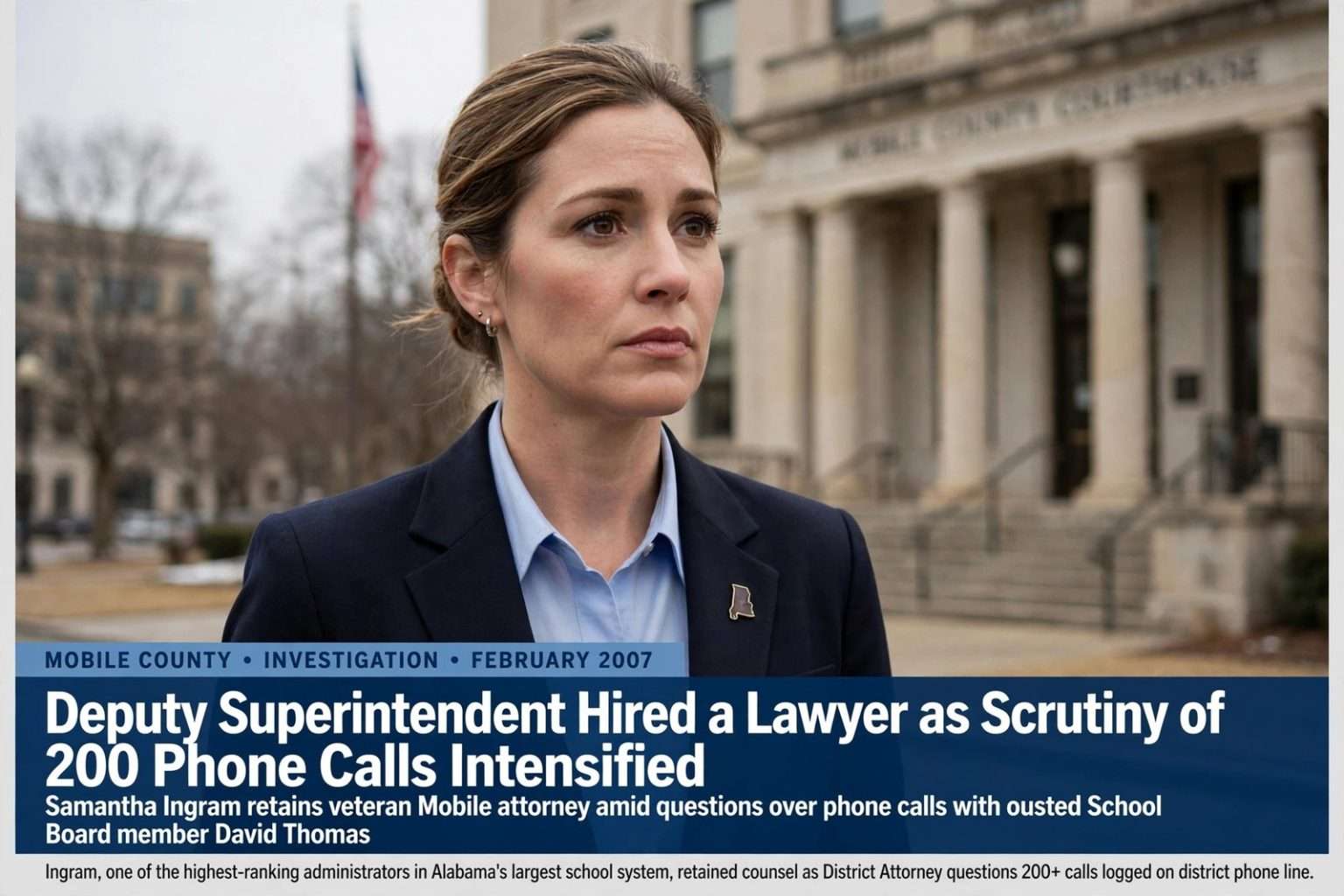
Mobile County Deputy School Superintendent Samantha Ingram retained veteran Mobile attorney William A. Kimbrough, a step that signaled how serious the questions surrounding her had become. Ingram had most recently surfaced in connection with more than 200 telephone conversations with ousted Mobile County School Board member David Thomas, who was operating under a court order, described at the time as possibly ambiguous, restricting his contact with school board members and school system employees.
Mobile County District Attorney John Tyson framed the puzzle in a single exasperated question. “What in God’s name are they talking about?” Tyson asked. “Ms. Ingram testified under oath that she is not a friend of David’s.”
The tension in that remark is the heart of the matter. Two hundred conversations is not an accident, a wrong number or a chance encounter. It is a pattern. If the parties were not friends, and if a court order limited contact between an ousted board member and system employees, then the volume of calls demanded an explanation that had not yet been offered.
The tally came to light as part of the broader scrutiny that had followed David Thomas since his departure from the elected board, and it landed on Ingram at the peak of a career spent inside the system’s administration. As deputy superintendent, she occupied one of the highest-ranking posts in Alabama’s largest school system, with authority over operations and personnel questions that reached every school in the county. A record of two hundred calls with a former board member — logged on a district telephone account — put her on the wrong side of an uncomfortable question about who was actually directing the system’s business.
The choice of counsel was itself a message. Kimbrough was among the most experienced criminal defense lawyers practicing in Mobile, the kind of attorney retained by people who expect to be asked hard questions under oath. Individuals facing an internal inquiry or a friendly conversation with a district attorney rarely hire trial counsel; the decision usually signals an expectation of a subpoena, a deposition or a grand jury — and a client who intends to be prepared for all three.
For context, the cast was short and every name mattered. Samantha Ingram: deputy superintendent, one of the highest-ranking administrators in Alabama’s largest school system. David Thomas: ousted member of the Mobile County School Board, subject of a court order restricting contact. William A. Kimbrough: a veteran Mobile defense attorney, retained by Ingram. John Tyson: Mobile County district attorney.
A family thread through the courthouse
The affair did not stop at the school board’s doorstep. David Thomas was the cousin of Mobile County Circuit Judge Herman Thomas, and the relationship between the two men had itself become a subject of official inquiry. The Alabama Judicial Inquiry Commission, the body that investigates complaints against Alabama judges, was reported to be still addressing an inquiry into Judge Thomas, with its next meeting set for Friday, March 9 in Montgomery.
Notably, it was Judge Thomas himself who had requested the investigation after news reports criticized his conduct on a number of fronts, including allegations of preferential and possibly improper actions on behalf of his cousin, the former school board member.
That request was a calculated move. A judge who invites scrutiny hopes to be cleared by it. The risk is that investigators, once invited, look at everything.
The calculus is a familiar one in public life. An official who requests an investigation of his own conduct controls the optics of the moment — transparency, cooperation, confidence in the outcome — and if the file comes back clean, the request becomes the strongest possible shield. But a commission does not bound its work by the issues that prompted it. The Judicial Inquiry Commission’s mandate runs to allegations of misconduct generally, and once a file is open, every thread in it — including the cousin relationship with the ousted school board member and the questions swirling around the school system — becomes fair game.
The March 9 meeting in Montgomery carried procedural weight because it was where the commission decided such files’ fates. The body can close a file without action, seek further investigation, or — when it finds probable cause — file formal charges with the Alabama Court of the Judiciary, which can discipline or remove a judge. Which way the Thomas inquiry was leaning was not public, but the meeting date meant the courthouse intrigue of early 2007 was moving toward a decision point in the capital.
Why a court order restricted contact at all
The underlying restriction on David Thomas, limiting his contact with board members and school system employees, was the residue of his removal from the elected board. Court orders of that kind are meant to prevent a person who has lost official standing from continuing to exert influence over the institution through back channels, and to protect employees from pressure by a figure who no longer holds authority but may still command loyalty.
Whether the order was clear enough to be enforced was, by the account then circulating, genuinely disputed. Ambiguity in such orders is common and consequential, since a person cannot be punished for violating a directive that a reasonable reader could construe two ways.
That ambiguity sat at the center of every question the episode raised. If the order forbade contact with board members and employees, did it reach a deputy superintendent’s telephone? Did it distinguish social calls from official business, or private telephones from district lines? An order drafted broadly enough to close every channel reads as overly broad; one drafted narrowly leaves a corridor of arguable contact — and two hundred calls’ worth of room for disagreement about whether they fell inside it.
What the ambiguity did not explain was the volume. Even a generous reading of the order had to absorb the arithmetic: two hundred conversations with a single former board member is a sustained relationship, whatever its subject. And the question Tyson put so bluntly — what were they talking about, if not friendship? — remained unanswered in public, because the person who could answer it had just hired a lawyer whose first counsel would be not to.
The deputy superintendent’s sworn testimony — that she was not a friend of David’s — only sharpened the riddle. Testimony of that kind typically arrives in a proceeding where the relationship itself is at issue, and it placed Ingram’s description of the calls against the record of their frequency. Either the calls were business of some kind, in which case the content mattered enormously to a system she helped run; or they were personal, in which case the sworn denial sat uneasily beside the log. Both branches led to questions she would face with Kimbrough beside her.
For the school system’s workforce, the episode carried its own chill. Employees occupy the middle of any such arrangement — the people a determined former official most needs, and most pressures. A court order exists in part to tell them that contact is not a favor they can safely grant. How clearly the order said so, and how carefully anyone checked compliance, were precisely the matters the dispute had put in doubt.
The larger picture
Taken together, the elements formed an unflattering portrait of institutional entanglement in Mobile County: an ousted board member, a sitting circuit judge who was his cousin, a deputy superintendent with hundreds of calls to explain, a district attorney asking what they had been talking about, and a state commission preparing to meet.
The Mobile County Public School System was Alabama’s largest, with a budget in the hundreds of millions of dollars and tens of thousands of students. Its administrators were not minor officials, and the questions being asked in early 2007 went to whether the system’s business was being conducted in the open.
Scale is what gave the questions their weight. A school system of that size awards construction contracts, purchases services by the millions, hires and transfers employees by the thousands, and makes decisions that reach every neighborhood in the county. Its superintendent and deputy superintendents hold more operational power than most elected officials in the state. If access to that machinery could be maintained through a former board member’s telephone line rather than the public’s meeting rooms, the integrity question was not academic — it went to how hundreds of millions of dollars were being directed.
The episode also illustrated how the county’s institutions brushed against one another. The school board governed the system; the courts had issued the order restraining the ousted member; the district attorney’s office sat over the criminal-law questions; and the state’s judicial commission was examining a circuit judge whose family connected back to the board. Each institution had its own jurisdiction and its own calendar, and no single one could resolve the picture as a whole — which is why the public learned about it in fragments, from a telephone log here and a commission meeting date there.
Ingram, through her decision to retain counsel, had signaled that she intended to answer those questions carefully, and with a lawyer at her elbow. Whether the conversations had an innocent explanation — and whether that explanation could survive the arithmetic of two hundred calls and a sworn denial of friendship — was the question the spring of 2007 had left hanging over the school system’s administration.