Senate Seat Shuffle: Glover to Challenge Myers, Pringle Bows Out
State Rep. Rusty Glover planned to challenge Sen. Hap Myers for Alabama's District 34 seat, while former Rep. Chris Pringle ruled out a run, saying he would not enter a race he could not win.
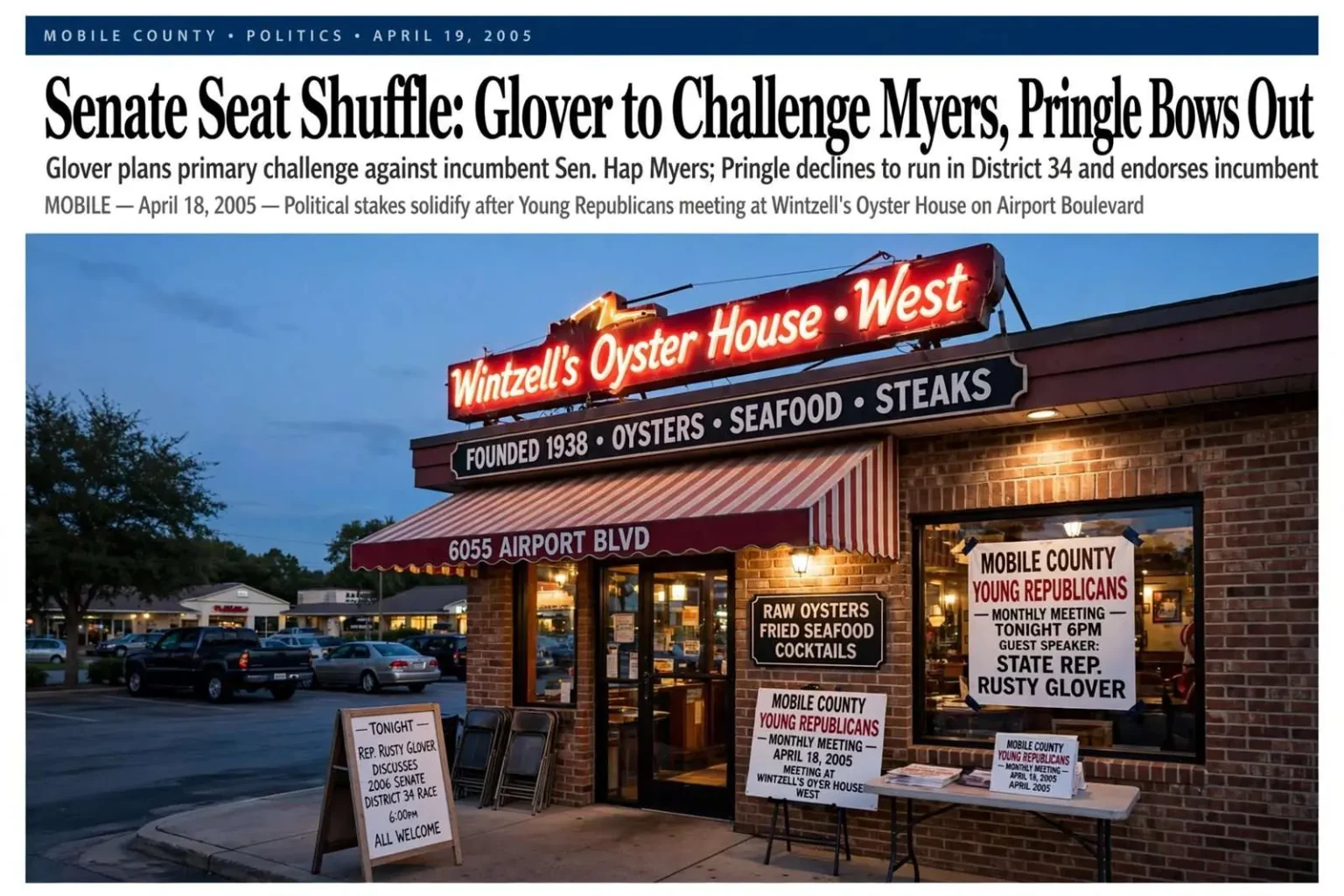
MOBILE — The shape of Mobile County’s 2006 legislative races began to firm up in April 2005, and the news came, as local political news often does, out of a monthly meeting at an oyster house on Airport Boulevard. The Mobile County Young Republicans gathered on Monday, April 18, 2005, at Wintzell’s Oyster House — West, with state Rep. Rusty Glover as the guest speaker. The meeting was open to the public, and in the way of such gatherings, the guest’s presence was itself the announcement.
Wintzell’s, founded in 1938, had long since become one of Mobile’s political institutions — its walls papered with decades of aphorisms and oyster lore, its tables the site of campaign kickoffs, post-election wakes and the quiet conversations in which Alabama candidacies actually form. The restaurant’s western location on Airport Boulevard sat in the heart of the suburban territory whose legislative seats were at issue.
Glover eyes the Senate
Glover, the Republican legislator representing House District 102, was not merely making the rounds. He was planning to run against incumbent state Sen. Hap Myers for the District 34 seat — a primary challenge from one Republican to another. A teacher by profession and a veteran of the county’s Republican organization, Glover had built his House career in the fast-growing western suburbs, and a move to the Senate would position him for the longer career that upper-chamber seniority makes possible.
A primary challenge of that kind was a calculated gamble. Alabama legislators rarely seek to unseat colleagues of their own party without a reason — a district’s politics shifting, a seat opening, or a conviction that the incumbent is vulnerable. Mobile County’s rapid suburban growth was redrawing the county’s political map year by year, and the legislature’s delegation seats were changing hands faster in the mid-2000s than they had in decades.
Pringle takes himself out
The other piece of news was a subtraction. Former state Rep. Chris Pringle, who had given up his House seat to run for Congress, announced he would not enter the District 34 Senate race. His explanation was unusually blunt for a politician.
“I’m not going to get in a race I can’t win,” Pringle said — a remark that suggested his congressional bid had been, at minimum, an education. He added that he intended to work on Myers’s campaign and help him raise money. The candor was notable, and so was the alignment. Pringle was putting himself on the incumbent’s side against a fellow Republican legislator.
Pringle’s withdrawal carried weight beyond its arithmetic. A former House member with deep roots in west Mobile Republican politics was exactly the kind of candidate a Senate primary attracts, and his decision to stand down — and to raise money for the incumbent instead — signaled to donors and activists that the field would not grow. In a county where party networks decide primaries, a public commitment like Pringle’s functions as a door closing.
The cascade
A legislator moving up creates a hole behind him, and Alabama’s political ecosystem fills such holes quickly. With Glover aiming at the Senate, Chad Fincher — active in local Republican circles — was reportedly eyeing a run for the House District 102 seat Glover would be vacating. The grandson of a longtime area legislator and an engineer by training, Fincher fit the profile of the candidates Mobile County’s Republican committees had been cultivating for the suburban districts.
These chains of succession are how most Alabama legislative careers actually begin. A senator retires or is challenged; a House member moves up; a party activist or local officeholder moves into the House seat. The whole sequence is usually visible a year or more in advance to anyone paying attention to who is showing up at Young Republicans meetings, who is speaking to civic clubs, and who is quietly opening a campaign account at the county probate office.
The pattern also explains why gatherings like the one at Wintzell’s matter so much. Party meetings are where prospective candidates take the temperature of the room — where a challenger discovers whether the activists will return his calls, and where an incumbent learns whether his own side will spend the cycle defending him. The speeches are forgettable; the seating arrangements are not.
What actually happened
The 2006 cycle bore out much of what was being discussed that spring, though not always as predicted. Rusty Glover won election to the Alabama Senate from District 34 and went on to serve multiple terms, later running for lieutenant governor. Chad Fincher was elected to the Alabama House from District 102, where he served several terms and rose into the chamber’s leadership circle before leaving for a private-sector career.
Chris Pringle’s assessment of his own prospects proved temporary rather than permanent. He returned to the Alabama House in a later election and eventually rose to become Speaker Pro Tempore — a reminder that in state politics, declining one race is not the same as leaving public life. Pringle’s comeback also demonstrated the durability of the networks that produce candidacies in the first place: a politician who sits out a cycle but keeps working for the party keeps the option of running when the next seat opens.
Why District 34 mattered
Alabama Senate District 34 covered a swath of suburban Mobile County that was, in the mid-2000s, in the middle of a decisive shift toward the Republican Party. Once a bastion of conservative Democratic officeholders in the old county tradition, the district’s precincts had been carried by Republican statewide candidates for a generation, and its legislative seats had followed. A contested GOP primary in such a district was, in practical terms, the election; whoever emerged was heavily favored in November.
That is why an intra-party challenge like Glover’s drew such attention, and why the endorsements and fundraising decisions of figures like Pringle carried real weight. Republican primaries in Mobile County’s suburban districts were decided by a few thousand votes, most of them cast by the same core of club members, church groups and neighborhood associations that populated the county’s party organizations. An endorsement that reached those networks could be worth more than a mailing.
The fight was not between parties. It was over who would define the party’s bench in south Alabama for the coming decade — a question that would be settled, in the end, by a few thousand primary voters and a great deal of preliminary maneuvering in rooms like the one at Wintzell’s. The 2006 elections answered it: Glover in the Senate, Fincher in the House, and a generation of Mobile County Republicans promoted through the chain that the April 2005 meeting had set in motion.
The Young Republicans’ role
The Mobile County Young Republicans, the organization whose monthly meeting produced the news, occupied a particular place in the county’s political machinery. Its rolls drew college students, young professionals and the children of the county’s established Republican families, and its meetings doubled as a recruiting station — the place where future legislative staffers, council candidates and legislators first gave a speech and shook the hands that would later write checks. Alabama’s Republican ascent ran through organizations like this one, which supplied the labor for phone banks and campaigns in the years when the party was still taking the courthouse from conservative Democrats.
Meeting at Wintzell’s — West gave the organization a venue convenient to the western suburbs where most of its members lived, and where the county’s growth was fastest. Every seat on the agenda that spring, from House District 102 to Senate District 34, sat within or adjacent to that growth corridor, and the people in the room knew the precincts involved as their own neighborhoods.
The incumbent’s position
For Hap Myers, the spring of 2005 brought the kind of news no incumbent enjoys: a credible, well-connected House colleague preparing a challenge, with the county’s activist class watching to see whether the party would consolidate behind the sitting senator or take a flier on the challenger. Myers had held the District 34 seat through the district’s transition from Democratic to Republican dominance, and he entered the cycle with the advantages incumbency confers in Alabama — seniority, a donor list and the goodwill that comes from years of constituent service.
But the demographics were moving. District 34’s population had grown and shifted westward, diluting the old neighborhoods that had first elected him and adding voters who knew him mainly by reputation. Political observers in the county read Glover’s move against that backdrop — a challenge timed to catch an incumbent’s coalition before it fully reconstituted itself.
Pringle’s decision to back Myers added a further wrinkle. The former House member was popular with precisely the west Mobile activists whose allegiance the primary would contest, and his endorsement of the incumbent told those activists that the party’s savvy operators saw the seat as Myers’ to lose. By summer, the shape of the race was fixed: a one-on-one Republican primary, with the county’s organizational strength deployed on both sides and the general election waiting as a formality.