Retired Republican Judge Endorses the Democrat in the Race for Juvenile Court
Retired Mobile County Circuit Judge John Butler, a Republican who spent 22 years overseeing juvenile court, endorsed Democrat Jeff Glidewell over the GOP incumbent appointed to succeed him.
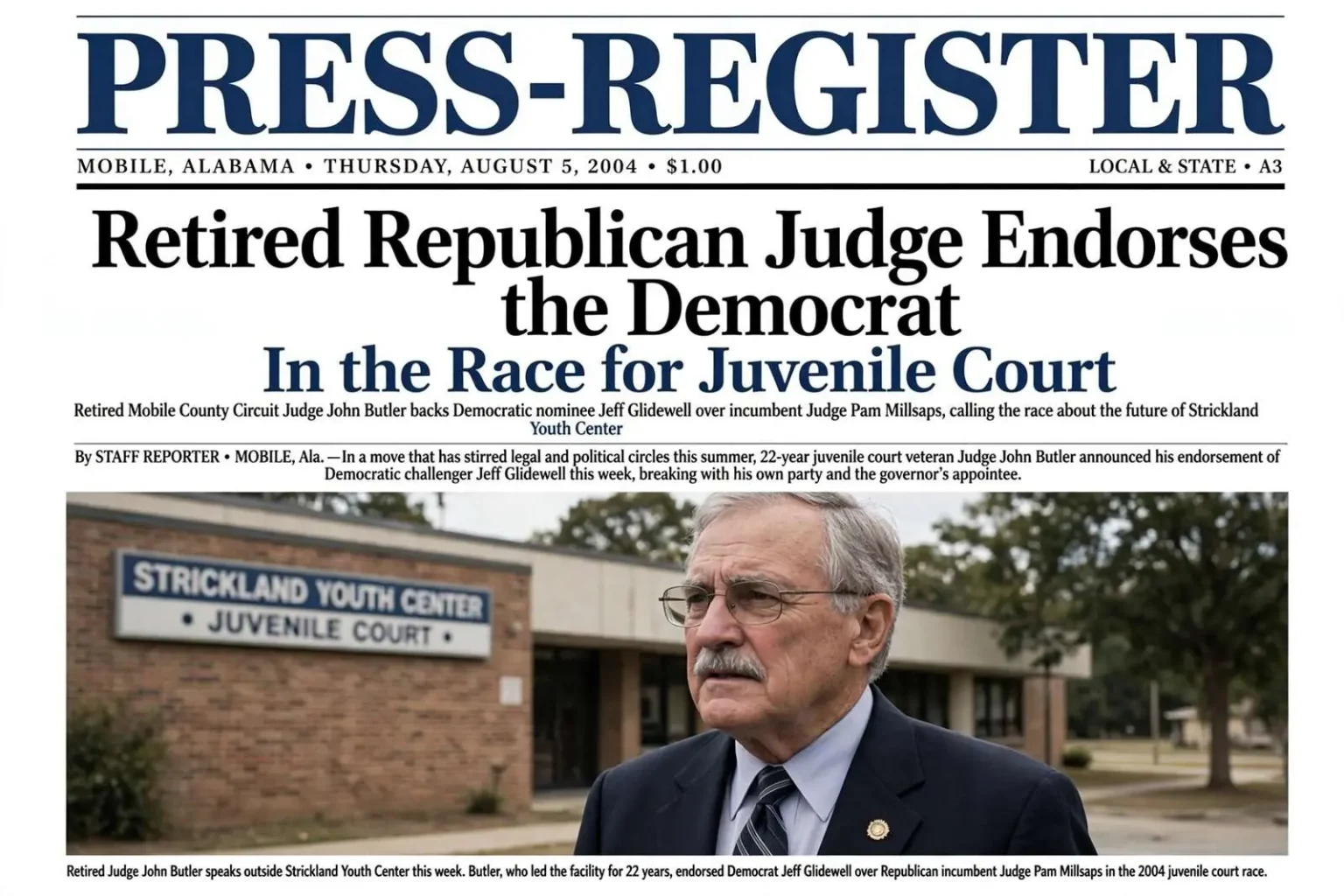
Retired Mobile County Circuit Judge John Butler, a Republican, endorsed Democratic nominee Jeff Glidewell in the summer of 2004 in his campaign to win the juvenile court judgeship from incumbent Judge Pam Millsaps — a decision that created a considerable stir in Mobile legal and political circles. The reason it landed so hard was the sequence of events behind it. Butler had retired specifically in a way that allowed Republican Gov. Bob Riley to appoint his successor. Riley chose Millsaps. Butler then turned around and endorsed the Democrat running against her.
In Alabama judicial politics, where party loyalty is treated as destiny and sitting judges rarely cross the aisle even in private, the move was practically seismic. The man who had built Mobile County’s juvenile court system — a Republican and one of the most respected jurists in the county — was telling voters, in effect, that the appointment his own retirement had made possible was not the choice he wanted holding the job he had held for a generation.
An explanation withheld
Asked why he had chosen to publicly back the Democratic nominee over his own Republican successor, Butler declined to elaborate. “Actions speak louder than words,” he said. “Stay tuned.” It was a pointed non-answer from a judge who had spent his career choosing his words with care, and it left observers to draw their own conclusions about what he thought of the direction juvenile court had taken since he left the bench.
The refusal to explain became its own message. Butler had spent decades in a profession where every pronouncement is weighed for its consequences, and he understood better than anyone that a vague endorsement from a respected source does more damage than a specific one: it cannot be quoted back, argued with, or picked apart. What he would not do — and this was the part that stung — was say anything at all in defense of the governor’s appointee. Silence, in a judicial race, is rarely neutral.
Twenty-two years at Strickland
Butler’s endorsement carried weight because of what he had built. For 22 years he presided over the Strickland Youth Center, Mobile County’s juvenile justice complex — the facility where children in the county’s system are detained, evaluated and brought before a judge. His career at juvenile court began in 1971, when he was appointed referee. Over the decades that followed he stood at the forefront of a long series of initiatives aimed at delinquency, youth crime and the dysfunctional family situations that so often precede both.
The Strickland position was, by any measure, one of the hardest jobs in the county courthouse. The judge who holds it sees the county’s youngest defendants — children charged with everything from truancy to violent felony — and decides, case by case, between confinement and intervention, between a school placement and a detention bed. Butler held that docket through three decades of rising juvenile crime, changing state law and shifting national philosophy, and emerged as the region’s recognized authority on what actually works with troubled children.
Among the programs he helped bring into being: Area Boys and Girls Club programs, the Camp Martin Leadership Academy, Girls Reaching Womanhood Thru Healing, known as GROWTH, and Pointe Academy, a school for juvenile offenders. Taken together, these represent an approach to juvenile justice that emphasized intervention, education and mentorship alongside detention — the kind of institution-building that takes decades and rarely makes headlines.
The philosophy behind the programs was practical rather than sentimental. Butler’s court operated on the premise that a child pulled off a path to prison is cheaper and safer for the county than a child processed through it, and that detention without education simply produces an adult inmate a few years later. The clubs, camps and schools he founded were the machinery of that premise — places where a county agency, a school system and a volunteer organization each did the part the others could not.
The race itself
Millsaps, the Republican incumbent, had been tapped by Riley to take on the juvenile court assignment following Butler’s retirement. She was already a sitting circuit judge in Place 8, and in a Mobile Bar Association preference poll conducted that spring, local attorneys had favored her over Glidewell by a wide margin, 359 to 105. That gap made Butler’s endorsement all the more striking. The lawyers who practiced before both candidates had registered a clear preference for the incumbent. The judge who had run the court for two decades went the other way.
The bar poll and the Butler endorsement, read together, framed the race’s central question: which mattered more, the bench’s day-to-day performance or the institution’s long-term direction? Practicing attorneys evaluated judges on temperament, preparation and docket management — categories where Millsaps, a veteran circuit judge, polled well. Butler’s judgment was about something else: the programs, priorities and philosophy of a specialized court he had spent a career defining, and about whether the person holding the seat would continue what he started.
Glidewell, the Democratic nominee, suddenly found himself with the endorsement every judicial candidate wants most and none can buy — the blessing of the man whose courtroom the winner will inherit. For a challenger working against a well-funded incumbent and an unfavorable bar poll, the nod restructured the race overnight, giving his campaign a closing argument that no attack ad could match: the founder of juvenile court thinks his successor should be replaced.
Why cross-party endorsements matter in judicial races
Alabama elects its judges in partisan contests, a system that forces candidates for the bench to run under party labels while insisting that they will decide cases without regard to party. The result is a persistent awkwardness, and it produces moments like this one, where the most credible voice in a judicial race — the person who actually did the job — is on the opposite side of the ballot from his own party.
The awkwardness is structural. In a state where one party dominates most countywide races, the partisan ballot is often the whole story: the primary is the real election, and the general election a formality. Judicial candidates therefore spend campaigns proving partisan credentials that have nothing to do with the job, while the voters — given no professional basis to compare candidates — lean on exactly those credentials. Cross-party endorsements are one of the few signals that cut through, which is why they are so rare and so potent when they come from someone whose professional standing cannot be dismissed as politics.
Butler’s endorsement did not come with a bill of particulars, and he did not offer one. He offered an instruction instead: watch what happens. In a judicial election, where the substance of a candidate’s work is largely invisible to the general public, that may have been the most information any voter was going to get.
What the endorsement left behind
Whatever the outcome that November, the 2004 juvenile court race had already produced a rare public debate about the office itself. Newspapers that would normally reduce a judicial contest to a line on the sample ballot were writing about Strickland Youth Center, about Butler’s programs, and about what continuity in the juvenile court seat actually meant for the county’s children. That was, arguably, the retired judge’s purpose — to force the one race where his expertise counted into the conversation where party labels usually settled everything.
The episode also exposed the strange mechanics of judicial appointments in Alabama. Butler’s carefully constructed retirement, made to hand a sitting governor a vacancy to fill, had been intended to produce a seamless Republican succession. Instead it produced the 2004 campaign’s defining irony: a vacancy engineered by a Republican icon, filled by a Republican governor, and condemned by the very man who created it. In Mobile County legal circles, the lesson was repeated all summer with a certain grim satisfaction — in judicial politics, even the appointments you engineer yourself can come back to endorse against you.
A career measured in institutions, not verdicts
The programs Butler founded outlived any single case on his docket, and that was the point. A trial judge’s legacy is usually measured in rulings, but a juvenile court judge’s legacy is measured in buildings, programs and habits — the alternative pathways that exist for a thirteen-year-old who would otherwise have none. Butler spent his career building those pathways, and his endorsement of Glidewell was understood locally as a statement about who would keep them funded and staffed.
The Boys and Girls Club programs he championed gave the court somewhere to send children short of detention — structured after-school environments that keep kids off the streets and in front of adults who watch for trouble. The Camp Martin Leadership Academy worked with boys already inside the system, using the residential camp setting for discipline and mentorship that a courtroom cannot supply. GROWTH addressed the specific circumstances of girls in the juvenile system, whose cases so often involve trauma and family dysfunction that the system’s traditional programs were never designed to handle. Pointe Academy put a school inside the system itself, so that a child removed from a regular classroom did not also lose the classroom.
Juvenile court judges in counties across Alabama sent visiting delegations to Mobile to study the model, and state officials periodically borrowed pieces of it for programs elsewhere. That reputation — statewide, even national, within the juvenile justice field — was the professional capital Butler spent when he crossed party lines in 2004. A retired judge with any other résumé could have been dismissed as a disgruntled predecessor; the founder of Strickland’s programs could not.
The campaign ahead
For Millsaps, the endorsement was a political problem without an easy answer. Attacking Butler would offend the legal establishment whose bar poll she had just won; ignoring him would leave his words standing unchallenged in every story about the race. Her campaign could, and did, point to her own credentials — a sitting circuit judge, preferred by the lawyers who knew her work — and argue that the voters’ task was to compare two judges, not to relitigate a retirement.
For Glidewell, the challenge was different: use the endorsement without being defined by it. A challenger inherits the endorser’s argument whether he agrees with all of it or not, and Glidewell spent the balance of the campaign making the case that he would preserve and expand the Strickland programs rather than merely preside over them. In practical terms, both candidates now campaigned on Butler’s legacy — one as its heir apparent, one as its founder’s choice — which told the county’s voters just how completely the retired judge had defined the office he left.
The race also served as a reminder of what is at stake in down-ballot judicial contests that most voters skip. The juvenile court judgeship controls decisions about thousands of children a year — who is detained, who is diverted, who goes home — and its programs absorb millions in county and state money. In a normal year, none of that surfaces in a campaign. In 2004, because a respected Republican crossed his own party, it did — and Mobile County’s voters had one rare season in which they could judge a juvenile court race on the juvenile court.