Mobile County Democrats Called a Saturday Meeting on Government Street
The Mobile County Democratic Executive Committee scheduled its regular meeting for Saturday, Oct. 15, 2005, at the Boilermakers hall on Government Street, with local party chairman Bob Beckerle presiding.
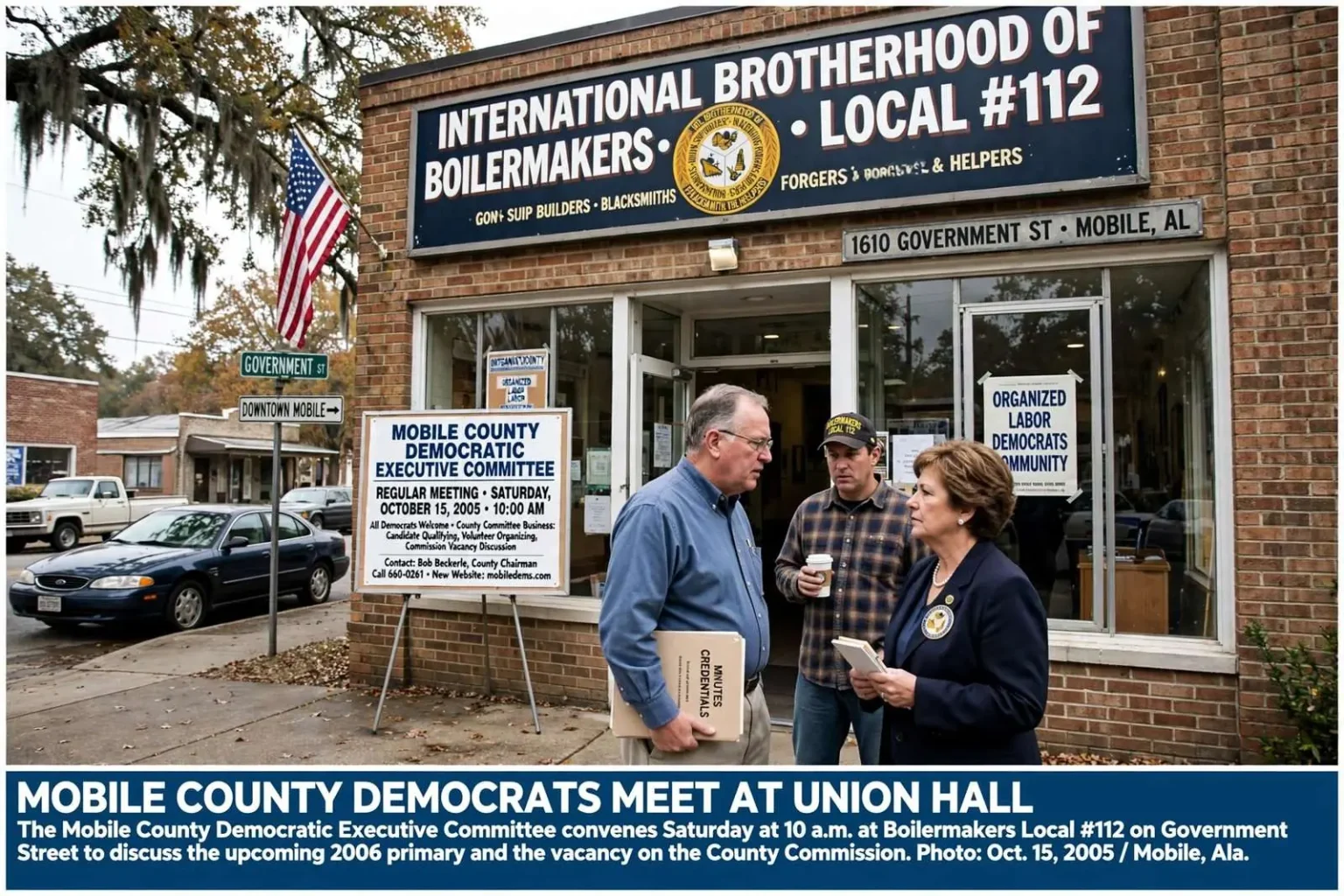
The Mobile County Democratic Executive Committee was set to hold its regular meeting on Saturday, Oct. 15, 2005, at 10 a.m., according to local party chairman Bob Beckerle. The gathering was scheduled for the hall of the International Brotherhood of Boilermakers Local #112, at 1610 Government St. in Mobile. Beckerle asked that anyone wanting more information call him at 660-0261 or visit the county party’s newly launched website, mobiledems.com.
The Business of a County Committee
The county executive committee is the working machinery of a political party at the local level. In Alabama, these committees are the bodies that handle candidate qualifying for the party’s primary ballot, resolve challenges, organize precinct-level volunteers, raise money for coordinated campaigns and manage the party’s local affairs. They are elected bodies in their own right, with members chosen from districts across the county, and the chairman is the party’s principal local officer.
For most of the year the work is unglamorous: minutes, dues, credentials, volunteer lists. But in the run-up to an election cycle, the county committee becomes the room where a party’s local strategy is actually assembled. Qualifying deadlines, sample ballots, poll watchers and get-out-the-vote plans all pass through committees of this kind, and the members who show up on Saturday mornings are the ones who decide how the party’s name appears on the ballot in their own counties.
Alabama’s county committees also operate within a statewide structure. The state Democratic Executive Committee sets the rules under which local parties qualify candidates for state and county offices, and disputes that cannot be resolved locally can be appealed upward. That makes the county chairman a figure with real procedural authority: his interpretations of qualifying rules and meeting procedures can determine whose name reaches the primary electorate and whose does not.
A Party at a Pivot Point
The October 2005 meeting came at a moment of unusual consequence for Mobile County Democrats. Sam Jones, who had served 18 years as a Democratic member of the Mobile County Commission representing north Mobile and north Mobile County, had just won election as mayor of Mobile and had resigned his commission seat with three years still to run on the term. His victory made him the first Black mayor in the city’s history, a milestone that drew national attention to Mobile and reshaped the arithmetic of local politics in a single evening.
That resignation touched off a partisan fight over how the vacancy should be filled. Gov. Bob Riley and his legal advisors maintained that the appointment belonged to the governor. The Democratic Party went to court seeking a special election instead, and a Montgomery judge ruled in the party’s favor. With the two remaining commissioners both Republicans, the outcome of that dispute would shape the partisan balance of county government.
The stakes were larger than a single seat. The Mobile County Commission is a three-member body, and each commissioner represents a district carved out of the county. The commission controls county roads, bridges, the county health and welfare functions, and a budget that runs into the hundreds of millions of dollars. Whichever party held the third seat held a vote on zoning appeals, road-paving priorities and the distribution of county services between the city of Mobile and the growing suburbs to the west and south.
Meanwhile, the 2006 election cycle was approaching, with the Legislature, the county commission, the sheriff’s office and local judgeships all headed for the ballot. Primary organizing and candidate recruitment were the immediate business of any county party in the fall of 2005, because qualifying for the following year’s primaries would open within months. Every Saturday meeting held between the resignation and the qualifying deadline was a working session on who would run, where, and with whose support.
The Venue Was Part of the Story
That the committee met in a boilermakers’ union hall on Government Street was itself a small piece of local political geography. Organized labor along the Mobile waterfront and in the shipbuilding, steel and industrial trades had long been a pillar of the county’s Democratic coalition, and union halls have served for generations as meeting space, phone-bank rooms and rally sites for candidates on the party’s ticket.
The boilermakers themselves were a natural fit for Mobile. The International Brotherhood of Boilermakers, Iron Ship Builders, Blacksmiths, Forgers and Helpers traces its organizing tradition to the heavy fabrication trades, and few Gulf Coast cities had more of that work than Mobile. The city’s shipyards and the fabrication shops that fed the port employed generations of union craftsmen, and the locals that represented them anchored a slice of the local economy in which union membership was a family inheritance passed from father to son.
Government Street, the historic east-west spine running from downtown out toward midtown, put the hall within easy reach of the courthouse, City Hall and the neighborhoods that made up much of the party’s base. A meeting spot on that corridor meant that committee members from Crichton, Toulminville, Maysville and the downtown districts could all reach the hall without crossing the bay or fighting suburban traffic, and that anyone leaving the meeting could be at the county courthouse annex within a few minutes.
Union halls also carried a symbolic weight that rented hotel conference rooms did not. Holding a party meeting in a labor hall signaled that the committee still counted the trades among its constituents, even as the regional economy shifted toward aerospace, healthcare and the growing suburbs south of the city. For a party preparing to defend a county commission seat and recruit legislative candidates, the message of the setting was that the old coalition still had a seat at the table.
The mobiledems.com Era
The notice’s mention of a new website is a marker of its moment. In 2005, a county-level party organization putting up a web presence was still a genuine step forward, a way of posting meeting notices, contact information and candidate lists without waiting for a newspaper to print them. Most political communication in Mobile County still ran through the daily paper, radio talk shows and word of mouth, and a domain name cost the committee little more than a few hundred dollars a year.
The timing tracked with the national party’s technological turn. The 2004 presidential cycle had demonstrated what email lists and online fundraising could do for national campaigns, and by 2005 state and county organizations were being urged to build the same infrastructure at the grassroots. Within a few cycles, local committees across South Alabama would be doing their organizing through email lists and then social media, and the printed meeting announcement of the sort that carried this notice would largely disappear.
For the chairman, the website solved a practical problem that had shaped county party operations for decades: getting accurate information to precinct officers and prospective candidates between monthly meetings. A posted calendar and a contact page meant that a Democrat in Grand Bay or Saraland could find the next meeting without knowing the chairman’s number, and that reporters chasing a story about the county commission vacancy had a place to check the party’s official position.
The Chairman
Beckerle, the chairman who called the meeting, was a Mobile attorney. His wife and law partner, Vivian Beckerle, a former Mobile County treasurer, would go on the following spring to seek the Democratic nomination for Congress in Alabama’s First District. Her candidacy put the county chairman’s household at the center of the district’s campaign conversation and gave the committee’s fall organizing an added edge of personal stakes.
The First District then reached across the southern tier of the state, taking in Mobile, Baldwin and the Wiregrass counties to the east, and its races had historically tested how far a Democrat could carry the party’s traditional coalition in a region that was trending Republican in federal contests. A county treasurer turned congressional candidate embodied the kind of ticket-balancing the party often attempted in that era: proven local administrative experience, name recognition from countywide office, and standing in both the city’s neighborhoods and its courthouse circles.
For the committee itself, the chairman’s dual role — county officer and spouse of a congressional candidate — illustrated how small the world of Mobile County Democratic politics remained. The same handful of families supplied chairmen, candidates, donors and poll workers cycle after cycle, and a Saturday meeting in a union hall was where those overlapping obligations were sorted out face to face rather than by press release.
Read today, the item is a modest thing: a time, a place, a phone number. But it captures a county party organizing itself at the start of a cycle that would reshape Mobile County government, and it preserves the ordinary connective tissue of local democracy, the Saturday-morning meeting in a rented hall where the work actually gets done. The qualifying fights, the commission vacancy and the congressional race that followed all began in rooms like that one, run by volunteers who kept the minutes and locked up the hall when the morning’s business ended.