University of South Alabama Tillmans Corner
Ten Names in the Mix as School Board Moves to Fill a Vacant Seat
After John Holland resigned from the Mobile County school board following an ethics ruling, at least ten names circulated as possible appointees, with a state takeover looming if the board deadlocked.
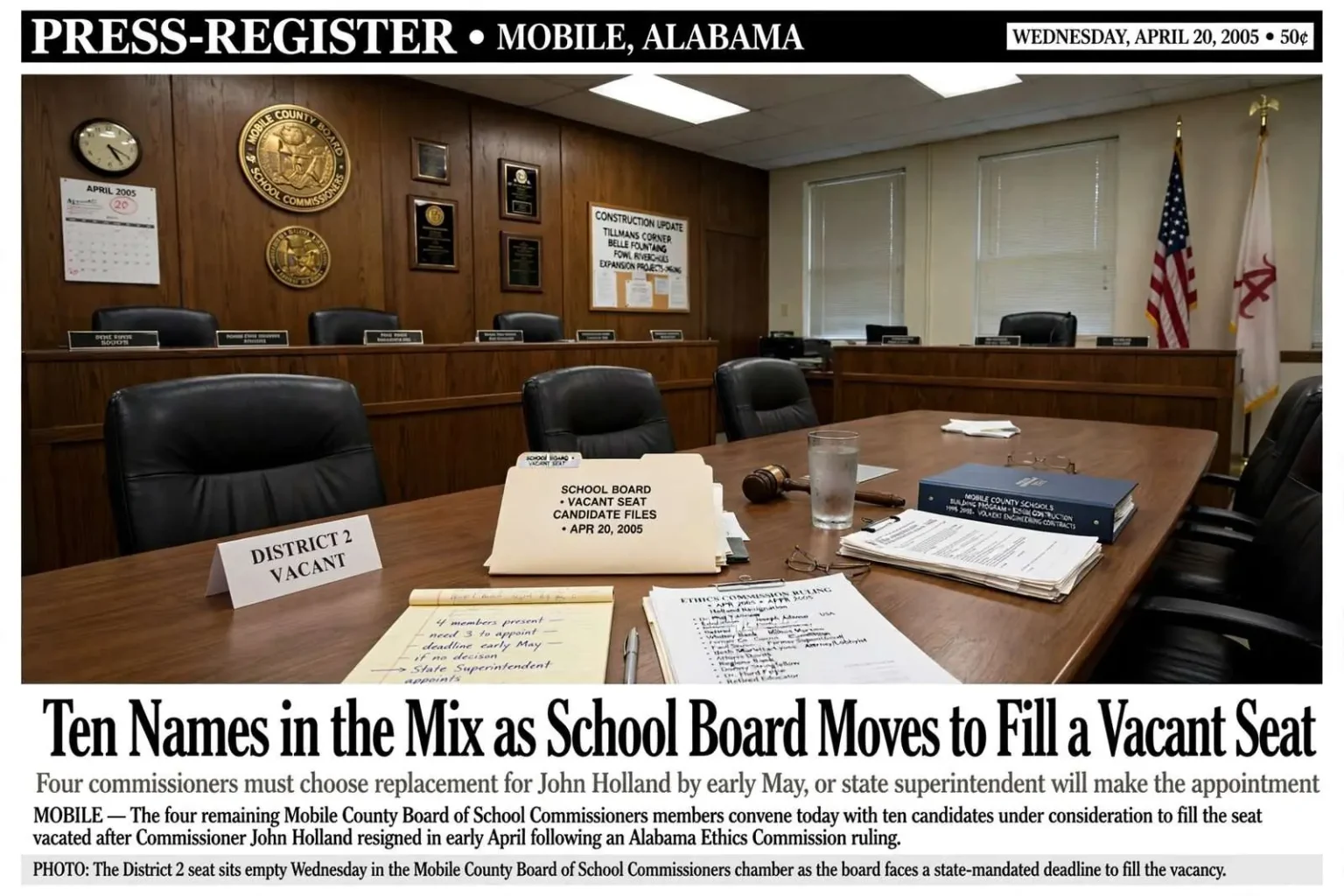
MOBILE — The four remaining members of the Mobile County Board of School Commissioners were expected to learn on Wednesday, April 20, 2005, who wanted the seat left empty by the resignation of Commissioner John Holland — and they were operating under a deadline with teeth. Interested candidates were coming forward, names were circulating among political insiders, and the commissioners knew that whatever they decided, they would have to decide it quickly. The vacancy sat in the middle of a school system in the midst of an enormous construction program, and the clock on the wall was set by state law.
Holland resigned in early April after the Alabama Ethics Commission ruled that he had committed two minor violations of the state’s ethics law by voting in favor of contracts with Volkert Engineering, the Mobile firm where his son-in-law was employed. Holland had first joined the board in 1994 and his term was set to expire in 2006, which meant the appointee would inherit an office with a year and a half of life remaining. The Ethics Commission characterized the violations as minor — a failure to abstain rather than an act of self-dealing — but the ruling made the resignation unavoidable, and it left the seven-member board short a member in a district that stretches across a wide swath of south Mobile County.
The board’s freedom to choose was not unlimited. Attorneys for the school system advised that if the four remaining commissioners could not reach a majority decision on a replacement by early May, the appointment would pass to the state superintendent of education in Montgomery. That is a meaningful threat in a system the size of Mobile County’s — the largest school district in Alabama, with annual expenditures then exceeding $600 million. A four-member board is, by construction, capable of deadlocking two to two, and the prospect of the state making the choice instead concentrated minds at the board table.
The names in circulation
According to sources familiar with the process at the time, the prospective appointees under consideration by the remaining four commissioners included a roster that read like a directory of the city’s civic establishment. Among them were:
Dr. Judy Stout, vice president for academic affairs at the University of South Alabama. Dr. Phil Feldman, a professor in USA’s College of Education. Joseph Adamo, a retired J.C. Penney executive. John Turner, a regional executive with Whitney Bank. Milton Morrow, most recently the unsuccessful Democratic nominee for Mobile County Commission, District 2. Paul Sousa, a former Mobile County school principal who went on to serve as superintendent of the system. Beth Marietta-Lyons, a Mobile attorney, lobbyist and former state legislator. Steve Davitt, a senior vice president with Regions Bank. Donny Stringfellow, a former middle school principal. And Dr. Hurd Pope, a veteran educator with 13 years at Barton Academy, which he left in 1979 as assistant superintendent for curriculum and instruction.
The list was a fair cross-section of who ran things in Mobile in 2005: two university administrators, two bankers, two retired school administrators, a lawyer-lobbyist, a retail executive and a recently defeated candidate for county office. Some of the names carried deep institutional knowledge of the school system itself — Sousa and Pope between them had spent decades inside its classrooms and central office — while others represented the business and civic communities whose support the board has traditionally needed for tax referendums and building programs. What united them was a willingness to take on a job that pays $12,000 a year, consumes hundreds of hours of meeting time, and places its holder at the center of the county’s most consequential public institution.
The context of the vacancy
Holland’s departure was not a scandal in the ordinary sense, and the distinction mattered to how the vacancy was understood. The Ethics Commission characterized the violations as minor, and the underlying conduct was a failure to abstain rather than an act of self-enrichment. Holland himself would later argue that his votes had made no practical difference to the outcomes, and that he had not known the Volkert employee who hired his son-in-law. Volkert, one of Mobile’s oldest and largest engineering firms, had roughly 600 employees, and a commissioner could hardly be expected to track every relative on every payroll.
But the timing was awkward, and everyone involved knew it. The Mobile County system had been in the middle of an enormous building program funded by voter-approved taxes, and Volkert had supervised school construction projects totaling roughly $250 million between 1996 and 2003. Any appearance of a conflict involving the engineering firm managing that work was going to draw attention, whether or not money had changed hands improperly. The board needed a replacement whose selection would reassure the public rather than reopen the question, and that consideration shaped the deliberations as much as any candidate’s qualifications.
For the four remaining commissioners, the vacancy also arrived at a moment when the board’s own structure was under scrutiny. The Mobile County board, unlike many school boards in Alabama, is a countywide body whose members run in districts but answer to voters across the county. That arrangement was the product of decades of litigation over representation, and it meant that an appointment to fill the District 2 seat would be watched not only by the parents of that district but by taxpayers everywhere in the county who helped fund the system’s $600 million budget.
What the job actually involves
Little noticed in the speculation over candidates was the sheer scope of the office the appointee would assume. School board members in Mobile County serve six-year terms, are paid $12,000 annually, and are elected on a rotating basis so that the board never turns over all at once. District 2, the seat Holland held, includes parts of Mobile west of Interstate 65, south of Old Shell Road and east of Sollie and Cody roads, along with areas of the county south of the city limits — Tillmans Corner, Belle Fountaine and other Fowl River communities — some of the fastest-growing residential territory in the county.
The district’s schools had absorbed much of the population growth that followed the development of west Mobile in the 1980s and 1990s, and several of its campuses had been rebuilt or expanded under the construction program Volkert helped manage. The new commissioner would inherit matters ranging from overcrowding and portable classrooms to bus routes that stretched down the Fowl River corridor. In a district where population kept running ahead of construction, those were not abstract questions.
The board’s responsibilities extended beyond construction. The commissioners set policy for a system serving roughly 65,000 students, hired and evaluated the superintendent, approved the annual budget, and determined tax questions that went before county voters. A single vote on a five-member board, as Holland’s ethics case demonstrated, could matter on a contract worth millions — or could be one voice among a majority that made the vote academic. Either way, the office demanded the kind of institutional patience that does not always advertise itself during an appointment fight.
The appointment process itself
Procedurally, the matter was straightforward and unforgiving. The remaining four commissioners were expected to receive expressions of interest through the April 20 date, after which they could interview candidates, solicit references and negotiate among themselves. Any three of the four could make an appointment; anything less, by early May, would hand the decision to the state. That dynamic gave each commissioner leverage — and gave the candidates reason to court more than one commissioner at a time.
Appointment vacancies of this kind were familiar territory for the board. Members over the years had been seated through elections, special elections and appointments after resignations and deaths, and the board had seen its share of contentious fill-ins. What made this episode unusual was the deadline: the state law provision that strips a local board of its choice if it dithers. Board members who might otherwise have indulged in months of courtesy delays understood that failure to coalesce meant losing control of the decision entirely, with the appointment going to someone chosen in Montgomery who had never set foot in a District 2 classroom.
For the candidates themselves, the calculus involved more than the year and a half remaining on the term. An appointed commissioner who proved capable could seek a full six-year term in the next election cycle with the advantages of incumbency — a record, name recognition and relationships with system employees. That was the prize the ten names on the list were really competing for, and it explains why the field reached so far beyond the usual pool of education activists to include bankers, executives and former legislators.
The wider stakes for the system
The appointment came at a delicate moment for the system’s leadership. The board was still working through the aftermath of Holland’s resignation, the construction program was generating a steady stream of change orders and contractor decisions, and the district’s relationship with the state education department remained close given its size and its dependence on state funding formulas. A smooth, unanimous appointment would signal stability; a deadlock that handed the choice to the state would signal the opposite to bond markets and legislators alike.
Local government observers in Mobile noted that the episode offered a compact lesson in how conflicts of interest are policed in Alabama. The Ethics Commission’s ruling — that a board member may not vote on contracts involving a firm that employs a close family member, even if the member derives no direct benefit — set a marker that other board members and commissioners across the state took note of. Whatever else the vacancy produced, it had already clarified the line between an inconvenient abstention and an unlawful vote.