Sessions’ Chief of Staff, With Deep Mobile Roots, Moves to a Washington Lobbying Practice
Armand DeKeyser, chief of staff to U.S. Sen. Jeff Sessions for eight years and a former executive assistant to Mobile Mayor Arthur Outlaw, joined the government relations group at Kilpatrick Stockton in January 2005.
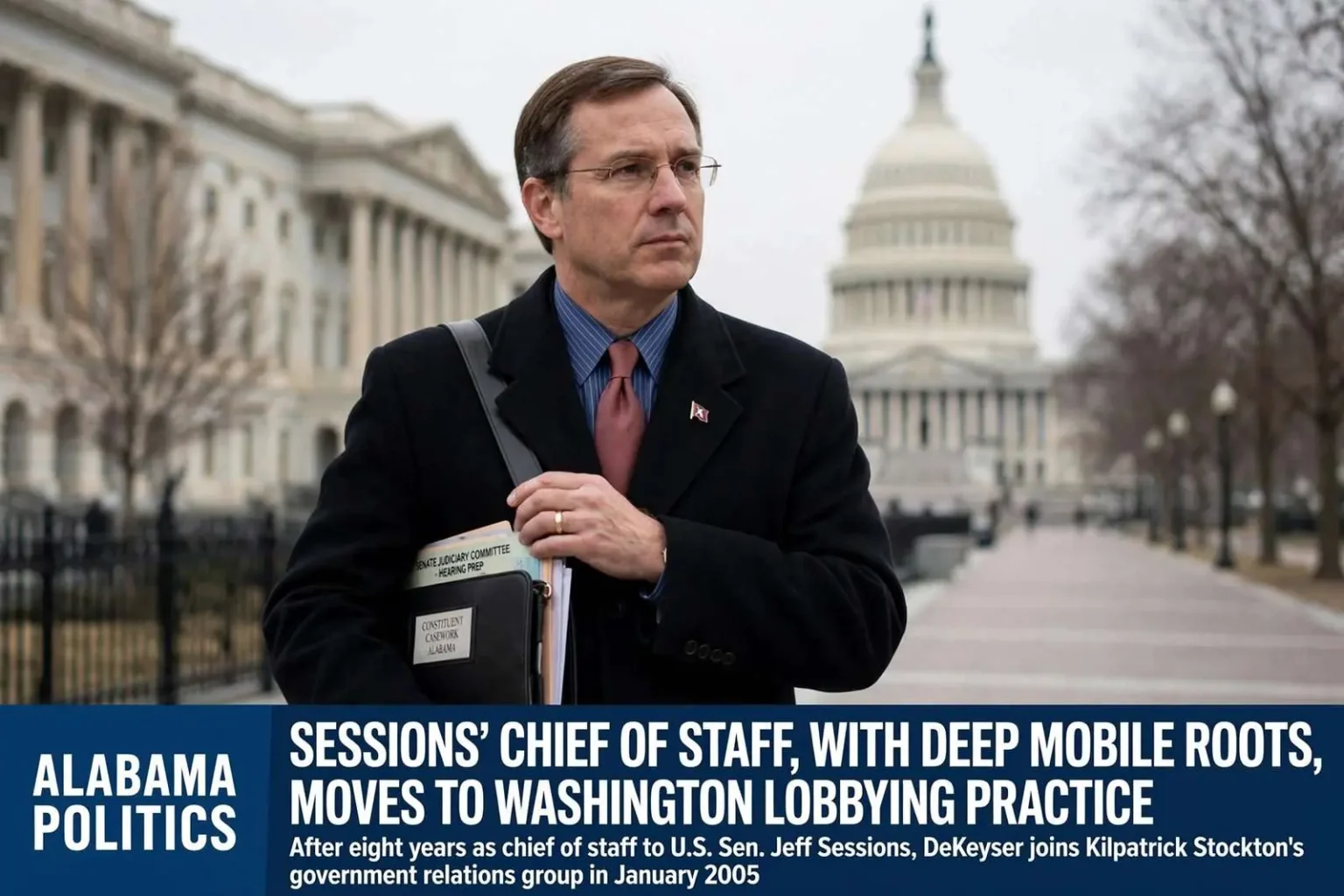
WASHINGTON — Armand DeKeyser, who spent eight years as chief of staff to U.S. Sen. Jeff Sessions and whose career was built largely in Mobile and the Southern District of Alabama, moved to the private sector in January 2005, joining the law firm Kilpatrick Stockton as executive director of its government relations group in Washington.
The move drew notice in South Alabama for an obvious reason. For most of a decade, DeKeyser had been one of the most consequential Alabamians in Washington whom most Alabamians could not have named — the man who ran the Senate office through which the state’s business with the federal government passed.
In a Senate office, the chief of staff sits at the top of the staff hierarchy, answering directly to the senator and setting the tone for everything from legislation to hiring to the daily flow of constituent requests. Alabama’s two Senate offices together handle tens of thousands of pieces of constituent correspondence in a given year, and the senior senator’s operation touches federal matters ranging from military basing decisions to judicial nominations to federal highway and water projects. The person managing that operation rarely appears at press conferences, but almost nothing moves without his sign-off.
What the Job Entailed
As chief of staff, DeKeyser oversaw Sessions’ transition into the U.S. Senate after the 1996 election. That meant hiring and then managing a 38-person staff in Washington along with four district offices spread across Alabama — a machine that handled everything from constituent casework to the legislative and committee obligations of a member of the Judiciary Committee.
The geographic spread mattered in a state like Alabama. District offices in places such as Mobile, Montgomery, Birmingham and Huntsville serve as the front door to the federal government for residents who need help with Social Security claims, veterans’ benefits, immigration questions or Medicare disputes. Caseworkers in those offices open and track thousands of individual cases, and the Washington office depends on them to keep the senator informed about what federal agencies are actually doing to the people he represents. Keeping that network running — staffed, disciplined and responsive — was DeKeyser’s daily work.
The committee side of the job carried its own weight. Sessions sat on the Senate Judiciary Committee, a panel with jurisdiction over the federal courts, immigration law, criminal justice policy and the confirmation of federal judges, including justices of the U.S. Supreme Court. Judiciary Committee work demands heavy staff support: preparing the senator for hearings, vetting nominees, drafting amendments and tracking bills that can move with little notice. A chief of staff coordinates all of it with the senator’s legislative directors and committee staff.
Steve Sacher, the supervising partner of Kilpatrick Stockton’s government relations group, described the hire in terms of that experience. “With over 35 years of leadership in government and business, Armand DeKeyser is an outstanding addition to our federal legislative and government affairs capability,” Sacher said. “Armand’s experience, credibility and widely acknowledged political savvy will be invaluable as he works closely with firm clients and attorneys on an array of issues before Congress and federal regulatory agencies.”
Kilpatrick Stockton was a national law firm of roughly 500 attorneys with offices in Washington, Atlanta and several other cities, and its government relations practice sat at the intersection of law and lobbying. Firms of that kind hire former senior congressional staff precisely because clients want advocates who know how a Senate office actually operates — which staffer handles which issue, how a hearing gets scheduled, and when a letter from a senator’s office will move an agency faster than a formal petition. An executive director role in such a practice blends business development, client management and strategic advice.
DeKeyser’s move also fit a well-worn pattern in Washington. Chiefs of staff to senators are among the most recruited professionals in the capital, and law firms, trade associations and corporations regularly bid for their services when they leave Capitol Hill. The revolving door has critics, but for firms with clients before Congress the appeal is straightforward: eight years running a Senate operation, including one on the Judiciary Committee, is difficult experience to replicate anywhere else.
The Alabama Career Behind It
DeKeyser’s path to Sessions’ Senate office ran through Alabama’s law enforcement and municipal institutions. He served as chief of the administrative division in the office of the Alabama attorney general during Sessions’ tenure in that post.
Sessions held the attorney general’s office from 1995 to 1997 after a career as a federal prosecutor in Mobile. The attorney general’s administrative division handles the business side of a statewide legal operation — budgeting, personnel, procurement and the internal systems that let several hundred employees pursue the state’s litigation. Running that division in the attorney general’s office is a management job with a law enforcement setting, and it placed DeKeyser at the center of state government in Montgomery.
Earlier, he was law enforcement coordinator and victim-witness coordinator for the U.S. Attorney’s office in the Southern District of Alabama, the federal judicial district headquartered in Mobile that covers the state’s southwestern counties. In that role he worked at the junction of federal prosecution and the communities it affects — coordinating with local police and sheriffs’ departments on federal cases and helping guide crime victims through a court process that can be intimidating and slow. Victim-witness coordination became a formal part of federal prosecutor offices after the Victim and Witness Protection Act of 1982, and coordinators in the Southern District worked cases touching everything from drug trafficking along the Gulf Coast to white-collar fraud.
Those early posts gave DeKeyser two credentials that would define his Washington career. The first was fluency in the federal-state relationship: he had seen how U.S. attorneys, the Alabama attorney general and county-level law enforcement actually interact on the ground. The second was a network of Alabama officials built over years of practical work, not campaigning. When Sessions won the Senate seat in 1996, the transition team needed a chief of staff who knew both Washington and Alabama’s institutions, and DeKeyser fit.
For South Alabama, the practical meaning of his position showed up in ordinary ways. Requests for federal assistance after hurricanes, questions about military installations and defense contracts in the Mobile area, federal transportation money, port funding and judicial appointments all passed through the Senate office he managed. Mobile in particular had durable federal interests during those years: the Port of Alabama’s facilities on the Mobile River, the Coast Guard sector, the federal courthouse for the Southern District, and Brookley Field’s redevelopment as an industrial airfield all depended in part on federal decisions that senators influence.
DeKeyser’s departure in January 2005 closed out an eight-year tenure that spanned Sessions’ first two terms in the Senate, covering the impeachment trial of President Clinton in 1999, the contested 2000 election, the September 2001 terrorist attacks and the creation of the Department of Homeland Security, and the wars in Afghanistan and Iraq. Each of those episodes put heavy demands on Senate offices — unexpected votes, constituent concern, and committee work that expanded overnight.
What replaced him in the public eye was the quieter question of succession in a Senate office, and what remained in Alabama was the record of a career that ran from the Mobile federal courthouse to the attorney general’s office in Montgomery to the top of a Senate operation in Washington. His new employers were counting on exactly that record. In hiring him, Kilpatrick Stockton bought not just a lobbyist’s Rolodex but the institutional memory of how Alabama’s federal business had been conducted for nearly a decade.
The Senate office DeKeyser built after the 1996 election also reflected a broader shift in how senators organized themselves. By the late 1990s, a well-run Senate operation had grown far beyond the three or four aides who once handled a member’s correspondence. Modern offices split into communications, legislative, casework and state operations, with district directors reporting to Washington and a scheduling operation that kept the senator in front of voters, donors and committees without missing floor votes. Managing 38 people in Washington plus four Alabama offices meant managing budgets, personnel decisions, security protocols for constituent communications and the technology that tied the offices together.
His background in law enforcement coordination proved especially useful in that structure. Constituent casework in a state like Alabama skews heavily toward federal agencies with law enforcement or public-safety roles — the FBI, the Drug Enforcement Administration, the Bureau of Alcohol, Tobacco, Firearms and Explosives, the U.S. Citizenship and Immigration Services and the Department of Veterans Affairs among them. A chief of staff who had spent years inside the Southern District of Alabama’s U.S. Attorney’s office understood how those agencies made decisions and how long their processes took, which shaped how the office set expectations for the Alabamians writing in for help.
The Judiciary Committee portfolio added a further dimension. During DeKeyser’s tenure, the committee handled confirmation fights over federal appellate and district court nominees that consumed weeks of Senate time, along with reauthorizations of major crime legislation and oversight of the Justice Department. Alabama’s federal bench, including the Southern District based at the courthouse in Mobile, filled vacancies through that process, and Senate offices invested significant staff time in evaluating and advancing nominees.
By the time he left, the operation he had assembled was regarded as one of the more disciplined state operations in the Senate — a point of quiet pride in Alabama political circles, and the credential Kilpatrick Stockton was paying for.